Patti Harrison Had Dreams of a Tech Utopia. Silicon Valley Smashed Them
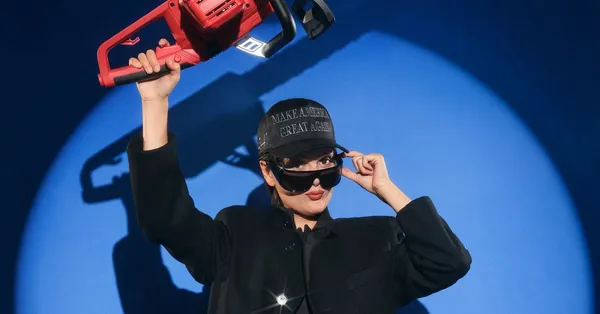
It’s that quality in Harrison’s work that WIRED borrowed for our own rather unhinged cover concept. Harrison plays five (well, actually six) of the current masters of the universe—Elon Musk, Sam Altman, Dario Amodei, Mark Zuckerberg, and Jeff Bezos (with Lauren Sánchez Bezos by his side). Combining her farcical sensibilities with our commentary on the man-heavy leadership of Silicon Valley worked perfectly—and she was happy to lampoon the people behind the platforms she used to enjoy. (RIP Harrison’s Twitter account.) We caught up with Harrison in London, where she had just finished a sold-out run of her show, Just Ironing Some Things Out!, and a week of performances at the Edinburgh Festival Fringe. This interview has been edited for length and clarity. KATIE DRUMMOND: When we were putting together our WIRED Women cover, we knew we had to put the best possible woman on it. You immediately came to mind, and I can’t stress enough how much you nailed the assignment. PATTI HARRISON: That’s such a nice intro. I want to argue with a bunch of it. You do? I was coming in today like, oh, I guess I didn’t really check to see what the interview was about. Then I had this natural creeping anxiety. What if this is some sort of ambush, like a transphobic takedown piece—and then it was going to launch into me having to define what a woman was. Oh my God. Thank you for being here, Patti. You are our WIRED Woman. I appreciate that so much. It’s very affirming. To be honest, when we were thinking about this cover and who would be perfect for it, I knew you, and I knew you were hilarious. I had no idea that you were a trans woman. It wasn’t part of the calculus. We were just so thrilled at the idea of imagining you and your really over-the-top absurdist approach to comedy embodying these characters. That was the whole joy of it for us. From the start, I’ve been pretty outspoken about being transgender. I just don’t talk about it a lot in my work explicitly. Or when I do acting stuff, I’m not always playing a character that’s said to be trans. Nor should you have to. It’s fun to kind of leave that open and nebulous, especially if it's not important to the content of the work or the jokes I’m making. So, it is meaningful to me to get to do this on the basis of you guys liking how much I’m online talking about jism and kissing my dog on the mouth, that kind of discourse. I mean, the kissing-the-dog-on-the-mouth discourse is so important. You are so, and I mean this as a compliment, conventionally funny. You’ve talked before about feeling pressure to incorporate politics into your work and how you don’t necessarily want to. You’ve also talked about how those things can’t really be separated. I’m curious about that line for you, because obviously sometimes we just want to make jokes about jizz and poo and kissing dogs. I think there’s a balance. I think in our current climate of social media access, the kind of social media we have access to and how it’s been monopolized, we have been corralled Temple Grandin–style humanely into choosing to be in this very limited silo where our speech is heavily censored. Right. I have strong moral views that I’m connected to. I definitely feel that it’s important to pay attention to what’s going on politically, but I think in terms of my ability to articulate, I have very scattered speech, and I forget stuff. So I have never felt that I was the right person to be speaking explicitly about those things. But I think when you live an intrinsically politicized life, your experience is political. I don’t think people can separate morals from politics. Comedy is sat in your understanding of the truth of the world and how you either speak on that or you subvert that. So making the choice to make a bunch of comedy that’s about anything other than what’s happening in the world in and of itself is political, because it’s a reaction to wanting to escape from a reality that is giving you existential dread. There is so much right now that just isn’t funny. How do you gesture to those more horrific realities of the news when there’s no punch line? I feel like people en masse are being traumatized in such a specific way by what they’re seeing on a daily basis, and that juxtaposed with AI slop, I feel like it creates a high probability for people to experience a cataclysmic kind of cognitive dissonance about what they’re seeing, how their feelings are spiking from it, and what they are to believe is real and what’s not real. I think people get overwhelmed, so then they opt out. I think a large part of that has to do with the fact that we have conflated our news intake with social media, which is horrific. I remember when Twitter was, like, comedy. It was just people tweeting, and then when they integrated the news it created this really toxic dynamic of incentivizing people to have really inflammatory political takes to get shares or retweets or whatever. Yes. You can talk about something horrible happening without making fun of that horrible thing. Good comedy, good art in general, is based in truth. The less filtered something is, the more raw it is, the more unabashed it is, the higher the likelihood it will connect in a deeper way, even if that means it connects with less people. We see a lot of comedy now that is people really afraid to engage with what’s happening, and I think the lowest-hanging fruit in a lot of ways, to try and be edgy or whatever, is taking digs at transgender people or using the R-word. People want to be shocking in their humor, and I think I’m one of those people. I’ve always been drawn to shock humor, and I think it’s just because of the way I was brought up and the way that my childhood played out. You can read all about that in my book that I’m also pushing today, sponsored by Darpa, which is so awesome that they gave me the money to self-publish this book. The Defense Advanced Research Project Agency? Mm-hmm. I actually used to cover that agency as a reporter. I didn’t know that you were deeply connected to Darpa. Yeah, and AIPAC. I take money from both, but I use it in fun, creative ways. I had no idea they were publishing books over there. It’s a residency. I’m allowed to write about my transgender journey, finding my womanhood, and also why we need to keep investing in robotics that are able to scan faces instantly, that are able to fly at 80 miles an hour and take a 90-degree turn instantly. Why they need to be able to carry a human amount of weight, why they need to be able to grab someone from under a bed, why they have to have that sort of prehensile grip, and why those things are necessary. And also my first time wearing makeup. And autonomous killing. Did I answer your question? I'm sort of in this weird soliloquy mode, and I’m going to try and give more succinct answers. I came in here so excited and nervous about getting to talk about some stuff. Because I have felt like I’ve done interviews with magazines and online publications over the past couple of years where I’ve made a deliberate effort to talk about the feeling of gaslighting and cognitive dissonance about not being able to speak out about the genocide in Gaza without the fear of repercussions. [And then] having those sound bites or having those parts of the interviews taken out before it’s published and feeling really disappointed by that. So I think when you’re asking questions in that way it’s nice, and it feels hopeful that there’s still media that is willing to do that. We will definitely edit you to make you sound succinct, but we will publish these parts of the interview. It’s a chain of just ums and likes and uhs and ... Darpa. I am trying really hard not to say “um” and “like,” and I’m not succeeding, but if you can imagine, this is way more successful than I’ve been in the past. What is your relationship to social media now? You were kicked off Twitter early in its downswing, if I may call it that, for impersonating Nilla Wafers, right? Yeah. I checked, and Donald Trump was unbanned. I think Kanye West was unbanned after Elon Musk bought the company and renamed it X. I went and looked up your account. I believe you are still banned. I think social media as we have it is hell. Truly the most literal panopticon. We’re bugs trapped under a little glass, and it’s hard because I think the frustration is that—well, there’s multiple frustrations. One is that we all see that this is evil. We all see that this profits bad things. The money moves up a more horrific chain at each level, and our time spent there posting, we all know it makes us feel bad, but we still do it. All that time is wasted. Our lives are wasted, and then we fund evil people who make the quality of everything worse, because it’s all interconnected. Yet we’re still on it, and there’s this anger about why can’t we just get off Instagram? But I think the other layer of that is we are also conditioned to attack each other individually instead of attacking the systemic issues, which is that they are testing these features to make sure that people become addicted. I think people are embarrassed to admit that they’re addicted to Instagram or their phones, or they’ll say it in a jokey way. There’s an entire global economy running through these platforms. I think I read that Tim Robinson found you on Instagram and thought you were hilarious. How do you separate yourself from that, and can you? I’ve gotten jobs on TV shows because of the way I was posting online, jokes I was making online, and that’s how I got into acting. So I do personally have this sense of like, “Oh no, if I delete this, this will end my income. This will end.” It’s really designed to make you feel that way, which is insidious, literally. Well, in a very short amount of time social media has changed significantly. When I was in middle school and high school, I loved Xanga, and as a middle schooler, that was the first place I was writing stuff as a joke, like writing joke posts about my fake day I would have in school where I’m like, “Oh my god, Mariah Carey came into school today, and she was singing, and it was so good. The principal ...” This is a bad example because that actually did happen to me. Wait, did it actually? No. But she should have. I am very gullible, which is a really bad trait for a journalist. I will keep that in mind to manipulate you later in life, but not right now in this moment. OK, so Mariah Carey was not singing at your school? She was. OK, so you’re a liar. I lie for attention and to make time pass, if that makes any sense. I listened to an audiobook, and I might butcher the title, but I believe it’s called Ten Arguments for Deleting Your Social Media Accounts Right Now, by Jaron Lanier. I really agreed with a lot of its framing of social media in a subjective way, which is that social media—and I believe this—at its core is not an evil thing. Social media is a tool for connection. When I was on MySpace in high school in rural Ohio, I was so limited in what I had access to culturally, and completely in the closet, having no language about queerness. Having the internet and having MySpace was amazing. It really helped me find communities outside of where I lived, where there weren’t people who liked the things that I liked, and I wasn’t being bludgeoned with 5 million ads at that time. YouTube was the same. Oh, yeah. I remember the day I came home from school, and I went to my friend’s house who lives across the street and seeing the first YouTube ad I saw and being, like, “What the fuck?” Like, being so angry as a teenager that there was a commercial on YouTube. When we first talked about you doing these covers, I remember you saying that you grew up looking at the technology industry and thinking, “This is amazing, and these people are doing amazing things and are going to save the world and change things for the better,” and that you have, obviously, over the years become very much disillusioned with that notion and disappointed and angry. I think that so many people share that view. Can you talk a little bit more about what your interest was in technology when you were younger and how it’s changed? When I was a kid, I was obsessed with sci-fi and fantasy and was obsessed with The Matrix and Aliens and just anything futuristic. I loved Ghost in the Shell. I loved anything that felt like a synthesis of technology and the organic. I think a lot of that comes from just being a bored hillbilly kid. In the show that I’m doing, I do an impression of a Boston Dynamics robot dog. And I tell the audience, “OK, I’m gonna do an impression, and you guys tell me what you think it is, and you can just yell it out.” Then I pull my shirt up over my head, and I get on all fours and jerk around the stage. I always bump into the mic stand, knock it over. Usually someone will say, like, “Darpa dog” or, like, “Boston Dynamics robot dog,” which is so funny. Those are very specific references. It makes me feel happy that those people are coming to my shows. But I’ll go on this long tear about how when I was a kid I was really excited about this future where there would be artificial intelligence, and there would be self-driving cars, and there would be robot animals walking amongst us. But then there’s the disillusionment that comes with realizing that capitalism will sour everything. Capitalism reveals grifters. Capitalism reveals the rot and shows you how quickly people will fold against their proclaimed morals to make money or to make a name for themselves. These companies, when they’re developing these robotics that have the potential to really hurt people, they promise these aren’t gonna be used in combat. We see them using these robot dogs in Gaza. We see them experimenting with this tech in combat situations. Combat, I feel, is a generous way to put it, considering it is a full-on genocide. I don’t have a way to reconcile that at this point, because it makes you lose faith in this community that I have always seen as intrinsically progressive, because it’s science, it’s progressive by nature. I think the idea behind capitalism is that it creates positive competition so we get innovation. But then once they see the best way we can have it, someone buys that way and then takes it away from everybody so that they can offer us shittier versions of the thing that used to be good. I feel like we used to have good social media. We used to have social media without ads, without algorithms. We saw things chronologically. Things that in moderation are good for your brain. You can learn. I want to talk to you about AI. Do you use it? I have used it in earlier iterations. Like Dall-E. Oh, the image generator. I do find it fascinating, like the technology of it. I just am horrified at the rate at which it’s immediately integrated without any sort of vetting into our society for profit. They don’t care. It’s like “Can’t we just put a pin in this right now?” Data centers are destroying the environment. I think there are people out there who are trying to get them to stop and take the appropriate amount of time before this is implemented or do more research on it, but I just think bad people with money are expediting these processes to the point that we all suffer. The idea of using ChatGPT or something to help me figure out what socks I should wear with my shoes feels evil. Are there things that scare you about it creatively and artistically? Does it come up in the context of your work? If I’m online, it’s inevitable that AI will absorb it. I have had the most fun in my career doing live shows and being in a room with an audience, and a lot of the shows that I do, I don’t record them into a special, and I do them for, like, a year and then I move on to the next show and I start to rebuild again, and that show doesn't live on video. Is that intentional? I think I am pushing back ’cause I’m kind of a contrarian cunt. I’m like, “Oh, I don’t wanna make clips of m