Can a Radar-Equipped AC Actually Cut Your Power Bill?
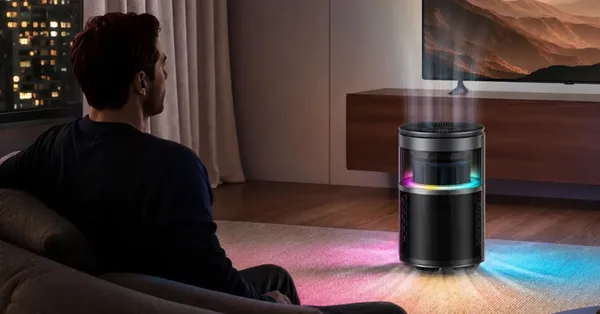
Air conditioners and electric fans account for around 20 percent of electricity used in buildings worldwide—3 to 4 percent of total greenhouse gas emissions—and, as demand for cooling in homes, workplaces, and schools grows, the number of AC units in use could reach 5.5 billion by 2050. The solution isn't one magic fix, but a suite of emerging technologies heading for living rooms and apartment windows. From radar sensors tracking your body to compact heat pumps and climate-safe refrigerants, here is how the next generation of air-conditioning plans to keep us cool without cooking the planet. The “Intelligent AC” Boom In 1994, Mitsubishi Electric was zooming past the air-con competition, introducing the first motion and occupancy sensors for AC, with infrared 3D sensing eventually following in the mid-2010s. Fast-forward to 2026 and AI-powered ACs now track people in the home with millimeter-level precision. AC makers have launched intelligent, targeted air conditioner units all year, from Samsung’s Bespoke AI system in March to Dyson’s Find+Follow feature for its Purifier Cool fan in June. At IFA in September, we got a whole sweep from Chinese companies like Hisense, Dreo, and Midea. LG’s latest DualCool AI AC has a 5-meter radar sensor for people detection plus targeting based on your everyday movement patterns. Hisense’s Companion Living AC also uses data from smart home sensors to identify and precool “target paths” within the home, based on your routines. So if you always head from the couch to the kitchen for a midnight snack, your AC can cool that particular zone before you even get up. The real-time cooling features aim to improve comfort inside sticky homes. A secondary benefit is that precisely locating people and delivering cooling directly to them could reduce energy consumption. “It definitely has the potential to reduce the total energy use for air-conditioning,” says Björn Palm, senior professor in energy technology at the KTH Royal Institute of Technology in Stockholm. By how much? That's less clear. Dyson’s Find+Follow purifier and fan uses a simple, low-resolution camera, feeding the “stick figure”-like, anonymous coordinates of its 17-point person detection into an algorithm, all instantly processed on-device and deleted, without any face recognition. “It can tell that you’re a human, whether you’re sitting or standing, which direction you’re moving," says Alex Hudson, an environmental care engineer at Dyson. "It might map your arms and shoulders.” The Purifier Cool can oscillate 350 degrees between “up to six people” in the space, directing airflow for personalized cooling. One hour after it detects that everyone has left the room, the appliance will switch to Auto mode and—if there is no big pollution spike for the purifier to deal with, like a truck driving past an open window—it’s a "considerably lower power draw than when it’s in fan mode, so there’s definitely a benefit there,” Hudson says. Samsung’s Bespoke AI WindFree Pro adds a motion radar sensor, which can recognize and track two occupants. “AI Direct Wind” can follow and blast you for immediate cooling, whereas “AI Indirect Wind,” you guessed it, cools the spot you’re in without blowing air right in your face. Samsung’s residential environment tests claim energy savings of “up to 30 percent” with its overall AI energy mode switched on. At IFA, Samsung added wearable data: a Galaxy Watch or Galaxy Ring can signal to the AC when you’ve fallen asleep, triggering a gentler Windfree Cooling mode overnight. Midea’s VitaBreeze AC, launching in early 2027, combines user photos with millimeter-wave radar sensors to personalize cooling. During setup, the user manually uploads a series of room images to the app, indicating the air conditioner placement. The AC then uses those images with radar data to create a 3D virtual grid of the room and furniture position. Millimeter wave (or mmWave) radar—the kind used in 5G cellular technology—bounces short-wavelength radio waves, typically 1 to 10 millimeters, to detect an object's distance and angle, as well as tiny movements in real time. Here, the Midea app’s Follow Me feature, similar to Samsung's, can pinpoint your real-time position in the room, triggering louver adjustments as you move around. Manuel Seethaler, head of Midea's Residential Air Conditioning product strategy in Europe, says that its technology can save more than 30 percent of energy in cooling mode compared with units without these algorithms. The average AC sold in 2024 was already about 20 percent more efficient than an equivalent model in 2014. However, there’s still plenty of room to grow, as the IEA predicts that “cooling demand” will grow by 1,600 terawatt-hours by 2035—Japan and South Korea’s total electricity combined. But this kind of proximity sensing could also result in marginal energy savings. “There is a performance improvement you can get if [targeted AC] is done well,” says Vincent Romanin, founder and CTO of San Francisco–based Gradient, which makes 120-volt all-weather window AC/heat pumps. “But we’re going into buildings where we’re reducing the energy by 85 percent and to design another feature that gets us to 87 percent? I personally have never used a product with an occupancy sensor that I feel like worked well.” Compact Window ACs For Palm, to reach sustainable home cooling by 2050, we need three major changes: cheaper, compact heat pumps for all home sizes; fewer toxic natural refrigerants (fluids and chemical compounds that absorb and release heat); and newly designed systems with low charge to ensure safety. Heat pumps have become a modern, efficient option for heating and cooling. For heating, it's a four-stage process: absorbing outside heat to produce gas via a refrigerant; compressing to raise the temperature; condensing, where heat is passed to the water in your home’s heating system; and cooling back into a liquid via an expansion valve to drop the pressure. When cooling is needed, the reversing valve switches back to run the process from inside to outside for air-conditioning. The key is to persuade renters and people living in smaller homes to make the overall switch. “For the domestic market, we need heat pumps which fit into an apartment without being too noisy or bulky,” Palm says. It's also critical to reduce the price. Gradient units typically use one-third less energy than a standard window AC, mostly for heating but with cooling efficiencies too. They’re a quick self-install option that lets apartment renters get their window back, see lower bills, and run a quieter AC system than older models. But fixing the form factor only solves part of the equation. Palm’s other criteria—replacing toxic synthetic refrigerants with natural alternatives like propane (R290), as in Bosch's Climate 6000iP, which launched in September—present a tougher engineering challenge. Leaking refrigerants alone account for an estimated 720 million metric tons of CO2-equivalent emissions every year. Natural refrigerants dramatically curb the potential for global warming, but their flammability demands complex, spark-free redesigns and low-charge systems that US regulators and supply chains are still cautious about embracing. Reaching sustainable cooling by 2050 won’t be glamorous, Palm says. Ultimately, the future of home cooling won't hinge on an air conditioner that tracks you to the kitchen for a midnight snack—it depends on the unsexy, invisible mechanical work happening deep inside the compressor.