Anthropic's AI acceleration is probably real
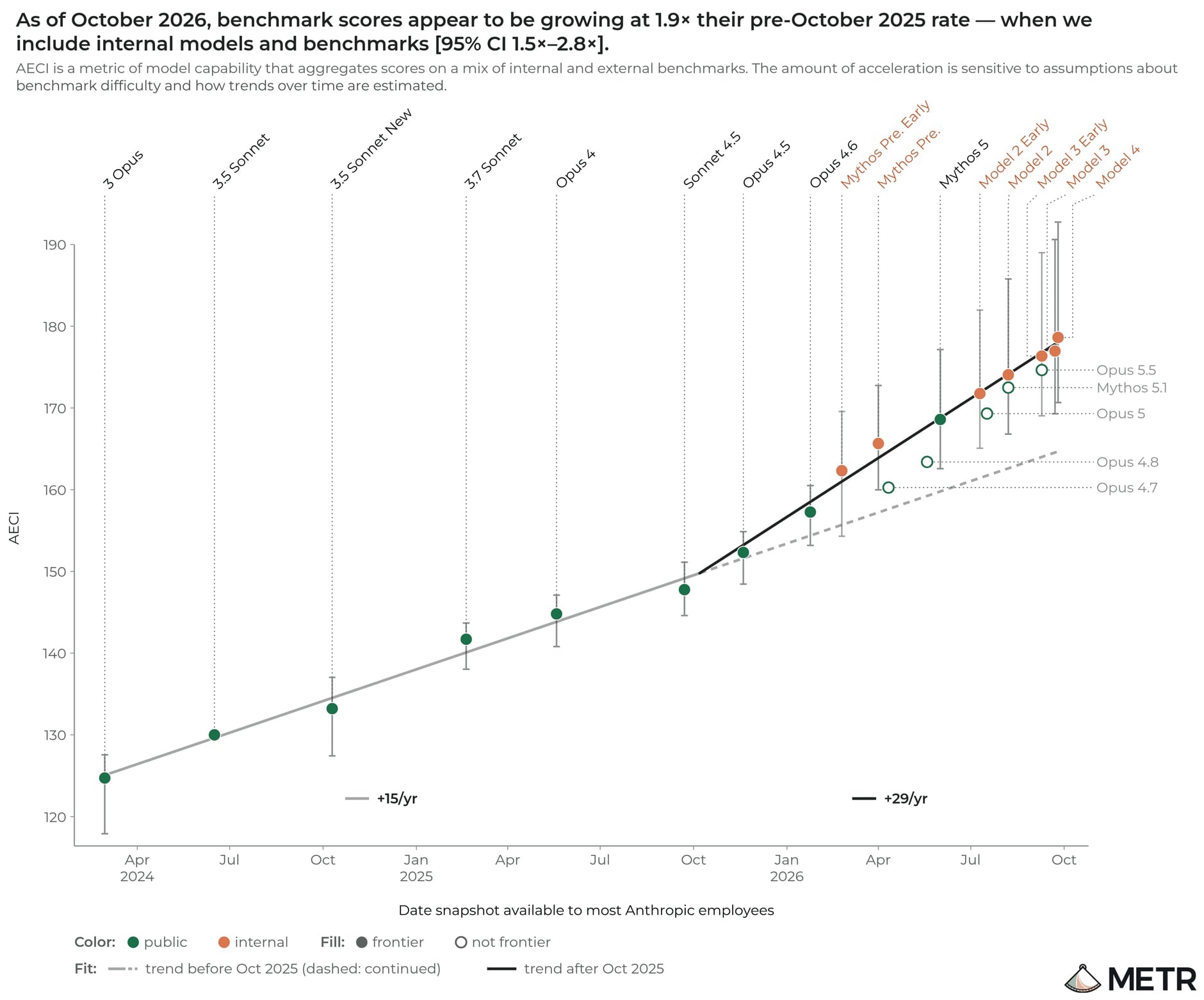
METR researchers spent three months inside Anthropic to investigate whether AI is accelerating Anthropic's research, and how much. Their answers are yes, and by a lot.
They estimate that between October 2025 and October 2026, Anthropic's model capabilities improved at a 2x faster growth rate than between March 2024 and October 2025. They attribute about 80% of that acceleration to AI, and 20% to non-AI factors. If true, this is the strongest evidence yet that AI is measurably speeding up frontier AI development itself – the feedback loop behind worries about recursive self-improvement leading to runaway AI progress.
Despite its urgency, METR’s report is hard to assess, because Anthropic redacted the majority of METR’s analysis. As a result, I’ve seen plenty of criticism that we can’t really learn anything from this report.
This is wrong. There is plenty of public information we can use to triangulate METR’s claims, and figure out what we should actually learn from it. Specifically, I use public data to answer three questions:
- Is the acceleration real? (yes.)
- Is the acceleration because of AI? (probably.)
- Is the acceleration going to continue? (who the fuck knows?)
Let’s take each of them in turn.
Is the acceleration real?
The majority of METR's unredacted analysis focuses on AECI, Anthropic's internal version of Epoch's Capabilities Index (ECI). Both indices do the same thing: they take a model's scores on many benchmarks and boil them down to a single capability number, after estimating how hard and how discriminating each benchmark is. The difference is that AECI is fit to mostly internal benchmarks. On AECI, Anthropic's models were improving at about 15 points a year before October 2025, and about 29 points a year after, a difference of 1.9x.
At first, this seems wrong. The frontier of public ECI shows no break at all in October 2025. But that is the frontier across all labs (not Anthropic's specific trend), and using Epoch's latest methodology. Once you make the comparison like-for-like, public data reproduces almost all of METR's conclusion. In sequence, we can:
- Focus only on the trend for Anthropic models. This is what anyone can see on Epoch's site today. It already shows a break: Anthropic's progress after October 2025 is 1.42x as fast as before.
- Refit ECI according to METR's method. Epoch's published scores now come from an updated Bayesian methodology, whereas AECI uses Epoch's older frequentist fit.[1] Refitting the same public data with Epoch's previous methodology raises the speedup to 1.64x.
- Compare to METR's AECI on the same models and dates. We don't know what benchmarks AECI includes, but METR does, and we can compare their fits on Anthropic's models to AECI fits on those models. AECI gives a 1.76x speedup. That is within about 0.1x of the least-squares ECI.
- Add Anthropic's internal models. METR plots the results from Anthropic's internal models, which could affect the trend break even further, since their capabilities are higher than public models. This replicates METR’s 1.91x speedup.
The first two steps represent the trend we can estimate with public data, while the last two steps represent additional information from Anthropic's private data.
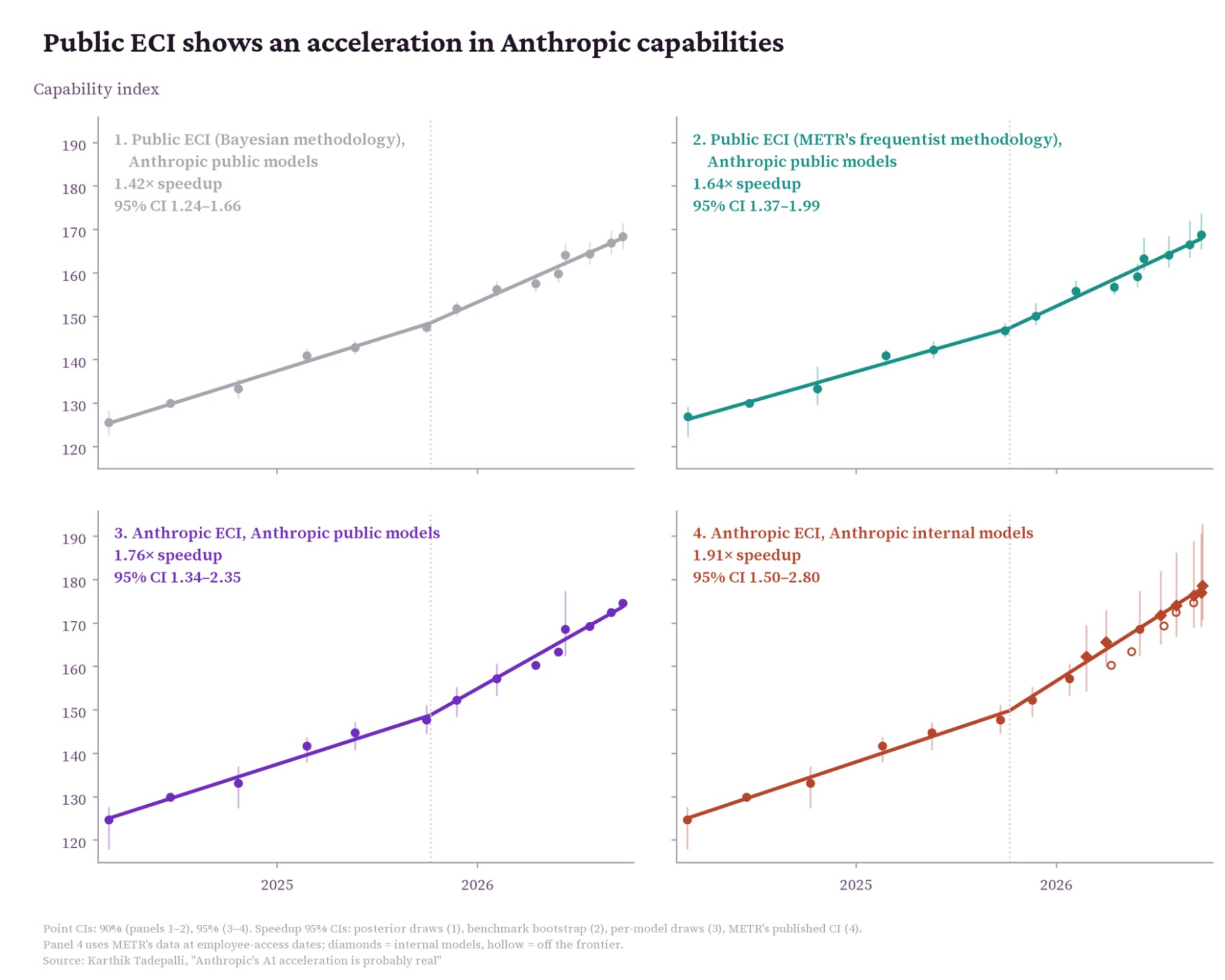
The last two steps take the acceleration from 1.64x to 1.9x, METR's headline, but the majority of the work is in the first two steps, which can be reproduced from public data. In other words, there is nothing mysterious about the gap between public ECI and Anthropic's results, and the public data supports a trend break in Anthropic's AI capabilities after October 2025. In other words, you don't need to trust Anthropic's internal data to believe METR's headline result of acceleration at Anthropic.
The one wrinkle is that you do need Anthropic's internal model data to distinguish between a trend break and a one-time jump. In the Opus 5.5 system card, Anthropic analyzed recent capability progress, and found that a one-time jump in AI capabilities at Mythos Preview (with the same trend as before) fits the AECI data better than a trend break. But METR finds the opposite – a trend break fits the data better than a one-time jump.
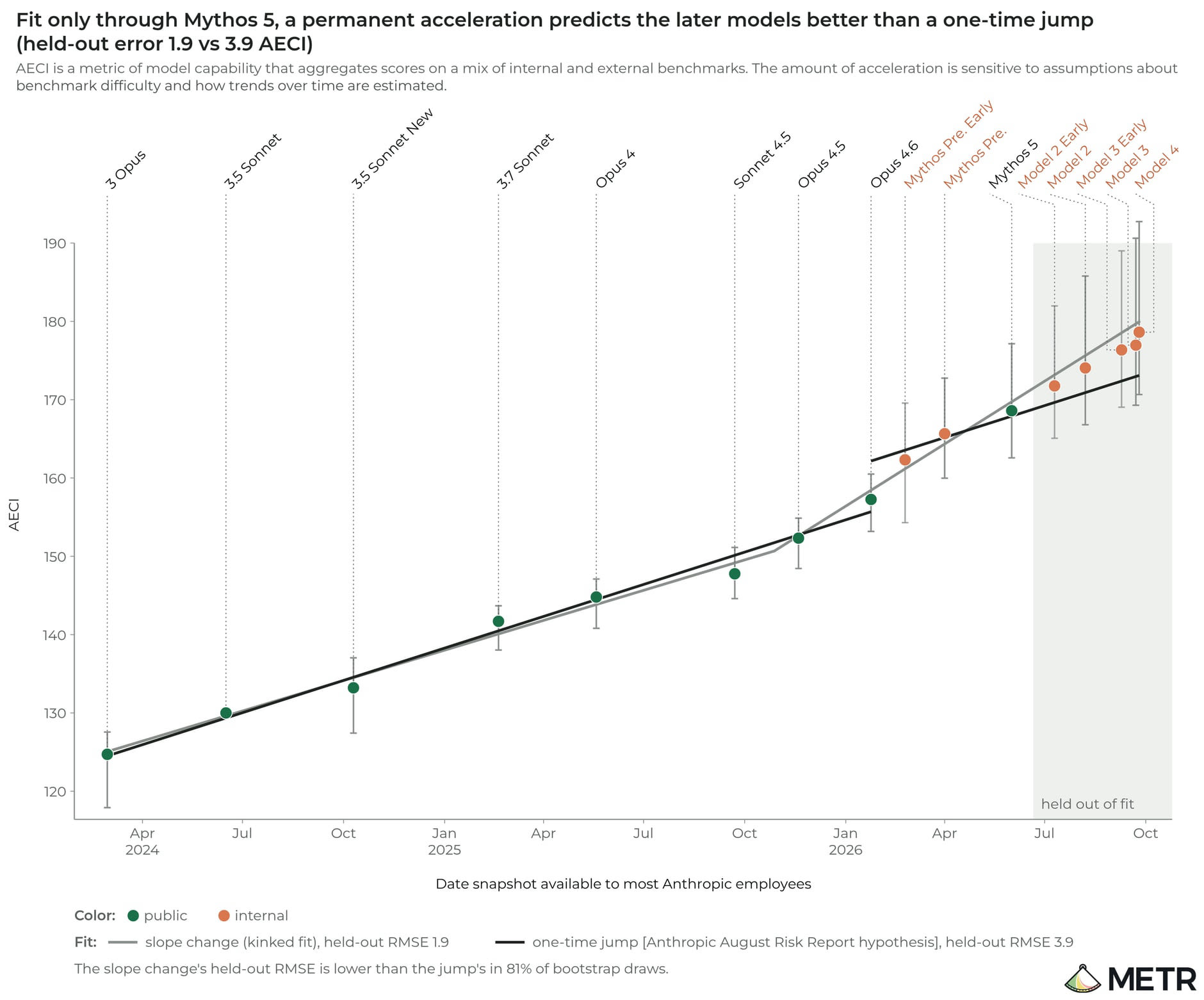
The difference is that METR's report includes Anthropic's unreleased models, while the Opus 5.5 system card did not. So the evidence favoring a trend break over a one-time jump does rely on Anthropic's internal models, and we can't scrutinize their AECI scores to know if we should actually believe a one-time jump over a trend break.
Is the acceleration beca
METR researchers spent three months inside Anthropic to investigate whether AI is accelerating Anthropic's research, and how much. Their answers are yes, and by a lot.
They estimate that between October 2025 and October 2026, Anthropic's model capabilities improved at a 2x faster growth rate than between March 2024 and October 2025. They attribute about 80% of that acceleration to AI, and 20% to non-AI factors. If true, this is the strongest evidence yet that AI is measurably speeding up frontier AI development itself – the feedback loop behind worries about recursive self-improvement leading to runaway AI progress.
Despite its urgency, METR’s report is hard to assess, because Anthropic redacted the majority of METR’s analysis. As a result, I’ve seen plenty of criticism that we can’t really learn anything from this report.
This is wrong. There is plenty of public information we can use to triangulate METR’s claims, and figure out what we should actually learn from it. Specifically, I use public data to answer three questions:
- Is the acceleration real? (yes.)
- Is the acceleration because of AI? (probably.)
- Is the acceleration going to continue? (who the fuck knows?)
Let’s take each of them in turn.
Is the acceleration real?
The majority of METR's unredacted analysis focuses on AECI, Anthropic's internal version of Epoch's Capabilities Index (ECI). Both indices do the same thing: they take a model's scores on many benchmarks and boil them down to a single capability number, after estimating how hard and how discriminating each benchmark is. The difference is that AECI is fit to mostly internal benchmarks. On AECI, Anthropic's models were improving at about 15 points a year before October 2025, and about 29 points a year after, a difference of 1.9x.
At first, this seems wrong. The frontier of public ECI shows no break at all in October 2025. But that is the frontier across all labs (not Anthropic's specific trend), and using Epoch's latest methodology. Once you make the comparison like-for-like, public data reproduces almost all of METR's conclusion. In sequence, we can:
- Focus only on the trend for Anthropic models. This is what anyone can see on Epoch's site today. It already shows a break: Anthropic's progress after October 2025 is 1.42x as fast as before.
- Refit ECI according to METR's method. Epoch's published scores now come from an updated Bayesian methodology, whereas AECI uses Epoch's older frequentist fit.[1] Refitting the same public data with Epoch's previous methodology raises the speedup to 1.64x.
- Compare to METR's AECI on the same models and dates. We don't know what benchmarks AECI includes, but METR does, and we can compare their fits on Anthropic's models to AECI fits on those models. AECI gives a 1.76x speedup. That is within about 0.1x of the least-squares ECI.
- Add Anthropic's internal models. METR plots the results from Anthropic's internal models, which could affect the trend break even further, since their capabilities are higher than public models. This replicates METR’s 1.91x speedup.
The first two steps represent the trend we can estimate with public data, while the last two steps represent additional information from Anthropic's private data.
The last two steps take the acceleration from 1.64x to 1.9x, METR's headline, but the majority of the work is in the first two steps, which can be reproduced from public data. In other words, there is nothing mysterious about the gap between public ECI and Anthropic's results, and the public data supports a trend break in Anthropic's AI capabilities after October 2025. In other words, you don't need to trust Anthropic's internal data to believe METR's headline result of acceleration at Anthropic.
The one wrinkle is that you do need Anthropic's internal model data to distinguish between a trend break and a one-time jump. In the Opus 5.5 system card, Anthropic analyzed recent capability progress, and found that a one-time jump in AI capabilities at Mythos Preview (with the same trend as before) fits the AECI data better than a trend break. But METR finds the opposite – a trend break fits the data better than a one-time jump.
The difference is that METR's report includes Anthropic's unreleased models, while the Opus 5.5 system card did not. So the evidence favoring a trend break over a one-time jump does rely on Anthropic's internal models, and we can't scrutinize their AECI scores to know if we should actually believe a one-time jump over a trend break.