
S$^4$R: Selective Sampling, Subspaces, and Sparse Reconstruction for Compressed Long-Context KV Caching
Qwen3.8-Omni: Towards Native Omni-Modal Agents
ABAI at COLIEE 2026 Task 1: Multi-Stage Retrieval with GraphRAG-Enhanced Meta-Learning, and a Post-Hoc Study of the Cross-Validation-to-Test Gap
Compressing Long Context into Answer-Aligned Memory Embeddings for LLM Inference
CliffCompaction: Cost-Efficient Compaction for Long-Horizon Coding Agents
DTOC: Dynamic Tool Output Compression for Adaptive Context Management in AI Agents
RAG-NAROK: Retrieval-Aware Knowledge Corpus Poisoning in RAG with Source-specific Refutation
Understanding GLiFormer’s Benchmarks and Schema-Driven Extraction
Overview
gliformer-large-v1 is a 575.6-million-parameter, Apache-2.0 model from knowledgator for schema-driven information extraction and text representation. It uses a shared DeBERTa encoder with task heads for named entity recognition, classification, joint relation extraction, structured records, and text embeddings. Its layout-aware architecture supports text and document-layout inputs, including PDF-oriented processing, but the published examples and evaluation results focus on English text rather than visual document understanding. You run it through the gliformer Python library or the GLiFormer source framework in Python 3.10 or newer. The most important consideration is its breadth: one checkpoint accepts labels and schemas at inference time, but its quality varies by task and dataset. Reported mean strict entity F1 is 50.91 across 26 NER datasets, mean macro-F1 is 75.03 across 13 classification datasets, joint relation extraction is weak on several benchmarks, and the strong 91.10 structuring score uses order-free, boundary-tolerant JSON evaluation rather than exact JSON matching. No context window, maximum sequence length, training-step count, VRAM requirement, inference latency, or checkpoint-specific training dataset is provided.
Best use cases
Schema-driven entity extraction from English text. Use the model when entity types vary by project and you want to provide labels at inference time instead of training a separate fixed-label NER model. For example, extract person, organization, and location from "Alice works at Acme in London." and receive each entity’s text, label, character offsets, and score. The shared DeBERTa encoder and task-conditioned interface support custom entity labels, but benchmark results show substantial variation: strict F1 reaches 80.16 on WikiNeural and 71.48 on CrossNER politics, while it falls to 13.81 on HarveyNER and 21.99 on FabNER.
Text classification with custom candidate classes. Use classify for jobs such as assigning support tickets to product or support, detecting sentiment, or routing documents among business categories. The model accepts candidate labels at inference time and supports named groups such as separate sentiment and topic label sets. It performs well on some conventional datasets, including 97.95 macro-F1 on Enron spam, 96.77 on Financial Phrasebank, 93.93 on IMDB, and 92.97 on SST-2, but performance is much lower on SST-5 at 40.33, Emotion at 48.07, and the SOTU dataset at 49.00.
Structured record extraction from semi-structured prose. Use structure when the output must contain fields and parent-child relationships, such as converting company descriptions into nested companies, departments, and employees. The decoder can produce Python dictionaries from simple field lists or nested Pydantic schemas. The reported multilevel structuring score is 91.10 on 500 examples, with scores from 89.94 at JSON depth 3 to 95.11 at depth 4. Treat this as source-grounded extraction, not factual verification: Pydantic validation checks shape and types, not whether extracted values are correct.
Joint relation extraction with a closed schema. Use inference with joint_relations when you need entities and relations in one configured task, such as extracting (Alice, works_at, Acme). This checkpoint has a joint relation head, so the schema must provide entity and relation labels together. It is not a strong choice for high-recall relation mining: reported micro-F1 is 12.78 on DocRED, 12.61 on CrossRE, 24.08 on FewRel, and 35.83 on zero-shot CoNLL04.
Embedding short text for similarity workflows. embed_text returns 1,024-dimensional vectors that you can compare with cosine similarity. This fits semantic search prototypes, duplicate detection, clustering, and retrieval features where a single local encoder is useful alongside extraction tasks. The provided material does not include embedding benchmark scores, so validate retrieval quality on your own corpus before selecting it for production search.
Limitations
The model does not provide a guaranteed extraction of every fact. NER can omit mentions, select incorrect spans, or assign incorrect labels. Its strict NER score requires both span and type to match, and the dataset results range from 13.81 to 80.16 F1. Labels, schema wording, domain, input length, and thresholds affect predictions.
Relation extraction is a major weakness in the published results. The reported runs use predicted entities, and the scores are not controlled comparisons between the base and large releases because they use different-sized subsets. The model also lacks an open relation head: the convenience method predict_relations requires one, so this checkpoint should use joint_relations instead.
Structured extraction can attach records to the wrong parent, omit fields, or produce incorrect values. Its 91.10 score is not exact JSON match. Evaluation flattens JSON value paths, aligns records without requiring original order, and permits limited boundary repairs. Fixed record anchors and configured span width constrain extraction capacity.
The layout-aware design supports text and document-layout inputs, but the supplied quality evidence does not establish performance on PDFs, other document layouts, or visual inputs. The checkpoint has no dedicated vision or audio capability. Results cover English tasks; quality for other languages is not established. The NER transfer groups also do not prove that every evaluated domain was absent from training.
The model is large at 575.6M parameters. The documentation provides no VRAM minimum, latency, throughput, maximum context length, or practical batch-size guidance beyond the NER example using batch_size=8. CUDA attention kernels are optional; CPU inference uses eager attention. You should benchmark memory and latency on your target hardware.
The Apache-2.0 license permits commercial use subject to the license terms. The provided material does not document additional dataset-specific restrictions, warranty terms, or safety evaluations. It also does not state whether the checkpoint is actively maintained.
How it compares
gliner-x-large
Choose gliformer-large-v1 over gliner-x-large when you need one interface for NER, classification, joint relations, structured records, and embeddings, or when nested record extraction matters. Choose GLiNER X-Large when the primary requirement is flexible zero-shot NER and you want a model positioned as a practical alternative to fixed-label NER systems and larger language models. The supplied information does not provide matched parameter counts, latency, cost, or benchmark scores, so it does not support a numeric quality or speed ranking between them.
modern-gliner-bi-large-v1.0
Choose gliformer-large-v1 when multi-task extraction, classification, relation extraction, structured records, and embeddings must share one checkpoint. Choose modern-gliner-bi-large-v1.0 for NER workl

阿里云加速构建Agentic Cloud:推出AgentCore、新一代CPFS等重磅新品
9月22日,2026杭州云栖大会上,阿里云CTO李飞飞系统性阐述了Agentic Cloud 战略布局,阿里云将Model、Harness、Context作为核心构建场景,推出全新的云上算力底座和Agent 构建治理平台AgentCore、Agent Sandbox、新一代高性能存储CPFS等一系列新品,让 AI 真正进入生产流程、走向规模化价值创造。
随着2026年Agent的爆发式增长,越来越多的智能体正跨过“问答型”的分水岭,进入自主规划、实时决策阶段,这对算力和云提出了更高的要求。李飞飞认为,企业级 Agent 的大规模落地还需要这些能力:以全面、统一、持续更新的上下文形成全域认知;支持自主运行与持续进化;融入安全、控制、信任和身份认证,实现人与 Agent、Agent 之间的可信协作;从静态规则走向实时感知、动态推理和自主行动。
围绕这四大能力支柱,阿里云重构了从 AI Native Cloud、 Agent Native Cloud到 Context Engine 的完整技术栈体系。
AI Native Cloud:挑战 RSI 的算力底座
当下模型尺寸正面临从万亿到十万亿参数的跃迁,训练范式也从预训练、后训练 Agentic RL 进一步走向以递归式自我改进RSI,这要求云底座同时解决超大规模集群稳定性、毫秒级弹性、百万级并发,以及训练、推理和环境交付的统一协同。

阿里云在会上展示了全栈自研的算力底座,覆盖计算、存储、网络等多个产品线,应对RSI带来的挑战。以灵骏真武M890超节点为例,这是首个国产十万卡超节点集群,有力支撑了Qwen3.8 Max、KIMI K3等超2T参数大模型对外提供商业服务。即将在明年推出灵骏真武V900超节点,性能提升三倍,搭载业界首发200Pbps通信带宽,6us时延集群架构,自研SNPO支持全光互联,支持千卡Scale-Up互连,单集群可扩展至 50 万卡规模,向广域超节点演进。
同时,阿里云还推出了新一代全栈自研高性能存储CPFS,提供高达百TB/s级吞吐和亿级IOPS,单文件系统规模提升5倍至100PiB,支撑大规模模型训练和多模态数据处理。在实际模型训练中,可将模型启动平均耗时降低50%、峰值算力利用率提升30%、AI存储成本降低69%,使GPU从“等待数据”转向持续高效计算。

推理方面,面对容量激增的KVCache和多轮任务的普及,阿里云围绕Token生产和缓存调用进行极致的优化,推出大模型KVCache管理和调度系统Tair KVCM,统一编排 Mempool、KVCacheStore 与远端共享存储等多级缓存,存有效命中率可达 99%,每token成本下降50%;推出存储加速引擎KV CacheStore,位于G3.5存储层,承接长上下文、多轮对话和复杂Agent任务产生的大量缓存,满足千亿级KV存储规模,在客户生产环境下实现缓存覆盖时间窗口扩大 900%,吞吐提升 20%,首 token 延迟降低 54%;全新的智算中心融合网络TPN,采用2层网络设计,访问带宽增加 2.5 倍,网络规模增加10倍,延时降低 1/3……这些围绕“算网存”多方协同的技术创新,为模型推理。
此外,人工智能平台PAI新增支持异步AgenticRL的训练框架,打通轨迹采样、回报累计、模型训练、参数更新的环路。在支持Qwen模型后训练的实战中,实现5天完成一次SOTA模型的后训练。
Agent Native Cloud:支撑 Agent 应用规模化落地

随着Harness工程和skill的成熟与普及,大模型竞争正从能力比拼转向业务价值兑现——能在真实的生产环境中精细化使用、具备智能组织和智能基础设施、不是概率智能而是可靠的生产力……这些正成为让 Agent 真正融入业务流程必须跨越的门槛。
为了更快让企业级客户与Harness深度协同,阿里云推出企业级Agent构建治理平台AgentCore,将企业级Agent基础设施标准化、托管化,支持长任务、失败重试、断点恢复和异步执行;提供安全执行环境、资源隔离、身份权限和全链路审计,统一管理模型、MCP Server、Skill 等资产,可提升任务完成率99%,TCO成本降低70%。

此外,阿里云还准备了一系列Agent相关产品,为企业级客户提供丰富的选择:包括Agent Sandbox,为 Agent 提供开箱即用、极致弹性、安全可靠的执行环境,创建吞吐10万/分钟,深休眠唤醒<600ms,兼容 E2B 和 K8s,满足从开发者到企业级 Agent 的规模化运行需求;Agentic OS,Agent 原生操作系统,可节省Token消耗30%以上,沙箱部署密度提升 3 倍;Agentic Computer,为智能体提供统一、长期在线的专属云电脑工位,兼容主流 Agent 框架,具备 Computer Use 和 GUI 操作能力,权限可控、操作可审计……
Context Engine:让企业全域数据成为 Agent 的实时上下文

决定Agent能力上限的不只是模型参数,还包括能否持续理解企业知识、业务状态和执行反馈,因此上下文不再是应用侧的一段缓存,而正在成为企业需要统一建设和治理的新型数据资产。
围绕这一变化,阿里云提出了“存储—计算处理—上下文工程”三位一体的引擎——Context Engine ,将企业全域数据转化为实时上下文,让 Agent 从“知道什么”进一步走向“此刻应该做什么”:底层以多模态数据存储承接对话、视频帧、点云、轨迹和 Agent 反馈;中间层覆盖数据集成、转换、治理、质量和建模;上层通过全域知识库、多模态语义整合、持续记忆管理和实时上下文装配,把分散数据组织成 Agent 可以按需调用、动态更新的上下文。
产品层面,Agent Context 面向复杂知识检索,将准确率提升 50 个百分点,Token使用效率提升3倍以上;OpenLake 提供统一全模态数据湖仓,通过一份数据支持多引擎计算,使总体拥有成本降低 38%;Apsara Lakebase 支持亚秒级、零拷贝创建数据分支,为 Agent 提供快速、隔离的数据空间;MC-MaxFrame 以自研分布式计算框架处理多模态数据,计算性能提升 12%;Flink Streaming Agent 提供 60 多种全模态算子,把实时数据流转化为可触发业务流程的实时行动。
从面向 Model 的模型生产,到面向 Harness 的自主运行与持续进化,再到面向 Context 的实时智能决策,阿里云正在把算力、网络、存储、运行环境、身份安全和企业数据组织成统一的 Agentic Cloud。“阿里云已形成从 AI 芯片、服务器 CPU,到互联、网卡、存储主控和 AI 软件栈的完整布局,可以从计算、网络到存储做全栈协同和联合调优,把智能生产效率做到更高。”李飞飞表示。


《AGI市场观察》发布:四款国产模型周用量破10万亿tokens,DeepSeek与混元占比近半
日前,智能经济30人论坛AGI测评中心发布最新一期《AGI市场观察》(2026年9月12日-18日)。报告以OpenRouter词元消耗数据、各厂商官方披露价格及Arena基准测评为基础,对国产大语言模型做周度量化追踪,本期围绕用量、份额、集中度、价格与性价比等方面给出观察。
数据显示,深度求索于9月10日下调DeepSeek V4 Flash及V4.1 Flash定价,后者周用量随之增长483.62%,位次由第9升至第2;腾讯Hy4 preview以12.01万亿tokens位列第三、份额15.54%,性价比位次与上期持平。
词元用量方面,周期内词元用量超过10万亿tokens的均为轻量级(Flash/类Flash),包括DeepSeek V4 Flash(14.59万亿)、DeepSeek V4.1 Flash(12.93万亿)、腾讯Hy4 preview(12.01万亿)、智谱AI GLM 5.3 Flash(11.62万亿)。而上海创智学院Nex-N2.5 Pro、阿里巴巴Qwen3.8 Flash则首次跻身Top 15。
市场份额方面,DeepSeek V4 Flash(18.88%)及V4.1 Flash(16.73%)、腾讯Hy4 preview(15.54%)、智谱AI GLM 5.3 Flash(15.04%)四款模型份额在中国大模型中的词元用量份额同处 “第一梯队”,四强合计约占66%。头部集聚态势不变,前三位模型贡献了近一半的用量份额,前五位更是占比超过四分之三。

价格与性价比方面,当期Top15大模型每百万tokens最高价与最低价相差38.75元,与上期持平,其中最低为小米MiMo-V2.5(1.25元),最高为月之暗面Kimi K3(40元)。在基准任务成本中,腾讯Hy3最低,低至0.308元/基准任务,其次分别为DeepSeek V4.1 Flash、MiniMax M3和GLM 5.3 Flash,同处于“经济好用”区间。

据悉,智能经济30人论坛是由中国(深圳)综合开发研究院等机构联合发起,汇聚全国人工智能、数字经济领域的专家学者与企业家,共同推动智库交流与合作。
雷峰网 雷峰网
Jev,让全球程序员玩疯了
作者|宇航猿
编辑|靖宇
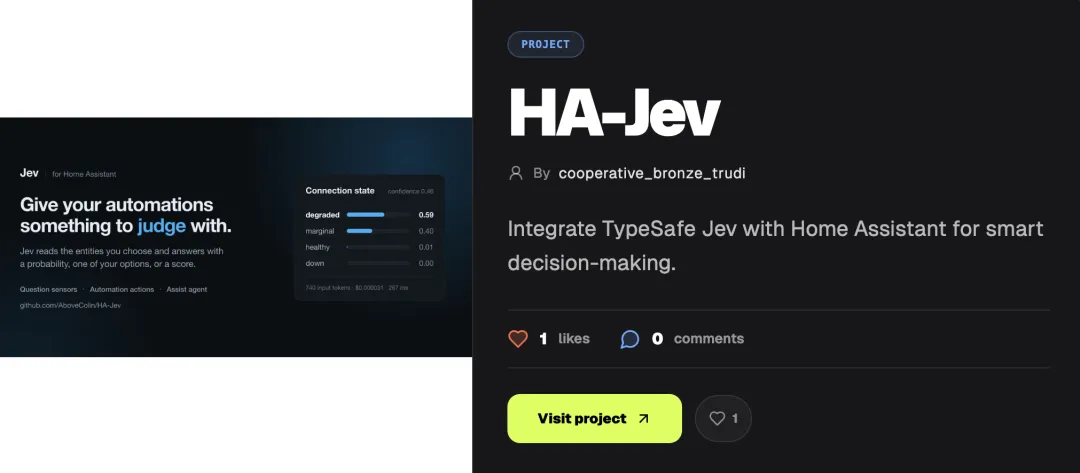
智能家居社区 Home Assistant 最近出现了一个名为 HA-Jev 的插件。
它的逻辑极其简单,传感器读取洗衣机的功率变化与洗衣房门的状态,然后抛出一个问题给模型,「洗衣机洗完了,衣服是不是被忘在里面了?」模型不输出任何文字分析,只返回一个概率值。当置信度超过 0.8 时,手机就会弹出一则取衣提醒。
HA-Jev 仅仅用来提醒用户洗完的衣服是不是还留在洗衣机里|图片来源:pitchhut
一次判断耗时几十毫秒,花费 0.000015 美元 。
插件开发者在论坛里留下一句意味深长的话,「我过去一直在用大语言模型回答根本不需要它的问题。衣服忘没忘拿是一个判断,不是一篇八股文。」
这句话恰好刺中了当前生成式 AI 的痛处。过去四年,整个行业把几乎所有的算力、资本和工程资源,都压在「教模型说出更流畅的人话」上。大家习惯了用百亿甚至千亿参数的庞然大物,先吐出一长串思考过程,再包装成礼貌体贴的自然语言,最后让开发者用复杂的正则表达式把需要的答案抠出来。
直到前 OpenAI 研究员 Diogo Almeida 带着他的新模型 Jev 登场。这个被称为「System One」的模型没有嘴巴,不生成任何文字,只输出概率判断。
上线不过数天, 全球开发者围绕它疯狂砸出了近五百个开源项目 。这可能是 Openclaw 之后,最让人们兴奋的新项目。
大家忽然发现,一旦剥离大模型的表达欲,原本昂贵而臃肿的 AI 应用,突然轻快得像一阵风。
01
大模型的「神经元」
如果把过去调用 GPT-5 或 Claude 的过程比作雇佣一位全知全能的哲学家,来帮你盯监控,那么开发者们现在用 Jev 所做的事,更像是给流水线装上了无数个廉价且反应灵敏的神经元。
在最耗费算力的 Agent 基础设施领域,这种变化几乎是颠覆性的。
过去开发者处理超长上下文,最常用的手段是让大模型做摘要。开发者 Tamara Tran 换了个思路,写了一个 Jev 插件用来压缩 Claude Code 的上下文。它不做任何归纳总结,而是逐条给历史工具调用的相关性打分,只要分值低于阈值,直接整条剔除。
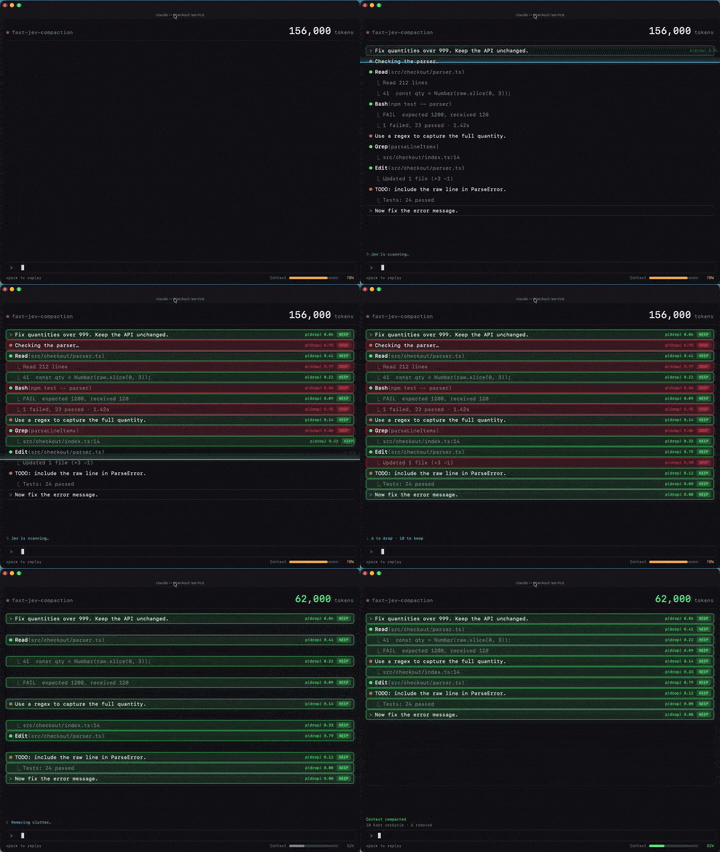
用 Jev 插件用来压缩 Claude Code 的上下文|图片来源:X
结果极其夸张, 接近 100 万 token 的臃肿上下文,在 1 秒钟内被精简到 8.6 万 ,整个过程模型没有敲下一个字符。这里的洞察非常朴素,摘要是昂贵的生成行为,但过滤只是一次冷酷的判断。
类似的颠覆也发生在移动端自动化上。

使用 mobile-jev 操作手机|图片来源:jevfast.com
Droidrun 团队做了一个名为 mobile-jev 的手机操作代理。在一段流出的演示中,它控制真实 Android 手机打开 Uber,输入起点和终点,一路精准点击直至付款界面, 全程 9 个操作步骤仅耗时 21 秒 。
整个流程没有调用过任何传统的文字生成大模型,文字输入是直接从用户指令中截取的纯文本片段,而每一个界面的下一步该点哪里、该滑动还是该确认,全部交给 Jev 做极速概率匹配。
除了操作界面,开发者们甚至把它塞进了最古老的基础设施里。
GitHub 上很快涌现出 pg-jev 和 duckdb-jev。开发者开始用自然语言,直接对数据库的行数据进行实时概率过滤和排序。在 Ruby 社区,有人直接把判断封装成了原生控制流语法,代码写出来就像是给程序赋予了直觉。
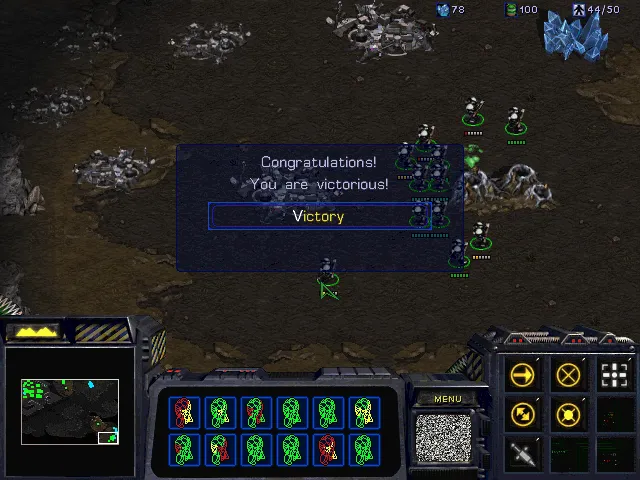
使用 Jev 打「星际」已经成了一系列 Github 项目|图片来源:Github
在游戏领域,有人让 Jev 操控模拟器状态去玩超级马里奥,有人让它驱动《毁灭战士》里的守卫,甚至有团队把它接入《星际争霸》完成了首个战斗任务。游戏需要的是几十毫秒内的操作决断,以往的大模型连第一帧的思路都还没理顺,游戏角色早就阵亡了。
甚至,在数据清洗这类脏活累活上,差距也大到令人发指 。
一位开发者手头积压了三个月的产品匹配数据,共计 9081 条。早在六月份他就用主流大模型测算过,昂贵的 API 费用让他直接放弃。换成 Jev 后,他用一个晚上写了 150 行脚本,整个任务 13 分钟跑完,总账单只有 32 美分。
当大模型不再假装自己是一个博学的人类,AI 才能真正嵌入自动化软件的毛细血管。
02
杰文斯悖论
Jev 这个名字,取自 19 世纪英国经济学家威廉·斯坦利·杰文斯(William Stanley Jevons)。
经济学上著名的「杰文斯悖论」指出,当技术的进步提高了某种资源的利用效率,导致其使用成本大幅下降时,该资源的总消耗量不但不会减少,反而会呈现爆发式增长。
TypeSafe AI 给 Jev 定下的价格是每百万输入 token 仅需 0.042 美元,输出免费。按照这个资费,一天进行 1 万次业务决策,单月成本在 120 美元左右。而在以往,如果使用同等准确率的顶级推理大模型做这套流程,每月账单会直奔 3.5 万美元。
暴跌的成本,瞬间激活了那些此前被判定为「毫无商业价值」的边缘场景 。
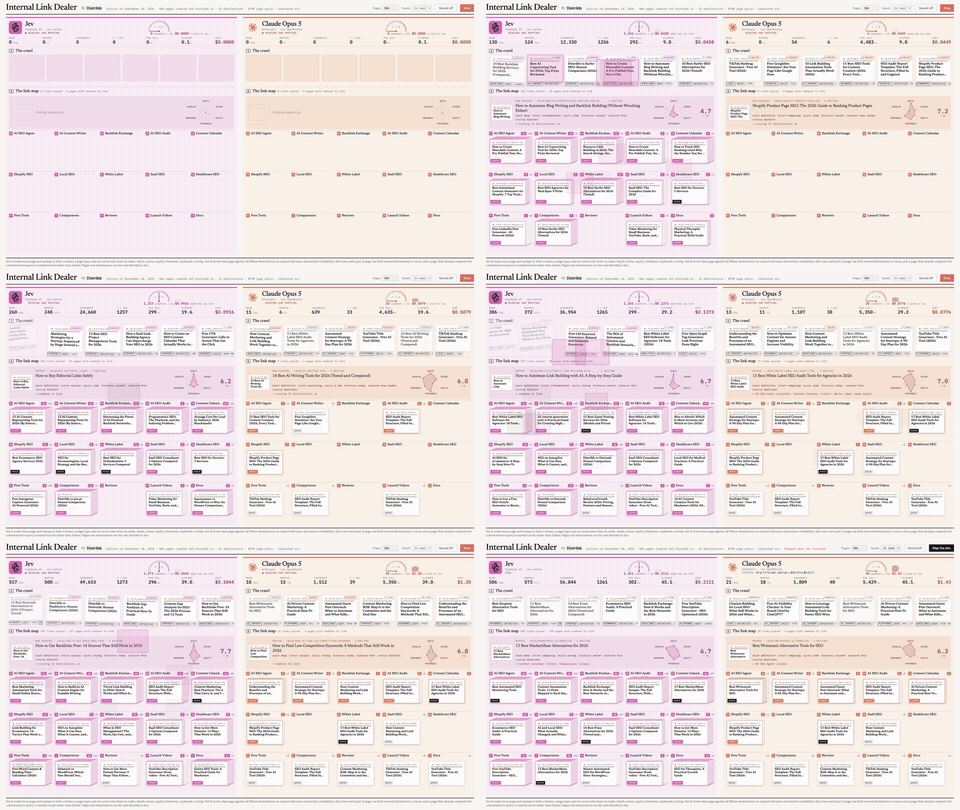
用 Jev 做 SEO 速度惊人|图片来源:X
在内容分析领域, Distribb 的创始人拿 Jev 扫描了近六百个网页,在 45 秒内完成了内部链接地图的重构 ,布设了五百多个链接,总共花费 21 美分。在过去,如果让顶级大模型来做这件事,同样的时间里连二十个页面都读不完。
那位创始人的感叹切中了本质,「这不是内容创作,这只是 8790 次判断该连还是不该连的决策题。」
这也解释了为什么创始人 Diogo Almeida 在离开 OpenAI 时会留下那句感叹,「 我们手里握着一道闪电,但它却没那么好用 。」
作为参与过构建 ChatGPT、共同发明 RLHF 的核心研究员,Almeida 的反思带着一种行业局内人的冷酷。在他看来,整个行业被困在「优化人类自然语言」这条死胡同里太久了。
计算机之间协同并不需要抑扬顿挫的修辞,机器需要的是明确的指令与概率。过去四年 AI 界花费数千亿美元调教出来的语言能力,在严肃的系统工程面前,大部分时间反而是低效的阻碍。
Pi 框架的 CTO Armin Ronacher 谈到这一现象时直言不讳,「我们早该意识到这一点的。只因为此前主流大模型一直被风投资本补贴得极为廉价,大家都习惯了挥霍,没人愿意去做真正的创造性思考。」
一旦这种廉价幻象被打破,架构设计的转向便不可逆转。
大模型,正在退回它原本该在的位置。
它不应该当中央处理器,它更适合做前端的公关发言人 。在未来的系统架构里,海量的毫秒级判断交给便宜得像自来水一样的直觉模型,只有在真正需要向人类用户输出成段文字、提供情绪价值或者起草复杂长篇报告的极少数节点,才需要把那个昂贵的生成式模型唤醒。
03
「判断」和「生成」分家
回看过去三年的 AI 叙事,主线一直是「大模型越来越大、越来越聪明、越来越全能」。一个模型既能聊天,又能写代码,还能看图做表,什么都会。整个行业默认「智能」是一块铁板,不可拆分。
Jev 的出现,撕开了这块铁板。它证明了 有些工作需要推理和表达,有些只需要快速判断 。把两者绑在一起,是一种结构性的浪费。
Jev 的大火,点燃了开源社区的热情|图片来源:Google DeepMind
Jev 上线仅一天,开源社区就已经跟进。vLLM 贡献者用 Google 的 DiffusionGemma 迅速搞出了开源版本,初步测试准确率接近官方。这说明「判断模型」作为一个品类已经成立,而不仅仅是一家公司的产品创新。
更值得注意的是下游的架构变化。在 Jev 催化的新范式里, 一个 AI 系统不再只有「一个大脑」,而是开始出现分工 :海量的毫秒级判断交给便宜到像自来水一样的直觉模型,只有在真正需要向人类输出成段文字、起草复杂文档的少数节点,才唤醒那个昂贵的生成式模型。
这不是降本增效,这是 AI 基础架构从「中央集权」,走向「分布式分工」的起点。
当一个判断的成本从几美分降到万分之一美分,开发者不是把原来的 100 次判断做得更便宜了。他们开始做 10000 次以前根本不会做的判断。给每条数据库记录加一个语义过滤器,给每次工具调用加一个安全审查,给洗衣机加一个「衣服忘拿了吗」的判断。
这些不是现有工作的优化版本,而是全新的智能消耗场景。
所以,你会用 Jev 来做什么创新?
*头图来源:jev-ai
本文为极客公园原创文章,转载请联系极客君微信 geekparkGO
ConsistWorld: Evidence Routing for Consistent Multi-Agent World Models
LongNovel: A Multi-Scale Benchmark for Hallucination Detection in Long-Context Novel Summarization
Block-Sparse Attention with Semantic-Geometric Decoupled Routing
An Empirical Cost Attribution of Context-Compression Gateways in Multi-Turn Coding Agents
Multi-Agent Coordination Lets Us Pour More Compute Into Post-Training
Training models to coordinate across multiple agents gives us a way to productively spend substantially more compute during post-training than current single-agent RL setups.
From the recent Dwarkesh Podcast with Noam Brown:
Noam Brown
But that’s one data point. We don’t know how long it would take a single agent to solve Navier-Stokes, because we haven’t done that experiment yet. Maybe we will, but that’s also only one data point.
If we want to do a thorough ablation, the experiments are just too expensive at that scale. So we have to do some kind of methodical science about what happens when you go to 64, 128, 256 or something and get a sense of the behavior. But it’s going to be very hard to push that all the way to 10,000 and know for sure what the benefit was that we actually got from using 10,000 agents versus 1,000.
There’s one thing I want to make clear. The effort to solve a Millennium Prize Problem, this was not due to multi-agent. I wouldn’t even attribute 10% of the credit to multi-agent. The reality is that OpenAI has trained a very powerful model. We can get that model to operate over very long horizons. We can get it to think in parallel.
But at its core, the reason why we’re able to do this is because we just have a general-purpose, very strong model. Things like multi-agent are flashy and new, and that probably gets disproportionate credit for that reason. But the core reason is this is just a very powerful model.
Noam is referring to the GPT-5.6 announcement.
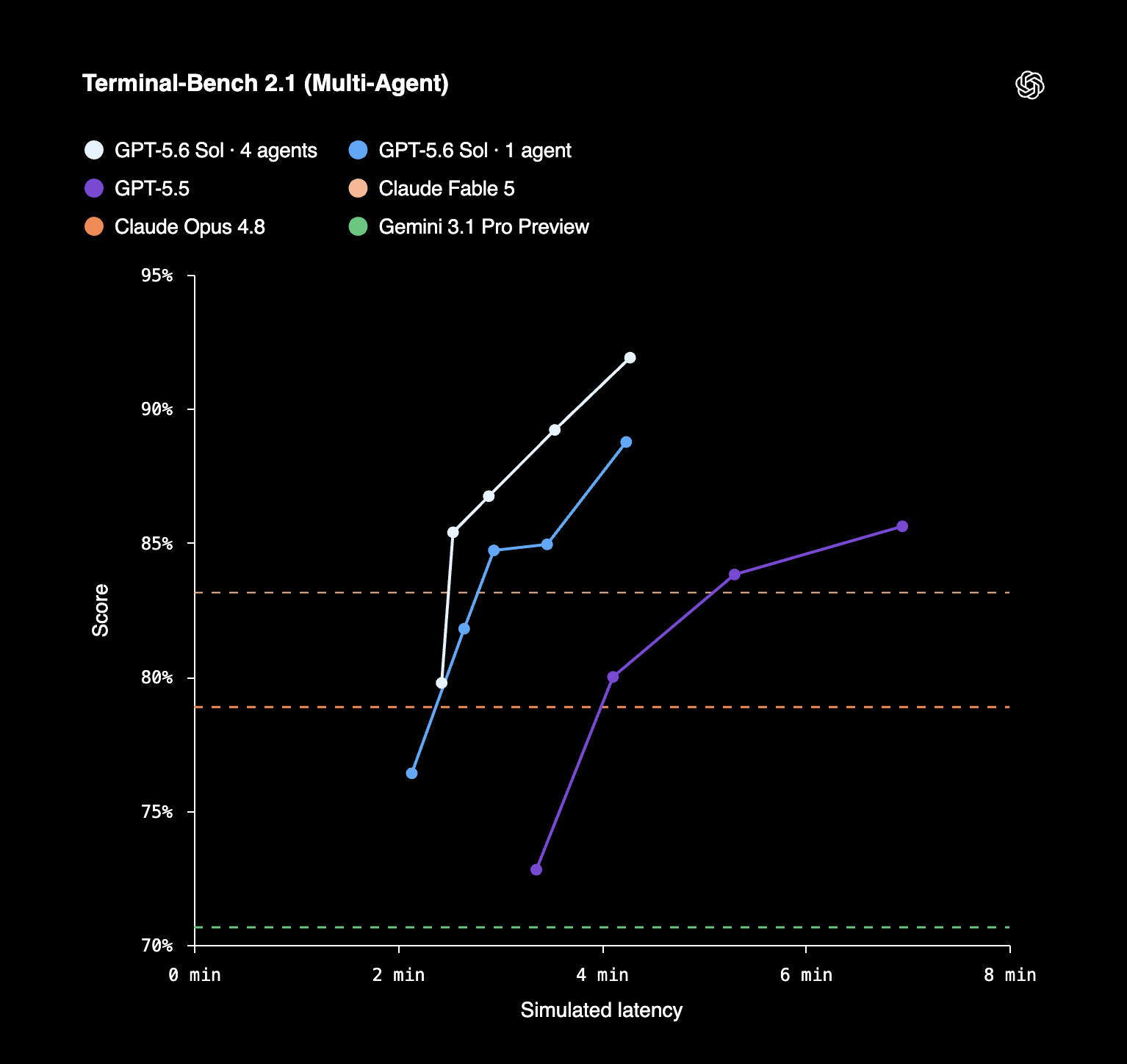
The OpenAI Builder's Guide to GPT-5.6 also hints at where multi-agent behavior enters the training stack (during RL post-training):
We trained GPT-5.6 end-to-end with three complementary architectural interventions that enable agents to operate more efficiently:
- Reuse work already performed: by allowing reasoning to be persisted across model turns and using native compaction to compress long-running conversations, the model can maintain coherence in its work across longer task horizons without getting confused or having to reconstruct prior context.
- Parallel decomposition where appropriate: using native multi-agent orchestration allows coordinating multiple agents across parallel workstreams to finish complex tasks faster.
- Move deterministic work into code: using programmatic tool calling to filter, aggregate, and orchestrate tool outputs outside the model’s context window, reserving model tokens for judgment and reducing cost, latency, and context rot.
The infrastructure required to coordinate model weight updates with inference workers generating RL rollouts is complex. Nathan Lambert has written about some of the systems work required to make RL training efficient.
An oversimplified picture of an RL training system looks something like:
- a set of learner workers updating the model weights;
- a set of inference workers running some version of those weights to generate rollouts;
- infrastructure moving weights, rewards, and other state between the two.
For a single-agent task, one rollout is a model producing a linear trajectory (tool calls, output tokens).
But once the policy being trained can spawn and coordinate other agents, the unit of a rollout becomes larger. Instead, one rollout becomes an asynchronous tree containing dozens or hundreds of model trajectories.
This means that the amount of inference compute that can usefully go into producing a single training trajectory can increase dramatically. And if you want the model to learn good coordination behavior - not merely bolt an orchestration layer onto an already-trained model - you want to include some of these large multi-agent trajectories inside the post-training loop.
I would guess the internal version of Astra is being trained with a refined recipe to encourage native multi-agent orchestration behavior. Even with this refined recipe, there are likely still quirks to work out, which is why Noam attributes <10% of the Navier-Stokes results to the multi-agent nature of the system they used to produce the solution.
As the recipe is improved, we'll see multi-agent systems behave more efficiently and produce more coherent behavior. Rather than spending spending 300B tokens to produce a solution, a more efficient multi-agent swarm may produce a solution with significantly fewer tokens.
As Noam also notes in the interview, this training process is still brittle. It is difficult to encourage the models to use cross-instance communication effectively; often you will see "useless" trajectories where models do not communicate and inject context into other instances at all.
Given the optimism and rumors of the new GPT-6 level model, though, it seems like the team at OpenAI has already made substantial progress in this direction.
Discuss
StepFun Launches Step 5 Preview: A 600B-Total, 27B-Active MoE Model With 1M Context for Long-Horizon Agentic Work
StepFun has released Step 5 Preview, its new flagship model for agentic work. The target workloads are software engineering, professional knowledge work, and finance. The main pitch is cost. StepFun team states the model delivers comparable intelligence at a substantially lower task cost. That is the ‘Pareto frontier’ framing in the launch title.
Is it deployable? Yes, as a hosted API and on the StepFun platform. Self-hosting waits for open weights. StepFun says open weights land on October 15, 2026. By simple arithmetic, 600B parameters need about 1.2 TB in BF16, before KV cache. Plan for multi-GPU server hardware once weights ship.
What StepFun Shipped
Step 5 Preview is a sparse Mixture-of-Experts (MoE) model. It holds about 600B total parameters and activates about 27B per token. That is roughly 4.5% of the weights per token.
The official model documentation lists these specs:
- Model ID:
step-5-preview - Context window: 1M tokens
- Input: text, images, and video
- Output: text
- Reasoning effort:
low,medium, andhigh - Streaming, tool calling, JSON Mode, JSON Schema, and prompt caching
On research tasks, StepFun team states the model coordinated 950 web fetches in a single agent action. StepFun team also documents a Claude Code integration through its Step Plan.
Architecture: Narrow and Deep
StepFun did not widen the network. It stacked 92 Transformer layers in a narrow-deep layout, according to Pandaily. The research team argues deeper stacks give longer paths for implicit multi-hop reasoning. This matters during long prefill, when agents search, run code, and read tool returns.
Training leans on on-policy, long-horizon reinforcement learning. StepFun cites bit-wise train and inference alignment across MoE routing. Other listed techniques include MTP-3 speculative decoding, FP8 MoE, and KV-cache offload. StepFun reports more than 3x end-to-end speedup for long-horizon RL.
Interactive Explainer
&&&Benchmarks: Company-Reported vs Independent
Step 5 Preview ran at High effort, while rivals ran at Max.
StepFun reports these results, via RuntimeWire:
| Benchmark | Step 5 Preview | Claude Opus 5 | GPT-6 Astra |
|---|---|---|---|
| FrontierFinance | 66.4 | 69.7 | 55 |
| DRACO | 83.3 | 87.6 | 76.8 |
On coding, StepFun reports 67.7 on DeepSWE v1.1, 49.0 on StepCodeBench, and 80.5 on ProgramBench. GPT-6 Astra and Claude Opus 5 stay ahead on all 3. StepCodeBench is StepFun’s own benchmark.
StepFun also ran 2 agent experiments lasting 24 hours each. In the first, the model tuned an H100 kernel to 508 TFLOPS, against 493 for Claude Opus 5. In the second, it raised Qwen3-30B-A3B on AIME24 from 53.3% to 60% through automated post-training.
The independent check comes from Artificial Analysis. It scores Step 5 Preview at 44 on its Intelligence Index. The median for reasoning models in a similar price tier is 24. It measured output at 99.8 tokens per second on StepFun’s API.
Pricing
StepFun’s API list prices per 1M tokens:
| Token type | Price |
|---|---|
| Input, cache miss | $1.00 |
| Input, cache hit | $0.05 |
| Output, including reasoning | $2.70 |
Artificial Analysis puts the medians for comparable models at $1.88 input and $10.00 output. There is 1 catch. The model generated 160M output tokens on the index run, against a 92M median. Verbose reasoning eats part of the per-token savings.
Key Takeaways
- StepFun’s Step 5 Preview is a 600B-total, 27B-active MoE model.
- It offers a 1M-token context with text, image, and video input.
- API pricing is $1.00 input and $2.70 output per 1M tokens.
- Artificial Analysis scores it 44 on its Intelligence Index.
- Open weights are scheduled for October 15, 2026.
FAQ
- What is Step 5 Preview? It is StepFun’s flagship MoE model for agentic coding, knowledge work, and finance.
- Is Step 5 Preview open weight? Not yet. StepFun schedules open weights for October 15, 2026.
- How large is the context window? 1M tokens, per StepFun’s documentation.
- How much does it cost? $1.00 per 1M input tokens and $2.70 per 1M output tokens.
Check out the Technical Details. All credit goes to the researcher of this project. Also, feel free to follow us on Twitter and don’t forget to join our 150k+ML SubReddit and Subscribe to our Newsletter. Wait! are you on telegram? now you can join us on telegram as well.
Need to partner with us for promoting your GitHub Repo OR Hugging Face Page OR Product Release OR Webinar etc.? Connect with us
The post StepFun Launches Step 5 Preview: A 600B-Total, 27B-Active MoE Model With 1M Context for Long-Horizon Agentic Work appeared first on
SpaceXAI Releases Grok 4.7: A Larger Base Model at the Same $2/$6 Price as Grok 4.6
SpaceXAI has released Grok 4.7, its new flagship model for coding, agentic tasks, and knowledge work. Grok 4.7 is built on a larger base model and a longer reinforcement learning run. It still ships at the same price and speed as Grok 4.6.
Is it deployable? Yes, as a hosted model. You can call grok-4.7 today through the xAI API, Cursor, Grok Build, OpenRouter, Vercel, and Cloudflare.
What Changed Under the Hood
SpaceXAI lists 4 changes over Grok 4.6:
- A new, larger base model: Grok 4.7 does not reuse the Grok 4.6 base.
- A longer RL run on harder tasks: The task mix is weighted toward problems that take many hours to complete.
- Better self-verification and long-context handling: The company says the model checks its own work more carefully.
- Native Grok Bot harness support: It was trained to understand the Grok Bot harness for conversational and knowledge work.
The developer docs list the API specs:
| Property | Value |
|---|---|
| Model name | grok-4.7 |
| Context window | 500,000 tokens |
| Knowledge cutoff | May 2026 |
| Modalities | Text and image input, text output |
| Reasoning effort | low, medium, high (default), xhigh |
| APIs | Responses API, Chat Completions |
| Tools | Function calling, web search, X search, code execution |
Benchmarks
The launch table compares Grok 4.7 at xHigh effort with Grok 4.6 High, GPT-5.6 Sol Max, and Fable 5.1 Max. The Grok 4.7 DeepSWE score was run at high effort. All scores are vendor-reported.
| Benchmark | Grok 4.7 xHigh | Grok 4.6 High | GPT-5.6 Sol Max | Fable 5.1 Max |
|---|---|---|---|---|
| Input price ($/M) | $2 | $2 | $4 | $10 |
| Output price ($/M) | $6 | $6 | $20 | $50 |
| CursorBench 4.0 | 46.3% | 40.4% | 41.7% | 51.8% |
| DeepSWE v1.1 | 71.0%* | 65.2% | 72.7% | 70.0% |
| EEBench | 64.0% | 53.0% | 39.4% | 56.4% |
| AA Briefcase v1.1 | 1,657 | 1,546 | 1,487 | 1,678 |
| Terminal-Bench 4.0 | 38.0% | 20.3% | 37.3% | 57.9% |
| Harvey Legal Agent Benchmark | 19.6% | 15.8% | 2.5% | 6.7% |
| HealthBench Professional | 56.7% | 48.5% | 60.5% | 62.1% |
*High effort
Grok 4.7 improves on Grok 4.6 in every row. The largest jump is on Terminal-Bench 4.0, from 20.3% to 38.0%. EEBench rose 11 points to 64.0%, the top score in the table. On Harvey’s legal agent benchmark, Grok 4.7 scored 19.6% against 6.7% for Fable 5.1 Max.
Grok 4.7 does not lead across the board. Fable 5.1 Max tops 4 of 7 benchmarks, including a 57.9% Terminal-Bench score. GPT-5.6 Sol Max holds the top DeepSWE v1.1 result at 72.7%.
Price is the other axis. Fable 5.1 Max costs 5x more on input and about 8.3x more on output. GPT-5.6 Sol Max costs 2x more on input and about 3.3x more on output. On a CursorBench 4.0 cost-per-task chart, SpaceXAI places Grok 4.7 at the frontier in price-performance.
On GDPval, which tests professional knowledge work, Grok 4.7 xhigh scored 1,695 Elo. That is up from 1,605 for Grok 4.6 high. Fable 5.1 max leads at 1,735, and GPT-6 Astra max scored 1,542. SpaceXAI also says Grok 4.7 is better at creating documents and presentations.
Safety and Cybersecurity
Grok 4.7 ships with an entirely new safeguard stack. SpaceXAI calls it the strongest model it has tested on refusals and jailbreak resistance. It topped LatchBio’s biosafety benchmark at 62.4%.
On HackerBench v0.3, SpaceXAI’s own benchmark for risky and malicious cyber tasks, the model let 3.3% of risky dual-use prompts through. The company says it rarely blocks legitimate security work. Select cybersecurity partners now get invite-only access to its red-team capabilities for defense research.
Pricing and Availability
Grok 4.7 costs $2 per million input tokens and $6 per million output tokens. It is available in Cursor on all plans and is the default model in Grok Build. It is also served through the Grok API, OpenRouter, Vercel, and Cloudflare.
Grok 4.7 Fast is the same model on faster infrastructure, with twice the output speed at twice the price. The docs say it runs only in Cursor and Grok Build, not on the public xAI API. It is also excluded from Grok Build’s free tier.
A US regional endpoint at https://us.api.x.ai/v1 keeps inference in the United States at a 10% premium. SpaceXAI recommends setting a prompt_cache_key for reliable cache hits.
import os
from xai_sdk import Client
from xai_sdk.chat import user

client = Client(api_key=os.getenv("XAI_API_KEY"))
chat = client.chat.create(model="grok-4.7")
chat.append(user("Explain this repo."))
print(chat.sample().content)
Interactive Explainer
Key Takeaways
- Grok 4.7 keeps Grok 4.6 pricing