
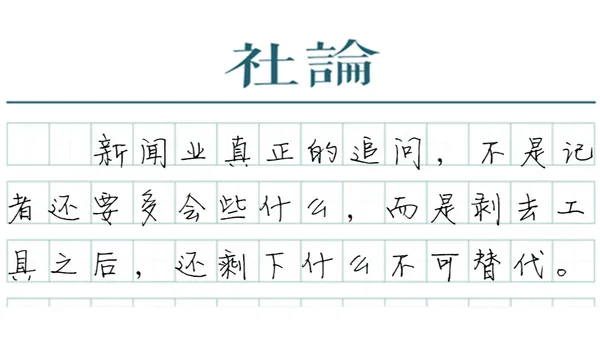
【记者节献词】功夫在诗外


被年轻人遗忘的磁带,正在 AI 时代闷声发大财

马斯克再抛惊人目标:明年SpaceX年化收入5000亿美元、星链计算机同步上天,Terafab芯片产能瞄准一太瓦

下周重磅日程:中美CPI、俄美乌三方会谈、CoreWeave财报与Anthropic路演


Law Firms Have Malpractice Insurance. Should Their A.I. Agents? - The New York Times



Ant Ling introduces Ling-3.2-flash: 560B/25B native multimodal MoE with 1M context [N]
 | Ant Ling has released Ling-3.2-flash, a native multimodal MoE with 560B total parameters, 25B activated parameters and a maximum 1M-token context window. The official documentation specifies text, image and video inputs. The release evaluation reports: MathVision(w/CI): 96.80 Humanity's Last Exam-MM: 30.12 ZEROBench / ZEROBench(Sub): 18.00 / 43.71 BabyVision: 69.85 OmniDocBench 1.5: 92.21 CharXiv_RQ: 85.15 GDP.pdf: 22.25 MedXpertQA-MM: 79.93 Vision2Web: 85.86 AndroidWorld: 85.63 BlenderBench: 67.77 AntBench-Medical is reported separately as 89.52% comprehensiveness and 99.22% correctness. HLE-MM uses the multimodal subset; full ZEROBench and its Sub result are separate entries. The chart identifies API-collected comparison results under the official evaluation settings. The release materials also demonstrate PDF-to-code implementation, GUI operation, 3D reconstruction workflows and multi-agent collaboration. Both OpenAl-compatible and Anthropic-compatible API access are documented. [link] [comments] |
The most scathing reviewer 2 review I have ever read
This is not my paper. Not my review either.
Official Review of Submission21893 by Reviewer Xz8e
Paper Summary:
The paper tries to learn correlations among components of each latent state in a world model to propagate the reward sensitivities to adaptively weight the uncertainties that most matter for long-horizon planning via a pessimistic objective.
Presentation: 1: Difficult to follow despite careful reading.
Informativeness: 1: I learned little or nothing new from this paper.
Soundness: 1: I have significant concerns about the paper’s soundness that do not appear easy to address.
Critical Strengths:
None
Critical Weaknesses:
First and foremost, the paper is highly likely to be fully AI-generated. The authors demonstrate a lack of technical accuracy and depth. They fail to communicate their ideas clearly and accurately. The paper makes few original contributions. See evidence below.
Neologistic and full of jagons that add little value of presenting research gaps, methodologies, and their contributions. I don’t believe authors even understand those terms before stitching them together.
Abstract is poorly written. This is not intended to communicate efficiently with readers. This is to create barriers in understanding their work. From the second sentence, “a scalar uncertainty”, “sparse latent dynamics” come out of nowhere and don’t know what they are referring to. And so many such examples follow thereafter: “factor-level residual bounds”, “retains initialization error”, “expected-error control”, “exact certificate”, “removing error-propagating dependencies and introducing approximation bias”, “localized mechanism-shift”, “comparator-dependent regret bound under simultaneous validity”, “a decision-relevant uncertainty bound”. And showcase experimental results without stating tasks?
Introduction is also disconnected, poorly motivated, fragmented. From the first paragraph “which model errors matter for a long-horizon decision, especially after an environmental mechanism changes?”, what is “environmental mechanism changes” here? Is it handling non-stationary environments, or continual learning tasks? Why brings something out of vacuum? Then the second paragraph pumps out “a global Lipschitz constant”, and reiterate what so-called “sparsity” And then jumps to uncertainty with a set of new terms “A small predicted covariance”, “Marginal calibration”, “a high-probability interval” and close by “Exploration should reduce uncertainty about mechanisms that affect decisions, rather than maximize uncertainty indiscriminately.”: okay, what uncertainty are you focusing on? epistemic or aleatoric? Methods and contributions are also vague and lack clarity.
Method section is horrible.
What do you mean by “a sufficient latent state”? An approximate model can hardly find sufficient statistics.
In the Gaussian transition model, what is z_t^(pa_e(i))?
What is the difference between z_(t+1)^i and ẑ_(t+1)^i, is the latter deterministic and why so?
What is “nominal imagination”? Where does “sparsity” come from and what is “a within-time DAG”? What is “nominal systems”? What is feedback policy? What problem setting are you looking at? Where does the “recurrent state” come from the encoder? What is mechanism i?
What is the motivation of introducing the adjacency matrix? If you intend to learn the dependency between different subcomponents of the latent state, use one sentence is enough.
And several notations are conflating, like parameter posterior q(θ|D) with the state posterior. The training objective is not motivated.
Experiments are not scientific. No random seeds reported, no task descriptions, no metrics explanations.
This paper is an affront to scientific research and reviewers’ time.
Questions For Authors:
None
Flag For Ethics Review: No
Rating: 1: Clear rejection
Confidence: 4: I have substantial direct research experience on this topic.
[link] [comments]
Instagram Edits for Desktop
Instagram's free desktop video editor with AI agents