
AI热情叠加中东局势缓和预期,纳指四连涨新高,美金融股下挫,原油五连跌,黄金走V
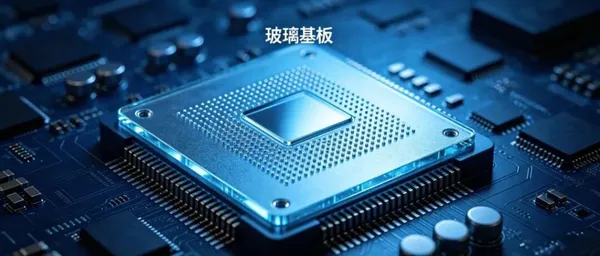
玻璃基板加速起风:英伟达正式入局,巨头竞赛谁能抢占先机?

GTR: Gated Token Recurrence for Efficient Dense Prediction
Accelerating the Mitigation of LLM Inference Nondeterminism Across GPU Architectures
Small Language Models are the Future of Agentic AI
Hill Sampling for Test-Time Scaling: A Simple and Better Alternative to Repeated Sampling, Evolution, and Training
CliffCompaction: Cost-Efficient Compaction for Long-Horizon Coding Agents

‘We believe in college’: inside Andreessen Horowitz’s $42m unaccredited academy that will charge Harvard prices without degrees
For elite students, college has never looked like a worse deal. Tuition is nearly half a million dollars, AI is threatening to destroy the entry-level jobs a degree used to guarantee, and now in the hottest industry—tech—it’s cool to skip school entirely. So on Tuesday, Andreessen Horowitz became the first venture capital firm to sell an alternative.
“The bet is that there’s an opportunity to educate the next generation in a way that is more future-forward, and that’s a big market opportunity,” Gagan Biyani, a cofounder of $3.2 billion ed-tech unicorn Udemy who is now running the new Horowitz Andreessen Academy, told Fortune. Higher education, he noted, is a $2 trillion industry. “We think there are lots of ways to turn this into a successful business.”
The Academy is putting $42 million from a16z and a group of individual investors into the one-year San Francisco-based program. It is a separate for-profit company from the VC firm. It is not accredited, will award no degree, will not take federal student aid, and does not guarantee a job or a paid internship. The founding class will be about 50 students starting Sept. 2027, and it’s tuition-free—plus every student will get $50,000 in compute credits and a $5,000 travel budget.
The Academy then intends to seek regulatory approval for a two-year program starting in 2028. If approved, Biyani said, it expects “to charge something similar to elite private universities”—in the range of $60,000 to $90,000 a year.
Biyani insisted that the school isn’t a rejection of the premise of higher education—”we believe in college,” he said. Instead, it’s rejecting the idea that 18-year-olds in SF are only valuable insofar as they have a startup idea to dedicate a decade to. Indeed, they are looking to find the best and the brightest high schoolers—call them pre-idea founders.
The Academy’s homepage promises students will learn from the people “shaping the future,” with a campus “buzzing” from visits from Sam Altman, Jensen Huang, Satya Nadella, Mira Murati, Fei-Fei Li and Travis Kalanick. Most of those names, Biyani said, are guest speakers who “come in for a talk or a fireside chat.”
A second tier, the faculty, has committed to teaching multi-session courses; Biyani said Instacart co-founder Max Mullen are former Windows president Steven Sinofsky are two who have agreed. A third tier, mentors, will hold office hours. The course list cited in a blog post lists “The Craft of Selling” to “AI Inference Engineering” to “Origins and Innovations in Digital Computing 1940–2025.”
Yet teaching, in any case, “is not the primary thing we plan on doing,” Biyani said. “The primary thing we’re offering is the ability for students to pursue their own objectives.” The year is split three ways: September through April on campus in San Francisco, May travelling abroad, and June through August spent in a “co-op” at a partner company.
That’s where the 10 founding partners come in, mostly from A16Z’s vast network—Anduril, Anthropic, Coinbase, Google, Meta, Nvidia, OpenAI, Palantir, Replit and Stripe. Their commitments “vary,” Biyani said. “Not all of them are going to take students for hiring.”
Rather, some are providing compute, hardware credits or advice on curriculum; another 50-odd hiring partners, from Databricks to Boom Supersonic, “are not committed to hiring a certain number, but they’re committed to interviewing or considering our students.” Co-ops are “typically” paid, the school’s FAQ says, but not guaranteed to be.
There is no minimum age and all students have to arrange their own housing. The sample applicants that the site features includes a teenager who built an AI book indexer with “six-figure ARR” and one who “created an AI dating coach with 1.7M likes.” Admissions, Biyani said, is “proof of work,” though transcripts and test scores are still required.
Future of higher ed? Experts aren’t sure
So is this the future of education? Experts are skeptical. Bryan Caplan, the economist at the famously libertarian George Mason University, who wrote a book arguing that college is mostly just a credential, thinks it will work—for the first 50 students. But “something that can work for 50 handpicked people isn’t going to work even for the top 5,000,” he said. “MIT is going to last for centuries. Don’t worry about it.”
The idea of the Academy, Caplan said, is that skipping college generally signals that “you’re a weird person, and people are understandably nervous about hiring weird people,” he told Fortune. The Academy’s selection is severe enough that the prestige overcomes the weirdness- but only insofar as they keep it elite.
Ryan Craig, a managing director at Achieve Partners, which builds apprenticeship programs, is excited about the idea but isn’t sure their model makes sense on year two, when it attempts to become a school. “It’s a bootcamp with a plan to be a college, but I’d say not a realistic plan to be a college,” he told Fortune. Legions of “alternative, innovative universities” charging elite-private tuition without federal aid have been tried before, and failed. “It’s hard to compete with free money from the government,” he said.
The idea that Craig was enthusiastic about was a 21st-century work college, where students earn enough in the paid co-ops to cover tuition. But that requires the partners to actually pay high school students near six-figure salaries.
Biyani said the school will figure that out after year one. “We will see over time how students will finance this,” he said.
This story was originally featured on Fortune.com

Why Apple could soon join Nvidia in the exclusive $5 trillion club

Nvidia options are doing something unusual ahead of two catalysts. Here's how one trader is playing it
Higher Quality Small Synthetic Natural Language Text Generation for Interpretability Research
Introduction
Small simple synthetic natural language datasets suitable for end-to-end training of tiny LLMs serve as an important resource for LLM interpretability researchers. Some well know examples include roneneldan/TinyStories, SimpleStories/SimpleStories, and klusai/ds-tf1-en-3m (TinyFabulist). This post solves key problems that degrade the quality of these datasets, while also offering an efficient accessible pipeline that can be run locally on an NVIDIA 5060 Ti (16GB) graphics card. The core problems this post solves, include:
- True Small Vocabulary. The aforementioned datasets attempt to produce a corpus with a small vocabulary, but arguably fall a bit short of that goal. E.g., TinyStories has 49,187 unique words, SimpleStories has 40,567, and TinyFabulist has 41,502.
- Guaranteed minimal word frequencies. In the aforementioned datasets, 15 to 24 percent of the unique words occur less than 2 times, while between around 43 to 54 percent occur less than 8 times. This means that most of the unique words are likely not learnable, and mostly contribute to noise and vocabulary bloat.
- Error free text. The aforementioned datasets, include lots of errors, such as misspelled and mangled words.
- Reliable Name Disambiguation and Stratification. The aforementioned datasets, have various name management issues, ranging from collision with existing words (e.g., May vs may), name bloat, and no control over gender balance, or bias (e.g., certain names may be more likely to co-occur with potentially negative moral concepts).
Methods
This section summarizes the methods. The source code is available here, and the proof of concept dataset Small World 345.6k.
We use using unsloth/gemma-4-26B-A4B-it-qat-GGUF for generation, through a local llama-cpp server, which gets about 250 tokens/second on a NVIDIA 5060 Ti (16GB). The server config is available here.
Small Capped vocabulary
One difficulty we encounter is that the model will tend to keep introducing new relatively rare words, causing the vocabulary to grow large over time, yet most words never end up occurring with enough frequency for their meaning to be learnable.
We address this problem through a feature where, after a certain number of examples have been generated, we begin redoing generations up to a number of times when they come back with new words. Since a new form of an existing word has different implications regarding sufficient statistics, we separately issue retries on new forms of an existing word at a different later point depending on the project configuration. In simpler-world-345.6k, we begin capping new words after 47,232 examples, and new forms after 115,200 examples. The vocabulary at that stage had grown to 8,972 words, and by the end became 8,973 in total (one stubborn word resisted 10+ retries at some point). From 47,232 onward, between rejection from other errors (see following subsections) and from rejecting new words, we had to redo somewhere around 0 to 8 completions per batch of 144, which only marginally reduced overall throughput.
Sufficient Word Statistics
Word distributions in text follow Zipf's law, which in simple terms, means that more common words have a vastly higher frequency than somewhat more rare words. When generating a relatively small text dataset, by default many or most of the words that show up will have a very low frequency. Words that occur only a few times in the whole corpus effectively become noise, and if encountered during interpretability experiments, might become cause for confusion.
We find that in order for each word, even in a relatively small capped vocabulary, to naturally occur a sufficient number of times, the number of examples would need to be extremely large. Thus, with some frequency, we randomly sample a word to integrate into a prompt, with inverse-squared frequency weighting.
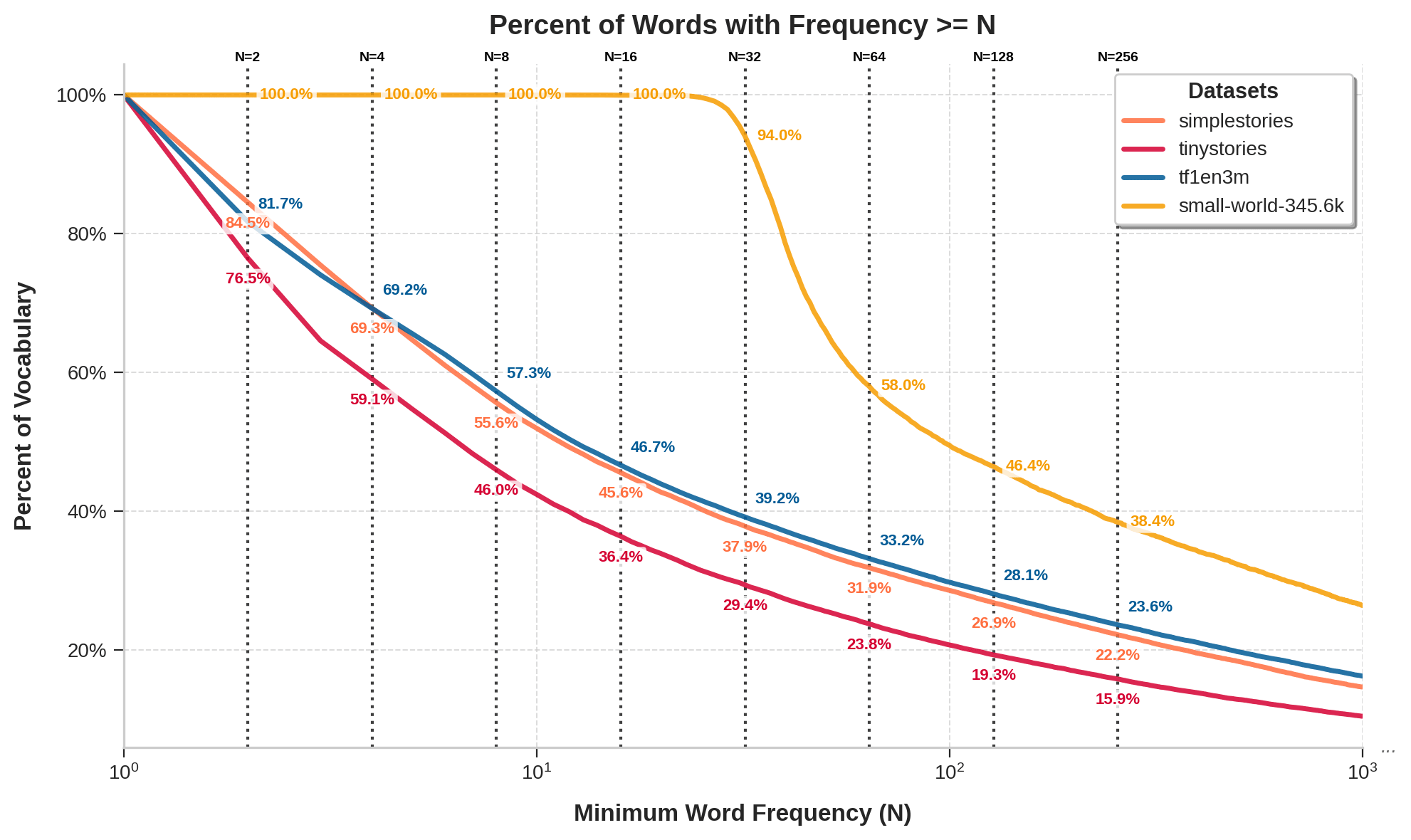
We compare against a few popular datasets meant to have a simple vocabulary, including TinyStories, SimpleStories, and TinyFables. The word statistics are calculated from the train splits after converted to lowercase. With this, TinyStories has 49,187 unique words, SimpleStories has 40,567, TinyFables has 41,502, and Small World 345.6k has 8,873.
The plot below shows the percentage of the corpus words which have a frequency greater than or equal to N, for N up to 1000.
For the other three datasets, between around 15 to 24 percent of the unique words occure less than 2 times, while between around 43 to 54 percent occure less than 8 times. Through capping and boosting, 100 percent of the unique words in Small World 345.6k occure at lea
NVIDIA Isaac ROS 5.0 Advances Agentic, Open Source Robotics Development
To build and deploy sophisticated robotics applications that can perceive, reason and act in dynamic environments, developers need new physical AI models and tools.
The ROS open framework is a project from Open Robotics that helps humans build robots. NVIDIA Isaac ROS 5.0 — a collection of GPU-accelerated packages built on ROS, released today at the ROSCon conference in Toronto, Canada — helps humans and AI agents build robots together.
The release introduces new agentic workflows and platform support to help developers build, customize and deploy robotics applications faster.
ROS provides the open source foundation for much of modern robotics development, giving developers common tools, libraries and standards for building and connecting robot applications.
NVIDIA Isaac ROS brings NVIDIA accelerated computing, physical AI models and production-ready libraries to the nearly 1.3 million ROS users, helping developers build high-performance robotics applications using free, familiar, open source tools.
Bringing AI Agents Into Robotics Development
AI agents are changing how software is built, helping developers automate repetitive tasks, navigate complex codebases and move from ideas to working applications faster. Isaac ROS 5.0 brings these capabilities to robotics development.
Isaac ROS 5.0 introduces support for ROS Lyrical and Ubuntu 24.04, giving developers a path to adopt the latest ROS platform while continuing to accelerate demanding robotics workloads with NVIDIA accelerated computing. NVIDIA worked with the Open Source Robotics Alliance to contribute a standard data-handling interface to ROS Lyrical that helps robotics software work efficiently across different computing hardware, including GPUs.
Available to the entire ROS community, it gives developers a consistent way to accelerate demanding robotics applications, with CUDA providing a working example for GPU acceleration.
New NVIDIA Isaac skills for setup and manipulation provide reusable workflows that developers and AI agents can use to complete robotics development tasks. Agent-ready documentation also makes it easier for AI agents to understand Isaac ROS tools and workflows, turning developer intent into working applications faster.
Some skills go beyond assisting with individual coding tasks. A new FoundationStereo fine-tuning skill enables an AI agent to help adapt a stereo perception model to a developer’s cameras, environment and robotics application, so developers can easily achieve more accurate perception for a given sensor configuration.
FoundationPose, a foundation model for object pose estimation and tracking, now provides an agent-ready inference library that enables robots to perceive and track the position and orientation of objects up to 5.5x faster.
In addition, pick and place — a common workflow that connects detection, depth estimation and pose output — is now available as a standalone, agent-ready skill, providing robot developers more flexibility beyond Isaac ROS.
Accelerating the Open Source Robotics Ecosystem
The robotics ecosystem is already extending this agentic approach to development workflows.
AgenticROS, an open source project sponsored by 3D perception technology company RealSense, connects Isaac ROS with NVIDIA Nemotron open models and NVIDIA NemoClaw blueprints, enabling AI agents to interact with ROS-based robots. RealSense is also optimizing its latest AI-native 3D stereo depth cameras, including RealSense D585 Pro, and an open source software development kit for Isaac ROS and the NVIDIA Jetson Thor edge AI platform, helping developers build perception, navigation and manipulation applications.
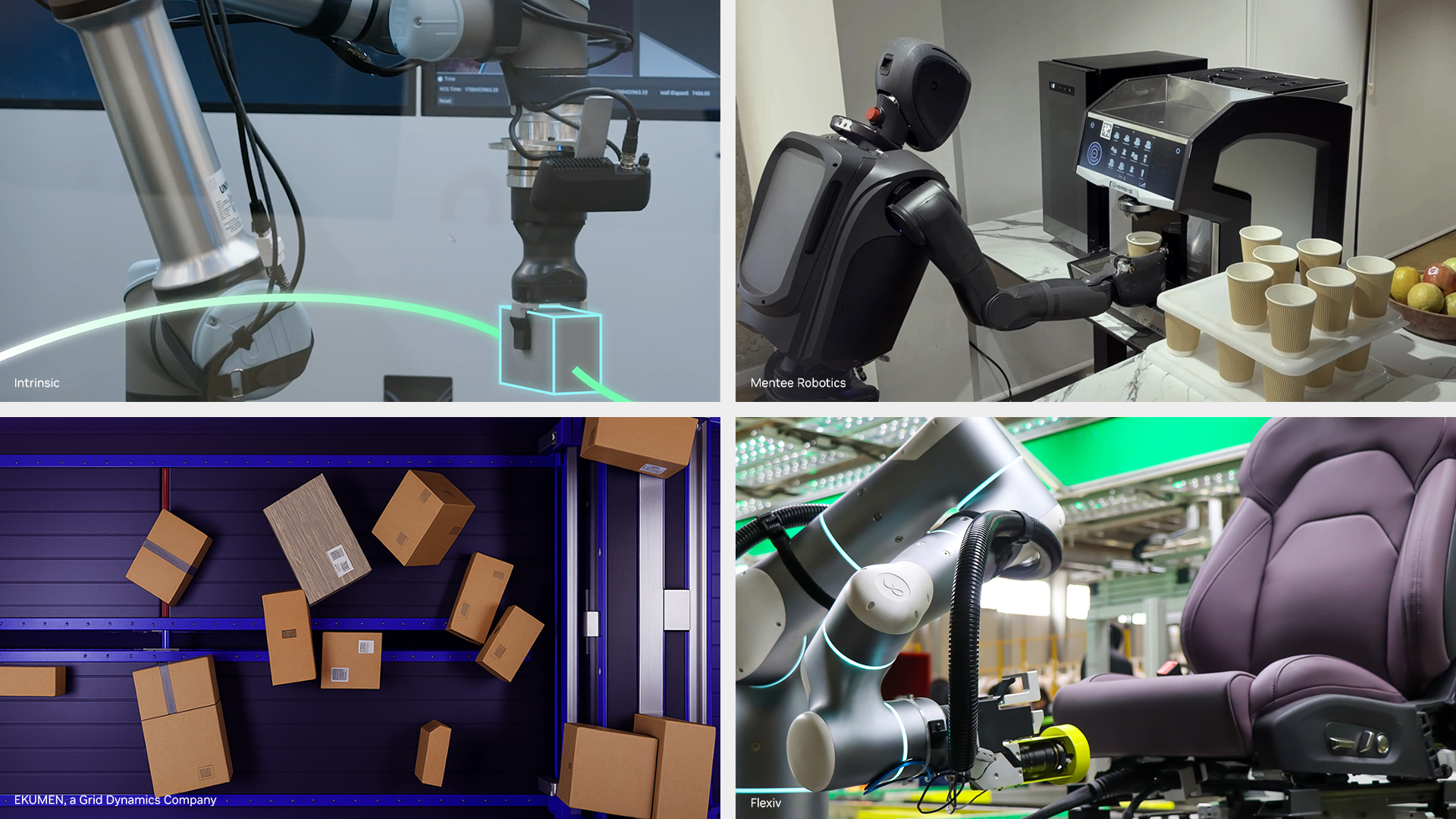
Intrinsic’s Open Machine Tending Solution is a reference application for computer numerical control machine tending, part of the newly released Intrinsic Core, an open source suite of preconfigured runtime services and capabilities designed to accelerate industrial robotics applications. It includes built-in compatibility with NVIDIA FoundationPose for out-of-the-box object registration, tracking and pose estimation. Using the FoundationPose perception pipeline, the solution enables robots to dynamically detect and handle parts while reducing the need for rigid, costly physical fixtures and specialized sys
At AI Day Singapore, NVIDIA and Partners Showcase AI Advancements Across Southeast Asia
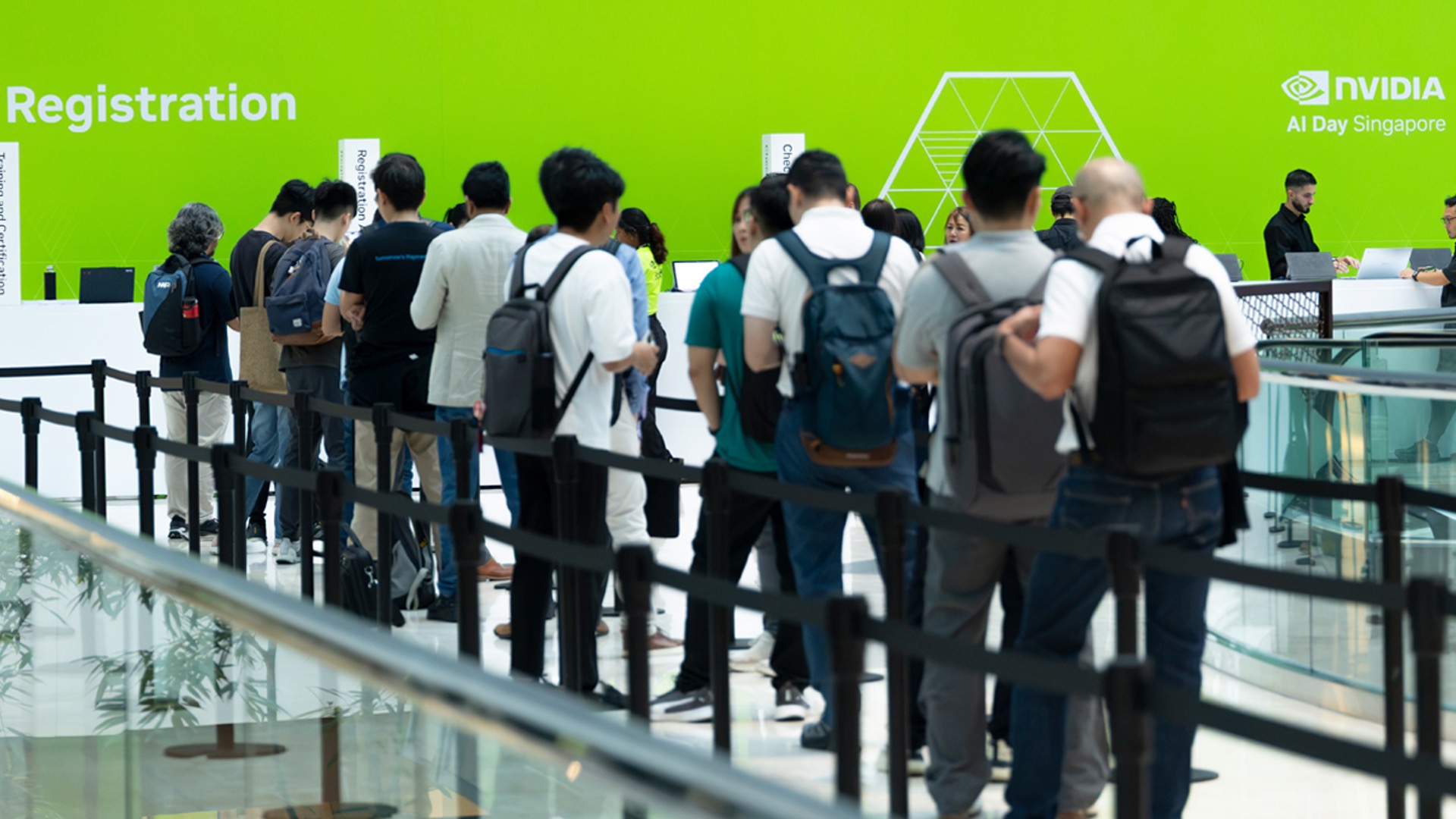
NVIDIA AI Day Singapore, which takes place Sept. 22-23 at the Raffles City Convention Centre, is offering attendees opportunities to explore the hands-on training, expert-led sessions and advanced tools to accelerate their work in AI and high-performance computing.
At the event, NVIDIA and its partners are showcasing breakthrough AI advancements across the Southeast Asia region at large.
Read more about these announcements below.
NVIDIA Accelerates Public Sector AI from Pilot to Production in Southeast Asia 

AI is becoming a matter of national strategy, with governments looking to move from pilots to production and deliver impact at scale, while building trusted AI capabilities that reflect local languages, cultures, priorities and economic needs.
NVIDIA is working to enable all nations to be AI nations — providing the technology, infrastructure, ecosystem and expertise needed to make this possible.
To accelerate this transition across Southeast Asia, NVIDIA is helping nations move AI from experimentation to production-scale deployment through open models, developer tools and a broad partner ecosystem.
Together, NVIDIA and its partners are focusing on four key areas:
- Enhancing government operations and service delivery.
- Developing accessible AI-powered citizen services, and empowering local businesses.
- Strengthening critical infrastructure and public safety.
- Supporting startups, developers and researchers to strengthen national AI capabilities and innovation in each country.
Singapore’s HTX (Home Team Science and Technology Agency) is embarking on research using the NVIDIA Nemotron 3 Super and Nemotron 3 Nano Omni models to advance AI for public safety. Nemotron Super has the potential to support the agency’s complex reasoning and agentic workflows, while Omni’s unified vision, audio and language capabilities could help HTX develop multimodal applications grounded in real-world operational data. Together, the models could strengthen HTX’s ability to deploy secure, locally controlled AI across Singapore’s Home Team.
NCS is advancing agentic AI adoption across enterprises and the public sector, using Nemotron models and the NVIDIA Blueprint for video search and summarization (VSS), while advancing physical AI for practical humanoid robotics applications, to address security, responsiveness and data governance requirements. ST Engineering is using NVIDIA NeMo tools and NVIDIA cuOpt software to develop its AI Studio platform and deploy agentic AI solutions across its businesses such as Marine MRO.
Beyond Singapore, similar work is already underway across the region. Malaysia’s YTL AI Labs is fine-tuning Nemotron models for enterprise and citizen services, while Viettel AI is doing the same for Vietnamese-language applications.
In Thailand, the Big Data Institute and iApp Technology, as members of the ThaiLLM Collaboration, are exploring Nemotron as a foundation model. With an initial focus on legal applications, iApp Technology is adapting Nemotron 3 Nano by fine-tuning OpenThai 2.0 Legal with Thai-language legal data using the NVIDIA NeMo framework.
The model is released as open source for the Thai developer community and serves as the engine for Thanoy, the company’s legal-assistant chatbot, which already serves approximately 43,000 users.
In Brunei, Antrique built an AI innovation platform to help boost productivity across the nation’s food sector.
Across the region, NVIDIA Cosmos open world models and the NVIDIA VSS Blueprint are advancing smart city solution development. Malaysia’s ITMAX uses Cosmos with VSS to improve city traffic operations, while Thailand’s AS-TECH applies the same stack to improve passenger flow in airports.
Learn more about NVIDIA
NVIDIA Introduces SoL-Pi: Auto-Research Loops That Cut Coding Agent Token Traffic by Up to 49%
Coding agents now run for hours, not minutes. Every edit, test run and log read goes back into the model’s context. A team of researchers from NVIDIA, NTU and MIT have released SoL-Pi, a set of 4 efficiency mechanisms for the open-source Pi coding agent. An AI found these mechanisms by running auto-research loops at the harness layer. On the 51-task EdgeBench evaluation, SoL-Pi cuts recorded token traffic by 44.7% to 49.0% versus Pi and cuts API cost by roughly 33%. Its scores stay close to Pi on both GPT-5.6 Sol and Opus 5.
Is it deployable? Yes. SoL-Pi ships on GitHub under NVlabs as an MIT-licensed extension that runs on an unmodified Pi release. It is tested with Pi 0.85.1 and Node.js 22.19 or newer.
Why Target the Harness
Most efficiency work lowers the cost per token through faster kernels, quantization or cheaper models. SoL-Pi instead reduces how many tokens a task consumes. The harness is the layer that handles tool calls, context, observations and delegation.
Tuning a harness by hand is slow, and its parts are coupled: a fix in one place can push cost into later steps. Meta-Harness and similar systems automate this work. However, a recent study found that evolved harnesses can overfit their search tasks and give only marginal gains on unseen ones.
How the Search Works
A research AI observes execution traces from a separate agent running base Pi. It then proposes harness changes and tests them. The search covered:
- 152 proposed directions across 6 families: context, progress, tools, delegation, prompt and policy, and improvement and evaluation
- 535 executable environments: 495 built from GitHub issue-pull request pairs and 40 synthetic tasks with executable verifiers
- More than 3,000 runs and 60,000+ agent-environment interactions
Each search is a disposable, isolated loop. It follows the autoresearch cycle, extended with a Ralph Loop implementation step and an independent reviewer.
Acceptance rules are fixed before the search starts, and the optimizer cannot change them. Every capability metric must stay within a predeclared tolerance. The candidate must also improve at least 1 efficiency metric. EdgeBench stays held out. Of its 51 public tasks, 11 are used for one-way acceptance of frozen candidates and 40 for final evaluation. Held-out results never feed back into the search.
The 4 Mechanisms That Survived
- Action Fusion: Base Pi often edits a file and then issues a separate command to test, build or run it. Action Fusion merges both into 1 tool request and returns both outcomes in 1 observation. This removes a model round trip.
- Online Context Compact: Plan steps are tracked through
update_plan. When a step completes, the harness estimates how many requests remain. It then compares the projected input savings with the extra cost of rewriting the prompt cache. It invokes Pi’s native compaction when this gate passes or when context nears the window limit. - ObservationPack: Tool outputs above 10 KiB are archived locally and sent in full for the next 2 provider requests. From the 3rd request onward, the model sees a stable handle, the original size and a short excerpt of head and tail lines. Exact pages stay retrievable through the handle.
- Evidence-Preserving Reducer: Build and test logs of at least 4 KiB go to a cheaper model, GPT-5.6 Luna at
high, which writes a compact receipt. A deterministic verifier checks the receipt’s schema, source hash, exit status, exact quotes and size. The harness falls back to the original log in 3 cases: verification fails, credentials are suspected, or the receipt is not smaller.
Results on EdgeBench
| Backend | Harness | Tokens (B) | API Cost | Avg. Score |
|---|---|---|---|---|
| GPT-5.6 Sol | Codex | 3.05 | $1,787 | 34.7 |
| GPT-5.6 Sol | Pi | 2.15 | $1,339 | 44.8 |
| GPT-5.6 Sol | SoL-Pi [Efficiency] | 1.10 | $894 | 42.0 |
| GPT-5.6 Sol | SoL-Pi [Performance] | 2.02 | $1,271 | 47.2 |
| Opus 5 | Claude Code | 2.00 | $2,535 | 43.7 |
| Opus 5 | Pi | 2.37 | $1,741 | 44.8 |
| Opus 5 | SoL-Pi [Efficiency] | 1.31 | $1,158 | 42.2 |
| Opus 5 | SoL-Pi [Performance] | 2.10 | $1,605 | 50.5 |
The full stack was built on GPT-5.6 Sol and moved to Opus 5 without further search. On Opus 5, it keeps 94.3% of Pi’s score while cutting token traffic by 44.7% and API cost by 33.5%. On GPT-5.6 Sol, it keeps 93.7% of Pi’s score with 49.0% fewer tokens and 33.2% lower cost.
The Performance point uses the best single mechanism for each backend: ObservationPack on GPT-5.6 Sol and Action Fusion on Opus 5. It lifts scores 5.3% and 12.8% above Pi.
On GPT-5.6 Sol, the full stack increases cache-write traffic from 0.0141 B to 0.0316 B tokens. Total cost still falls, from $1,339 to $894. The paper estimates hourly savings of $8.75 to $13.50 versus the native Codex and Claude Code harnesses, and $4.36 to $5.71 versus Pi.
Beyond EdgeBench
- Terminal-Bench 4 (63 CPU-only tasks): SoL-Pi solves 15 tasks versus 18 for both Codex and Pi. It lowers total cost by 26.3% versus Pi ($211.12 vs $286.45).
- IMO 2026, Lean 4-verified: SoL-Pi passes 3 of 6 problems, matching Pi, at the lowest cost per passed problem ($20.90). Codex passes 5.
- Agent swarm: A Codex coordinator with 20 SoL-Pi workers reaches 1,127 cycles at $60.11. With 20 Pi workers, it reaches 1,366 cycles at $82.12. A single Codex agent is still the cheapest option at $39.20 and reaches 1,333 cycles.
The research team calls the cross-model transfer preliminary. The mechanisms trigger less often on Opus 5, possibly because the search used only GPT-5.6 Sol trajectories.
Key Takeaways
- SoL-Pi cuts EdgeBench token traffic by 44.7% to 49.0% versus
Edge Computing, The Rise of Decentralized Models, and More
One Unifying Trend: AI Is Fragmenting From Centralized Clouds to Edge‑Centric, Locally‑Controlled Systems
Across the day’s headlines—from speculative decoding research to Asian firms releasing “Mythos‑like” models, from Ford’s AI‑driven quality fiasco to open‑source routing tools—the common thread is a clear shift away from monolithic, cloud‑only AI deployments. Companies, governments, and developers are building or demanding ways to run large‑scale models locally, on‑prem, or in regional data centers to sidestep regulation, cut latency, and regain reliability.
Why This Matters
Running inference at the edge reduces exposure to export bans, data‑privacy mandates, and single‑point‑of‑failure outages. It also re‑opens the economics of AI: hardware vendors can sell accelerators, startups can monetize niche models without cloud fees, and enterprises can avoid costly AI‑related recalls.
Technical Edge‑Optimizations Fueling the Shift
- Speculative decoding (DSpark) – DeepSpec’s full‑stack codebase shows how speculative decoding can cut LLM latency by up to 2× without extra hardware, making on‑device inference viable.
- Deterministic routing (Wayfinder Router) – The CLI tool lets developers route prompts between local and hosted models based on complexity, ensuring that cheap local models handle routine queries while only the most demanding calls hit expensive clouds.
- Linux PSI‑based KV cache trimming (KV‑psi) – By leveraging Pressure Stall Information to prune LLM caches under memory pressure, developers can squeeze larger models onto edge devices like Jetson Orin, extending the reach of generative AI to robotics and IoT.
- AI‑designed RFIC chips – Princeton’s diffusion‑driven chip design (IEEE Spectrum) demonstrates that AI can accelerate hardware creation, lowering the barrier for edge‑centric wireless solutions needed for 5G, autonomous vehicles, and satellite links.
Geopolitical & Regulatory Forces Accelerating Decentralization
The U.S. export ban on Anthropic’s Mythos and Fable models has created a vacuum that Asian startups are eager to fill. 360’s Tulongfeng and Sakana AI’s Fugu both claim “frontier capability without export‑control risk,” positioning themselves as the go‑to providers for non‑U.S. customers.
Anthropic’s accusation that Alibaba used 25 000 accounts to mine Claude (Ars Technica) underscores how state‑backed actors are willing to bypass restrictions, further incentivizing locally‑hosted alternatives.
Meanwhile, The Algorithmic Bridge argues that U.S. government control is reshaping the entire AI ecosystem, effectively “killing” the previous model of globally shared, cloud‑first AI services.
Enterprise Reliability & Ethical Backlash
Ford’s costly AI‑driven quality‑control experiment (The Independent) illustrates the operational risk of over‑relying on centralized AI without human expertise. Re‑hiring veteran engineers restored quality, proving that hybrid models—human plus edge‑deployed AI—remain essential.
On the ethical front, Hasbro’s Peppa Pig voice‑cloning clause (Gadget Review) sparked nearly 1 000 objections, highlighting the need for clear ownership and governance when AI reproduces personal data. Decentralized deployment can help enforce regional privacy rules, but it also complicates enforcement.
Who Wins, Who Loses
- Winners: Asian AI startups, edge‑hardware vendors, open‑source communities, enterprises that need low‑latency, compliant AI, and developers who can monetize locally‑hosted models.
- Losers: U.S. cloud‑centric AI giants losing market share, large‑scale data‑center providers facing reduced demand, and workers displaced by premature AI automation (as Ford’s case shows).
What Changes Next
Expect a rapid proliferation of open‑source inference stacks that combine speculative decoding, deterministic routing, and memory‑aware cache management. Parallelly, regional regulatory bodies will likely codify “AI‑localization” requirements, prompting more startups to ship models pre‑trained for specific jurisdictions. Enterprises will adopt hybrid pipelines: edge inference for routine tasks, cloud for rare, compute‑heavy queries, all under tighter human oversight.
Understanding GLiFormer’s Benchmarks and Schema-Driven Extraction
Overview
gliformer-large-v1 is a 575.6-million-parameter, Apache-2.0 model from knowledgator for schema-driven information extraction and text representation. It uses a shared DeBERTa encoder with task heads for named entity recognition, classification, joint relation extraction, structured records, and text embeddings. Its layout-aware architecture supports text and document-layout inputs, including PDF-oriented processing, but the published examples and evaluation results focus on English text rather than visual document understanding. You run it through the gliformer Python library or the GLiFormer source framework in Python 3.10 or newer. The most important consideration is its breadth: one checkpoint accepts labels and schemas at inference time, but its quality varies by task and dataset. Reported mean strict entity F1 is 50.91 across 26 NER datasets, mean macro-F1 is 75.03 across 13 classification datasets, joint relation extraction is weak on several benchmarks, and the strong 91.10 structuring score uses order-free, boundary-tolerant JSON evaluation rather than exact JSON matching. No context window, maximum sequence length, training-step count, VRAM requirement, inference latency, or checkpoint-specific training dataset is provided.
Best use cases
Schema-driven entity extraction from English text. Use the model when entity types vary by project and you want to provide labels at inference time instead of training a separate fixed-label NER model. For example, extract person, organization, and location from "Alice works at Acme in London." and receive each entity’s text, label, character offsets, and score. The shared DeBERTa encoder and task-conditioned interface support custom entity labels, but benchmark results show substantial variation: strict F1 reaches 80.16 on WikiNeural and 71.48 on CrossNER politics, while it falls to 13.81 on HarveyNER and 21.99 on FabNER.
Text classification with custom candidate classes. Use classify for jobs such as assigning support tickets to product or support, detecting sentiment, or routing documents among business categories. The model accepts candidate labels at inference time and supports named groups such as separate sentiment and topic label sets. It performs well on some conventional datasets, including 97.95 macro-F1 on Enron spam, 96.77 on Financial Phrasebank, 93.93 on IMDB, and 92.97 on SST-2, but performance is much lower on SST-5 at 40.33, Emotion at 48.07, and the SOTU dataset at 49.00.
Structured record extraction from semi-structured prose. Use structure when the output must contain fields and parent-child relationships, such as converting company descriptions into nested companies, departments, and employees. The decoder can produce Python dictionaries from simple field lists or nested Pydantic schemas. The reported multilevel structuring score is 91.10 on 500 examples, with scores from 89.94 at JSON depth 3 to 95.11 at depth 4. Treat this as source-grounded extraction, not factual verification: Pydantic validation checks shape and types, not whether extracted values are correct.
Joint relation extraction with a closed schema. Use inference with joint_relations when you need entities and relations in one configured task, such as extracting (Alice, works_at, Acme). This checkpoint has a joint relation head, so the schema must provide entity and relation labels together. It is not a strong choice for high-recall relation mining: reported micro-F1 is 12.78 on DocRED, 12.61 on CrossRE, 24.08 on FewRel, and 35.83 on zero-shot CoNLL04.
Embedding short text for similarity workflows. embed_text returns 1,024-dimensional vectors that you can compare with cosine similarity. This fits semantic search prototypes, duplicate detection, clustering, and retrieval features where a single local encoder is useful alongside extraction tasks. The provided material does not include embedding benchmark scores, so validate retrieval quality on your own corpus before selecting it for production search.
Limitations
The model does not provide a guaranteed extraction of every fact. NER can omit mentions, select incorrect spans, or assign incorrect labels. Its strict NER score requires both span and type to match, and the dataset results range from 13.81 to 80.16 F1. Labels, schema wording, domain, input length, and thresholds affect predictions.
Relation extraction is a major weakness in the published results. The reported runs use predicted entities, and the scores are not controlled comparisons between the base and large releases because they use different-sized subsets. The model also lacks an open relation head: the convenience method predict_relations requires one, so this checkpoint should use joint_relations instead.
Structured extraction can attach records to the wrong parent, omit fields, or produce incorrect values. Its 91.10 score is not exact JSON match. Evaluation flattens JSON value paths, aligns records without requiring original order, and permits limited boundary repairs. Fixed record anchors and configured span width constrain extraction capacity.
The layout-aware design supports text and document-layout inputs, but the supplied quality evidence does not establish performance on PDFs, other document layouts, or visual inputs. The checkpoint has no dedicated vision or audio capability. Results cover English tasks; quality for other languages is not established. The NER transfer groups also do not prove that every evaluated domain was absent from training.
The model is large at 575.6M parameters. The documentation provides no VRAM minimum, latency, throughput, maximum context length, or practical batch-size guidance beyond the NER example using batch_size=8. CUDA attention kernels are optional; CPU inference uses eager attention. You should benchmark memory and latency on your target hardware.
The Apache-2.0 license permits commercial use subject to the license terms. The provided material does not document additional dataset-specific restrictions, warranty terms, or safety evaluations. It also does not state whether the checkpoint is actively maintained.
How it compares
gliner-x-large
Choose gliformer-large-v1 over gliner-x-large when you need one interface for NER, classification, joint relations, structured records, and embeddings, or when nested record extraction matters. Choose GLiNER X-Large when the primary requirement is flexible zero-shot NER and you want a model positioned as a practical alternative to fixed-label NER systems and larger language models. The supplied information does not provide matched parameter counts, latency, cost, or benchmark scores, so it does not support a numeric quality or speed ranking between them.
modern-gliner-bi-large-v1.0
Choose gliformer-large-v1 when multi-task extraction, classification, relation extraction, structured records, and embeddings must share one checkpoint. Choose modern-gliner-bi-large-v1.0 for NER workl

Deals: Nothing Headphone (a) 30% off, Google Pixel 10a from under $400, up to $1,000 off NVIDIA RTX 50 PCs, more
Today’s 9to5Toys Lunch Break is headlined by Nothing’s 2026 Headphone (a) now at 30% off via Amazon (one of the best prices yet), alongside the ongoing return lows on Nothing Ear (3a). You can also score Google Pixel 10a from under $400 today, and the lowest prices to date on the latest Pixelsnap cases. Walmart’s 2026 GeForce Week sale is now live with up to $1,000 off NVIDIA RTX 50-series laptops, gaming PCs, and more from $99, we have even more early fall Prime Day deals landing at Amazon this week, and you can scope out the ongoing Googlebook pre-order deals right here. Head below for a closer look.
more…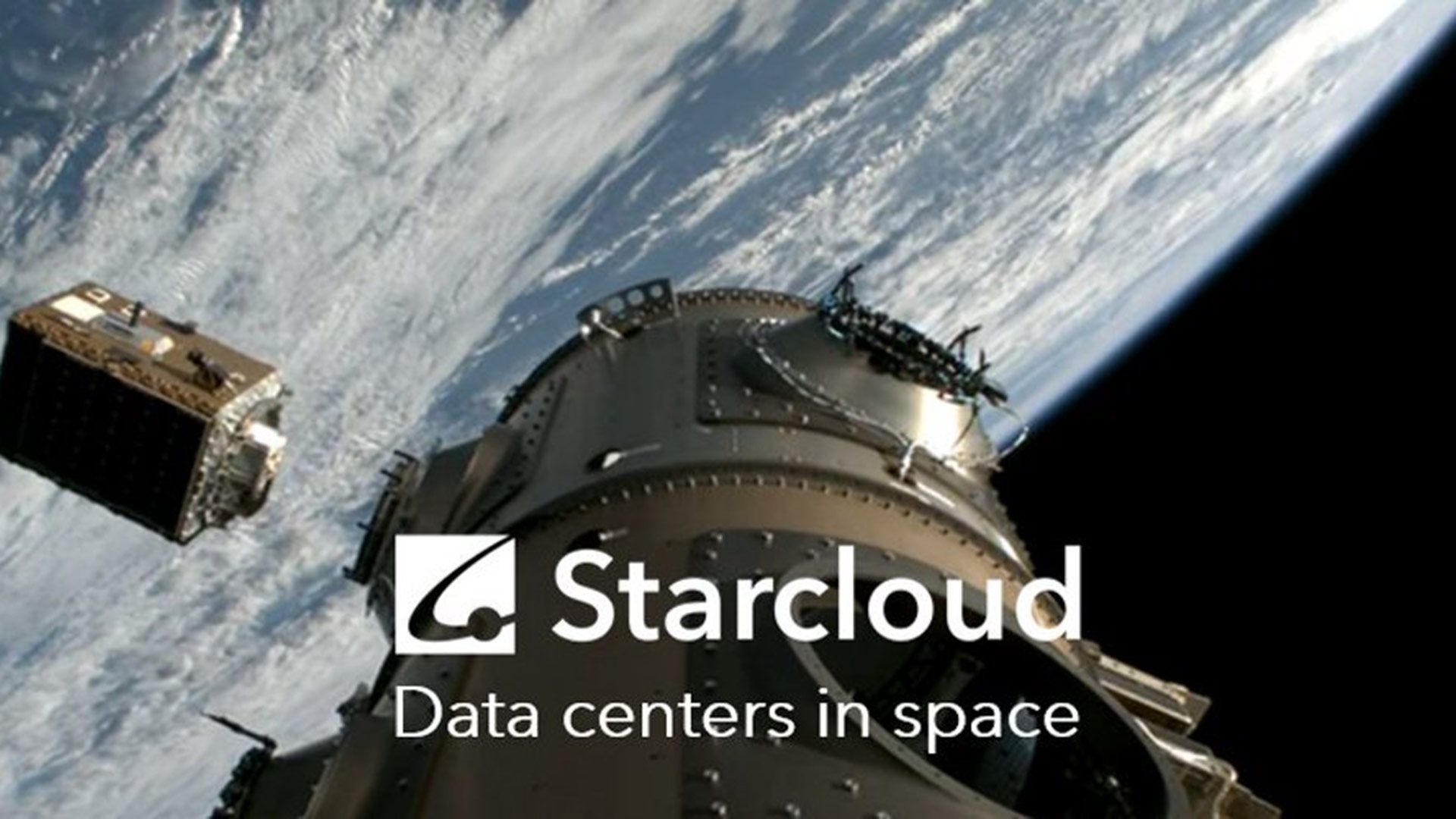
‘We’ll be the first to mine Bitcoin in space’ says Nvidia-backed startup