
🤖 AI 资讯

每日 05:00 更新 · 09-23 · 主站 liuch.name ↗
全部标签 →
筛选标签:开源 · 返回个性化推荐 · 清空筛选

AI“减速”讨论未歇,OpenAI、Anthropic同日上新,竞逐更低成本

澎湃新闻
· 大模型,AI应用,开源,融资,政策监管,OpenAI,Anthropic,xAI,代码生成,Agent智能体,推理思考,模型评测,提示工程,模型安全对齐,招聘HR,模型发布,合作,榜单评测,开发者生态

同日推出"廉价模型",OpenAI和Anthropic开打"价格战"

华尔街见闻Anthropic推出Claude Opus 5.5,成本较前代降低40%;OpenAI发布Sol和Luna,定价较上一系列低50%。降价的背后推手是中国开放权重模型持续抢占市场份额。以及Anthropic同时借此为史上最大科技IPO铺路,OpenAI则意在扭转年初增长颓势。
· 大模型,开源,融资,OpenAI,Anthropic,招聘HR,模型发布
AI 资讯

「开源版Jev」登上Hugging Face热榜第一

新浪科技
2026-09-23T07:22:02+08:00 · 开源

GitHub Actions leaking secrets when Miri output is cached

Lobsters

Comments

· 算力芯片,开源,Google,招聘HR

Arguing about arguments

Lobsters

Comments

2026-09-21T00:00:00.000Z · 大模型,算力芯片,AI应用,开源,Anthropic,Agent智能体,推理思考,扩散模型,强化学习,招聘HR,开发者生态
AI 资讯

QontoFAQ: A better Information Retrieval Benchmark [R]

Reddit r/MachineLearning

Retrieval benchmarks sometimes feel benchmaxxed by models, so we wanted to find a way to tie it as close as possible to my objective: finding the article that answers a product question right.

We worked on a new metric which seems more proportional to document relevance, and built up a benchmarking dataset to measure embedding models.

Here is an article on the approach: https://medium.com/qonto-way/qontofaq-benchmarking-information-retrieval-acd89600ebe1

and the associated code: https://github.com/qonto/qonto-faq-benchmark

submitted by /u/espadrine
[link] [comments]
2026-09-22 13:45:18 · 开源,扩散模型,模型评测,向量数据库,招聘HR,网络安全
AI 资讯

LinearSolveBench: new benchmark for linear solvers [P]

Reddit r/MachineLearning

LinearSolverBench measures the ability of a model or harness to write fast, accurate, and general numerical solvers for large sparse linear systems in C.

The goal is to encourage algorithmic advances in numerical methods for solving linear systems of equations.

https://github.com/hgarud/LinearSolveBench

submitted by /u/hgarud
[link] [comments]
2026-09-22 15:34:58 · AI应用,开源,搜索RAG,扩散模型,模型评测,招聘HR

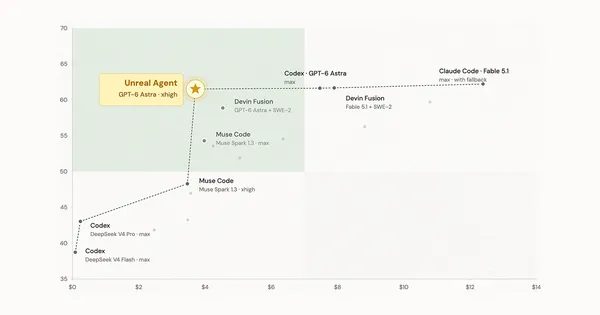
Unreal Agent

Hacker NewsComments
· 大模型,算力芯片,AI应用,开源,OpenAI,Google,Anthropic,代码生成,Agent智能体,强化学习,模型评测,提示工程,端侧AI,招聘HR,开发者生态

Obscura: VPN that can't log your activity

Hacker NewsComments
· AI应用,开源,搜索RAG,扩散模型,强化学习,招聘HR,榜单评测
AI 资讯

Microsoft killed FoxPro in 2007. Anyway, here's FoxPro revived

Hacker NewsComments
· AI应用,开源,Microsoft,代码生成,扩散模型,招聘HR,榜单评测,开发者生态
AI 资讯

CAffNet: Hard Constraint-Affine Neural Networks

arXiv cs.LGarXiv:2605.24437v2 Announce Type: replace Abstract: We present a novel framework for embedding hard constraint satisfaction into neural network (NN) architectures, specifically feedforward neural networks and transformers, with input-dependent affine constraints of arbitrary cardinality. Traditional constraint enforcement approaches either rely on penalty-based soft constraints, which offer no guarantee of satisfaction, or on post-processing methods that enforce constraints after the NN is trained, which may lead to suboptimality. We introduce a trainable constraint-affine (CAffine) layer into NNs, yielding CAffNet, which goes beyond enforcing affine constraints via fixed orthogonal or parallel projections and enables joint optimization with network parameters. Moreover, we impose no restrictions on the constraint space dimensions and establish that our construction preserves the universal approximation properties of NNs, while providing provable guarantees on constraint adherence for all inputs. Experimental validation demonstrates robust performance across diverse domains requiring guaranteed constraint satisfaction. The code is available at https://github.com/ice-t-lab/CAffNet.git.
2026-09-23 04:00:00 · 开源,Transformer,扩散模型,向量数据库,端侧AI,论文
AI 资讯

Agent0: Unleashing Self-Evolving Agents from Zero Data via Tool-Integrated Reasoning

arXiv cs.LGarXiv:2511.16043v2 Announce Type: replace Abstract: Large Language Model (LLM) Agents, often trained with Reinforcement Learning (RL), are constrained by a dependency on human-curated data, limiting scalability and tethering AI to human knowledge. Existing self-evolution frameworks offer an alternative but are typically restricted by the model's inherent capabilities and single-round interactions, hindering the development of complex curricula involving tool use or dynamic reasoning. We introduce Agent0, a fully autonomous framework that evolves high-performing agents without external data through multi-step co-evolution and seamless tool integration. Agent0 establishes a symbiotic competition between two agents initialized from the same base LLM: a curriculum agent that proposes increasingly challenging frontier tasks, and an executor agent that learns to solve them. We integrate external tools to enhance the executor's problem-solving capacity; this improvement, in turn, pressures the curriculum agent to construct more complex, tool-aware tasks. Through this iterative process, Agent0 establishes a self-reinforcing cycle that continuously produces high-quality curricula. Empirically, Agent0 substantially boosts reasoning capabilities, improving the Qwen3-8B-Base model by 18% on mathematical reasoning and 24% on general reasoning benchmarks. Code is available at https://github.com/aiming-lab/Agent0.
2026-09-23 04:00:00 · 大模型,AI应用,开源,阿里巴巴,Agent智能体,推理思考,强化学习,模型评测,招聘HR,论文
AI 资讯

CID: Measuring Feature Importance Through Counterfactual Distributions

arXiv cs.LGarXiv:2511.15371v3 Announce Type: replace Abstract: Assessing the importance of individual features in Machine Learning is critical to understand the model's decision-making process. While numerous methods exist, the lack of a definitive ground truth for comparison highlights the need for alternative, well-founded measures. This paper introduces a novel post-hoc local feature importance method called Counterfactual Importance Distribution (CID). We generate two sets of positive and negative counterfactuals, model their distributions using Kernel Density Estimation, and rank features based on a distributional dissimilarity measure. This measure, grounded in a rigorous mathematical framework, satisfies key properties required to function as a valid metric. We showcase the effectiveness of our method by comparing with well-established local feature importance explainers. Our method not only offers complementary perspectives to existing approaches, but also improves performance on faithfulness metrics (both for comprehensiveness and sufficiency), resulting in more faithful explanations of the system. These results highlight its potential as a valuable tool for model analysis. Link to repository: https://github.com/EddieConti/CID
2026-09-23 04:00:00 · 开源,招聘HR,论文
AI 资讯

GTR: Gated Token Recurrence for Efficient Dense Prediction

arXiv cs.LGarXiv:2609.26590v1 Announce Type: cross Abstract: Self-attention-based vision backbones perform well on dense prediction, but the quadratic computational cost of global softmax attention limits their efficiency as image resolution increases. We introduce Gated Token Recurrence (GTR), a softmax-free recurrent vision backbone that combines gated linear attention, alternating spatial scan directions, and spatially enhanced SwiGLU blocks. GTR is distilled from a detection-specialized DINOv3 teacher using only final-layer patch-token alignment through a linear projection and squared $\ell_2$ loss, without masked-token prediction or intermediate-layer supervision. With Objects365 detector pre-training, GTR-L achieves 58.9 box AP on COCO \texttt{val2017} with 1.908\,ms median batch-one latency under compiled FP16 execution on an RTX~4090. The same backbone also transfers to instance segmentation, pose estimation, oriented detection, semantic segmentation, and monocular depth estimation. In an isolated kernel benchmark, our specialized chunkwise CUDA operator is $4.0\times$ faster than FLA v0.5.0 at 1.6K tokens on RTX~4090. TensorRT deployment on DRIVE AGX Thor achieves 2.282--8.769\,ms median batch-one latency across the evaluated models. These results show that recurrent token mixing can provide an efficient alternative to global softmax attention for high-resolution dense prediction and edge deployment.Project page: https://intellindust-ai-lab.github.io/projects/GTR/
2026-09-23 04:00:00 · 开源,NVIDIA,Transformer,微调蒸馏,模型评测,模型安全对齐,招聘HR,论文
AI 资讯

SAM-V: Geometry-Aware Segment Anything for Multi-View Instance Segmentation

arXiv cs.LGarXiv:2609.25490v1 Announce Type: cross Abstract: Consistent multi-view object segmentation is critical for 3D perception and robotics, yet remains challenging under severe viewpoint and occlusion changes. Existing methods typically perform 3D instance segmentation on point clouds or rely on offline 2D mask-matching pipelines. However, 3D instance segmentation is limited by scarce 3D annotations, while offline 2D matching suffers from object identity ambiguity across frames. To leverage strong 2D and 3D priors jointly, we propose SAM-V (Geometry-Aware Segment Anything for Multi-View Instance Segmentation). Instead of combining the two priors through post-hoc matching, SAM-V directly integrates features from a feed-forward geometry model (VGGT) into a 2D segmentation foundation model (SAM), trained end-to-end for cross-view instance prediction. SAM-V introduces a prompt-fusion mechanism that enriches sparse SAM prompt tokens with view-specific camera tokens and local VGGT features, making the prompt representation both view-aware and spatially grounded, together with a mask decoder that attends to dense 2D and 3D features. By conditioning the mask decoding directly on multi-view geometry, SAM-V produces consistent multi-view segmentation of a prompted object in a single forward pass without offline mask matching or explicit 3D reconstruction. On the IGGT 3D tracking benchmark, where consistent instance identity across frames directly determines performance, SAM-V improves overall IoU by 5 points and frame-level recall by 12 points on the ScanNet++ split over the state-of-the-art multi-view instance segmentation baseline and leads on all metrics in the zero-shot ScanNet split. Our code and pretrained models are available at https://github.com/gong208/SAM-V.git.
2026-09-23 04:00:00 · AI应用,具身智能,开源,搜索RAG,扩散模型,预训练,模型评测,提示工程,招聘HR,论文
AI 资讯

SPARC: SuperPixel-Aware Region Contrastive Learning for Self-Supervised Dense Prediction

arXiv cs.LGarXiv:2609.25067v1 Announce Type: cross Abstract: Self-supervised learning (SSL) has become an effective approach for learning visual representations without manual annotations. Among SSL approaches, contrastive learning has been widely used for visual representation learning. However, existing contrastive SSL methods have focused primarily on image-level or pixel-level representation learning, while region-level representation learning remains less explored. We propose SPARC, a region-level contrastive learning framework that leverages superpixels to establish explicit correspondence between augmented image views. SPARC introduces a region contrastive branch that performs superpixel-based feature pooling and optimizes a region-level contrastive objective jointly with a global image-level objective. Under identical settings, SPARC consistently outperforms previous methods such as MoCo-v2 and DenseCL, achieving improvements of up to +9.79 mIoU for semantic segmentation and +4.88 AP for object detection. Ablation studies further demonstrate that region-level objectives produce the strongest performance. Thus, region-level contrastive learning is an effective approach for improving self-supervised visual pretraining for dense prediction tasks. Code repository can be accessed at https://github.com/xRIPEIx/SPARC.
2026-09-23 04:00:00 · AI应用,开源,搜索RAG,预训练,论文
AI 资讯

EquivSVA: A Formally Verified Dataset of Behavioral Assertions Across Equivalent RTL Implementations

arXiv cs.LGarXiv:2609.26751v1 Announce Type: new Abstract: Large language models are increasingly used to generate SystemVerilog Assertions from natural-language specifica- tions and register-transfer-level designs. Existing datasets and benchmarks support important goals such as large- scale training, formal evaluation, specification-to-assertion generation, and mutation-based testing. A complemen- tary need is to study whether a generated assertion cap- tures externally observable behavior or depends on inci- dental details of one RTL implementation. We present EquivSVA, a formally verified dataset organized around behavior families. Each family contains four structurally distinct RTL implementations of the same externally ob- servable behavior, shared interface-level gold properties, three controlled mutants, and formal-validation evidence. EquivSVA contains 120 behavior families across 12 cat- egories, 480 reference RTL implementations, 914 gold properties, and 360 mutants. Every final family passes a fixed 17-job validation suite covering RTL equivalence, gold-property proofs, property reachability, mutant dis- tinguishability, and gold-property checks on mutants. We also provide fixed family-safe train, development, and test splits. As a small demonstration of the analyses en- abled by the dataset, we evaluate the publicly released, Apache-2.0-licensed Qwen2.5-Coder-7B-Instruct model on the held-out test split. Of 293 interface-only generated properties, 93 are formally sound, and the number of sound properties varies across equivalent implementations for 14 of 24 test families. These results illustrate how behavior-family organization can support controlled stud- ies of assertion-generation robustness without requiring changes in intended functionality. The dataset, generators, validation scripts, and case-study artifacts are publicly released at https://github.com/aditigupta96/EquivSVA.
2026-09-23 04:00:00 · 大模型,开源,阿里巴巴,扩散模型,强化学习,模型评测,招聘HR,论文
继续滚动加载更多…