DiRotQ: Rotation-Aware Quantization for 4-bit Diffusion Transformers
SIFR: Stable Signed Flow Reinforcement
Conflux: Preventing Privilege Escalation with Principal Contexts and System-Level Evaluation
AUTEUR: Acoustic Plan Learning for Red-Teaming Text-to-Audio Models

The average worker would need to save for 52 years to claw their way out of the middle class and be classified as wealthy, research reveals
The exact number of years of saving it would take for the average worker to claw out of the middle-class bracket has been revealed—and it’s nearly half a century.
Sobering research released in October 2025 from the think tank Resolution Foundation shows that for aspirational Brits looking to move up the wealth ladder, the average worker would need to save their earnings for 52 years to raise £1.3 million ($1.7 million). That’s the amount needed to move from the middle and become as wealthy as the richest 10%.
And it gets worse: That’s with zero bills being paid.
“Wealth gaps in Britain are now so large that a typical full-time employee saving all their earnings across their entire working life would still not be able to reach the top of the wealth ladder,” wrote Molly Broome, formerly a senior economist at the Resolution Foundation and the lead author of the report.
And for those who happen to be born in the working class, the odds are increasingly stacked against them.
“Wealth mobility in Britain is low. People that start life wealthy tend to stay wealthy, and vice versa,” Broome added.
As the saying goes, money makes money. The report revealed the key driver of widening inequality is the “passive” gains. Essentially, those who bought property and invested their money have seen their wealth balloon since 2010.
Workers in the U.S. would need to save for 70 years to unlock the American Dream
As inflation squeezes workers in a cost-of-living vise, paired with a job crisis, and AI threatening to make it even worse, the salary it takes to be considered rich keeps climbing further out of reach. And the issue is transatlantic.
Even in the U.S., workers say they’d need at least $2.3 million to feel rich. Meanwhile, separate research highlights they’d need a staggering $4.4 million to achieve the American Dream—the house in the suburbs, two children, an annual vacation, and a new car in the driveway. Achieving those milestones would cost over $1 million more than most Americans will make in their lifetime, according to an Investopedia calculation.
With median weekly earnings of full-time workers averaging $1,232, according to the Bureau of Labor Statistics, it would take over 35 years of full-time work to feel rich with $2.3 million in the bank. That’s before a single bill is paid, and still $2.1 million short of affording the American Dream.
It would take the average American worker nearly 70 years without a single expense being paid to reach that $4.4 million benchmark—far longer than most people will work in a lifetime. And that’s without even considering inflation, any unexpected financial shocks, or automation’s impact on the future of work.
A version of this story originally published on Fortune.com on December 23, 2025.
Read more about success from Fortune’s Orianna Rosa Royle:
- The most successful people are not the smartest—instead, they’re both ambitious and lazy, career coach to the Fortune 500 says
- Self-made millionaire and Netflix’s finance guru Ramit Sethi reveals the financial red flags that are keeping you from getting rich
- Britain’s only blind female CEO got her big break after hearing a client slam: ‘Why the f–k do I want my website designed by a blind person?’
- Gen Z dropouts could be your future boss: 20-somethings without degrees are leading the side gigs economy
This story was originally featured on Fortune.com

The model that didn't exist, so you made it yourself
Sora System Card

158 Blog Posts To Learn About Search Engine
Let's learn about Search Engine via these 158 free blog posts. They are ordered by HackerNoon reader engagement data. Visit the Learn Repo or LearnRepo.com to find the most read blog posts about any technology.
A search engine is a software system designed to search for information on the World Wide Web, identifying results relevant to a user's query. It is a fundamental tool for accessing information and navigating the vast digital landscape.
1. How To Scrape Google With Python
Ever since Google Web Search API deprecation in 2011, I've been searching for an alternative. I need a way to get links from Google search into my Python script. So I made my own, and here is a quick guide on scraping Google searches with requests and Beautiful Soup.
2. How to Use Fuzzy Query Matches in Elasticsearch
 Typo is something that often happens and can reduce user’s experience, fortunately, Elasticsearch can handle it easily with Fuzzy Query.
3. The Best SEO is No SEO
 Always take content as priority.
4. Yelp's Mobile App Stability Soars to 99.98% with BugSnag
 Yelp's Mobile App Stability Soars to 99.98% with BugSnag. Here's how it was achieved.
5. AI Is Devouring E-Commerce
 AI is about to eat e-commerce: Here's why.
6. How To Master Elasticsearch Query DSL
 Photo by Evgeni Tcherkasski on Unsplash
7. Scrape Google Images with Node JS
 This tutorial will teach us to scrape Google Images with Node JS.
8. Ditching Google: the 3 Search Engines That Use AI to Give Results That are Meaningful
 If you’re the type that wants straight answers to every query without going through several blog posts, then you should consider AI-chat search engines.
9. What Is The Ultimate Search Engine For Developers - You.com vs Google vs DDG
 I wanted to compare You.com to DuckDuckGo (a popular and also privacy-oriented search engine) and Google, probably the default for most developers.
10. How to Implement Full-text Search in a Laravel Project
 In this article, I'll talk about what the problems with searching without full-text search are and how to implement such search
11. Optimizing SEO in Next.js: Techniques for Better Search Engine Visibility
 In this blog post, we will explore advanced techniques for optimizing SEO in Next.js to enhance search engine visibility and attract more organic traffic.
12. How to Build an AI-Search-Powered Personal Assistant App
 A search-powered personal assistant is a digital assistant that uses search engine technology to help users with various tasks. Here's how to make one.
13. Getting Started with the Weaviate Vector Search Engine
 Everybody who works with data in any way shape or form knows that one of the most important challenges is searching for the correct answers to your questions. There is a whole set of excellent (open source) search engines available but there is one thing that they can’t do, search and related data based on context.
14. GPT-4 and Stable Diffusion XL for $10/month: Is YouPro Worth It?
 With YouPro, the new YouChat provides more accurate and precise answers for more complex responses. YouImagine’s new Standard Diffusion XL is a great improvemen
15. Mastering SEO in the Era of Large Language Models: Evolving Tactics for LLM-Powered Search Engines
 How do you adapt your SEO tactics for LLM-powered search engines?
16. We Built A Search Engine With MeiliSearch and JavaScript: H

Apple Store Subscription Sign-Up Controversy Exposed
Here is how the process works at Apple Stores in the United States:
- A customer visits an Apple Store.
- An employee at the store asks if the customer would like to scan a QR code for a personalized shopping experience ("Connect and Personalize").
- If the customer agrees, the employee can view some of the customer's information on their company-issued device, including which Apple devices they own, which Apple services they are subscribed to, and which Apple subscription offers are available to them based on their recent purchases.
- The employee can proceed to show the customer their available subscription offers, presented with "Agree" and "Decline" buttons on the employee's device. The default payment method associated with the customer's Apple Account is automatically available for subscription sign-ups, so long as it has not expired.
Until early last week, Apple was tracking a metric known as the "services attach rate," with a target of 40% for each retail employee at at least some U.S. stores. In other words, employees were encouraged to get at least four out of every 10 customers they assisted with a device purchase to also sign up for at least one subscription.
In some cases, employees allegedly even tapped the "Agree" button themselves without receiving the customer's informed consent, seemingly in an attempt to ensure that their "services attach rate" was as high as possible.
Apple does email customers when a new trial has been activated on their accounts, but unsuspecting customers might not pay attention or realize that the email pertains to a subscription that will automatically renew later.
Metric Removed, Reminder Issued
MacRumors has confirmed that Apple removed the services metric for employees early last week, just days after Rossman's videos were published. However, the official explanation we were given for the metric's removal is that it is less relevant during the holiday season, when customers are often purchasing Apple products as gifts for others.
Later in the week, Apple issued an internal memo to retail employees reminding them of the importance of respecting customer privacy and obtaining consent, including when offering subscription trials and using the "Connect and Personalize" system, but also for things such as Apple Upgrade sign-ups and Genius Bar work authorizations.
The memo was issued ahead of the first weekend of Apple's holiday shopping season, which kicked off on Friday. During the holidays, Apple hires additional employees to help assist with an influx of customers, so the reminder was timely for new staff.
Whether these actions were timed solely around the holiday shopping season or were also influenced by Rossman's videos, we cannot say for sure. In any case, the actions conveniently address some of the concerns highlighted by Rossman.
How to Check Your Subscriptions
On an iPhone, open the Settings app and tap on your name at the top of the screen. Next, tap on "Subscriptions" and you will see a list of any subscriptions that are active on your Apple Account, including trials. You can tap on any individual subscription and tap on the "Cancel Subscription" or "Cancel All Services" button to cancel.
If you wish to dispute a transaction with Apple, go to reportaproblem.apple.com, select the "Request a refund" option, and follow the steps.
As always, regularly review your credit card or bank statements to ensure that you have not been charged for any subscriptions unexpectedly.
This article, "Apple Store Subscription Sign-Up Controversy Exposed" first appeared on MacRumors.com
Discuss this article in our forums

M6 MacBook Pro 体验:38 块的灵魂,一万五的身体
最近几天,大家的目光都在盯着新电脑——那台背弃「祖宗之法」的触摸屏 MacBook。
但如果把视线稍微挪开一点,会发现苹果在这次发布中,还有一件事同样值得聊聊——刚刚迎来更新的 Apple Creator Studio。
刚好,搭载 M6 芯片的新款 MacBook Pro 已经到了爱范儿手上。我们决定直接用这台新机器,去体验一下更新后的 Creator Studio。
看看在 M6 的底座之上,苹果这套软件全家桶到底进化出了什么新体验。

AI 算力跑进生产力
在聊软件之前,还是得先交代一下手里这台 M6 版 MacBook Pro 的硬件底子。爱范儿拿到的是一台 16GB + 512GB 的基础配置机型。
从外观上看,新款 M6 MacBook Pro 仍然遵循了苹果熟悉的产品策略——延续上一代 M5 机型的模具设计。依然是那块 14.2 英寸的 Liquid Retina XDR 显示屏,支持最高 120Hz ProMotion 自适应刷新率,接口配置也基本保持不变。

换句话说,这次 MacBook Pro 的更新重点,几乎全部落在了芯片上。
作为苹果首款采用 2nm 制程工艺的 Apple Silicon 芯片,M6 相比上一代 M5,在 CPU、GPU 和 AI 计算能力上都有了进一步提升。CPU 从 10 核增加到了 12 核,GPU 也同步来到了 12 核。
更值得关注的是,苹果重新调整了 CPU 的核心分工,并在 GPU 中加入了神经网络加速器(Neural Accelerator),同时将神经网络引擎(Neural Engine)升级为了双 16 核设计。
如果把这些变化放在一起看,会发现 M6 的升级方向已然清晰——苹果正在让 Mac 更擅长处理复杂的图形任务,以及越来越多的 AI 工作负载。
那么,当这块芯片遇上新升级的 Apple Creator Studio,又会擦出什么样的火花?
首先来看看 Logic Pro。
这次 Logic Pro 给我的第一印象,是整个软件的界面都焕然一新。新版采用了苹果最新的 Liquid Glass 设计语言,大量按钮和交互元素都换上了液态玻璃的视觉效果。
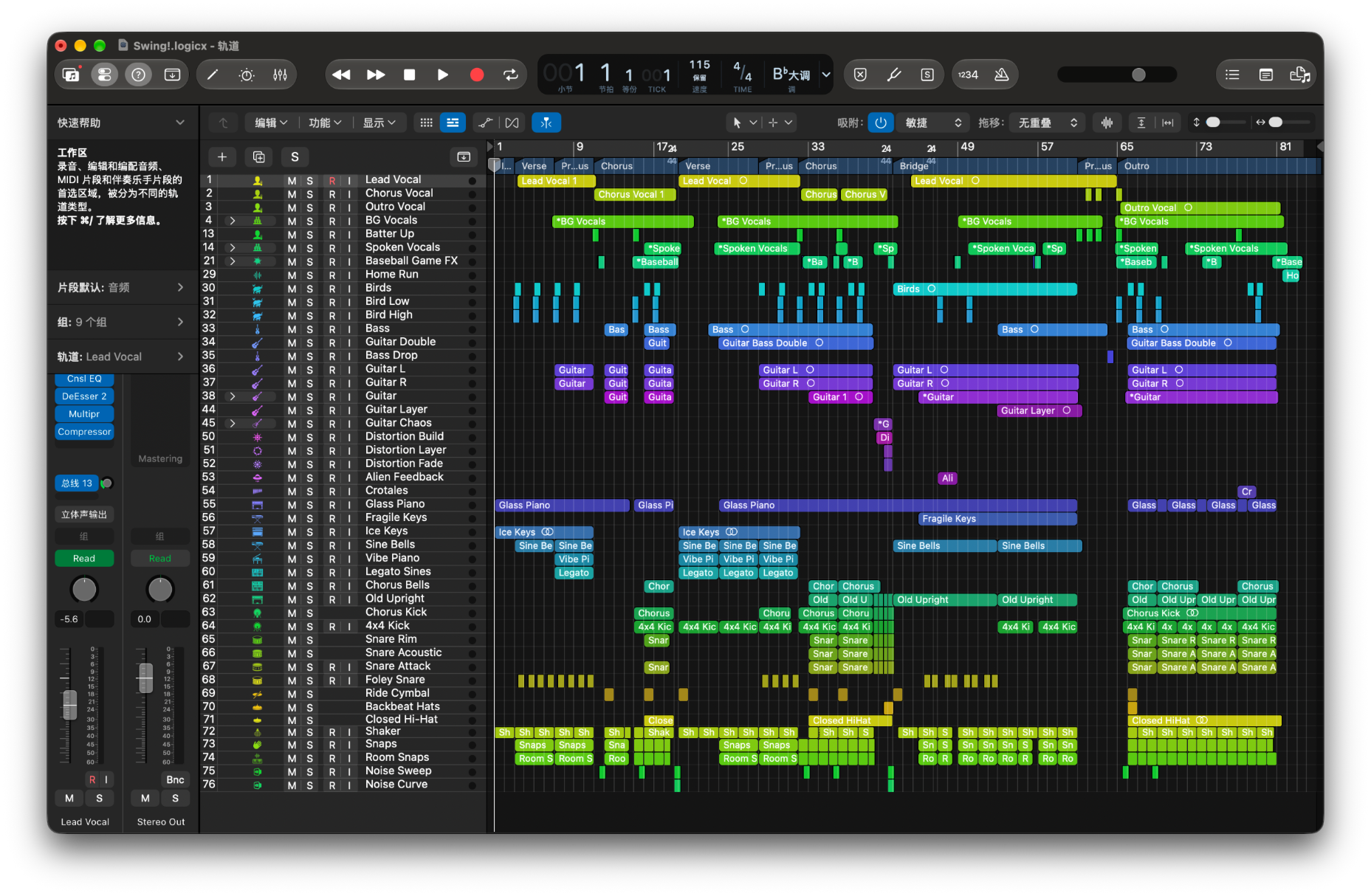
除了界面,乐器资源库也经过了重新整理。新版 Logic Pro 将乐器、音色和效果器资源进行了更系统的归类,日常查找起来直观了不少。
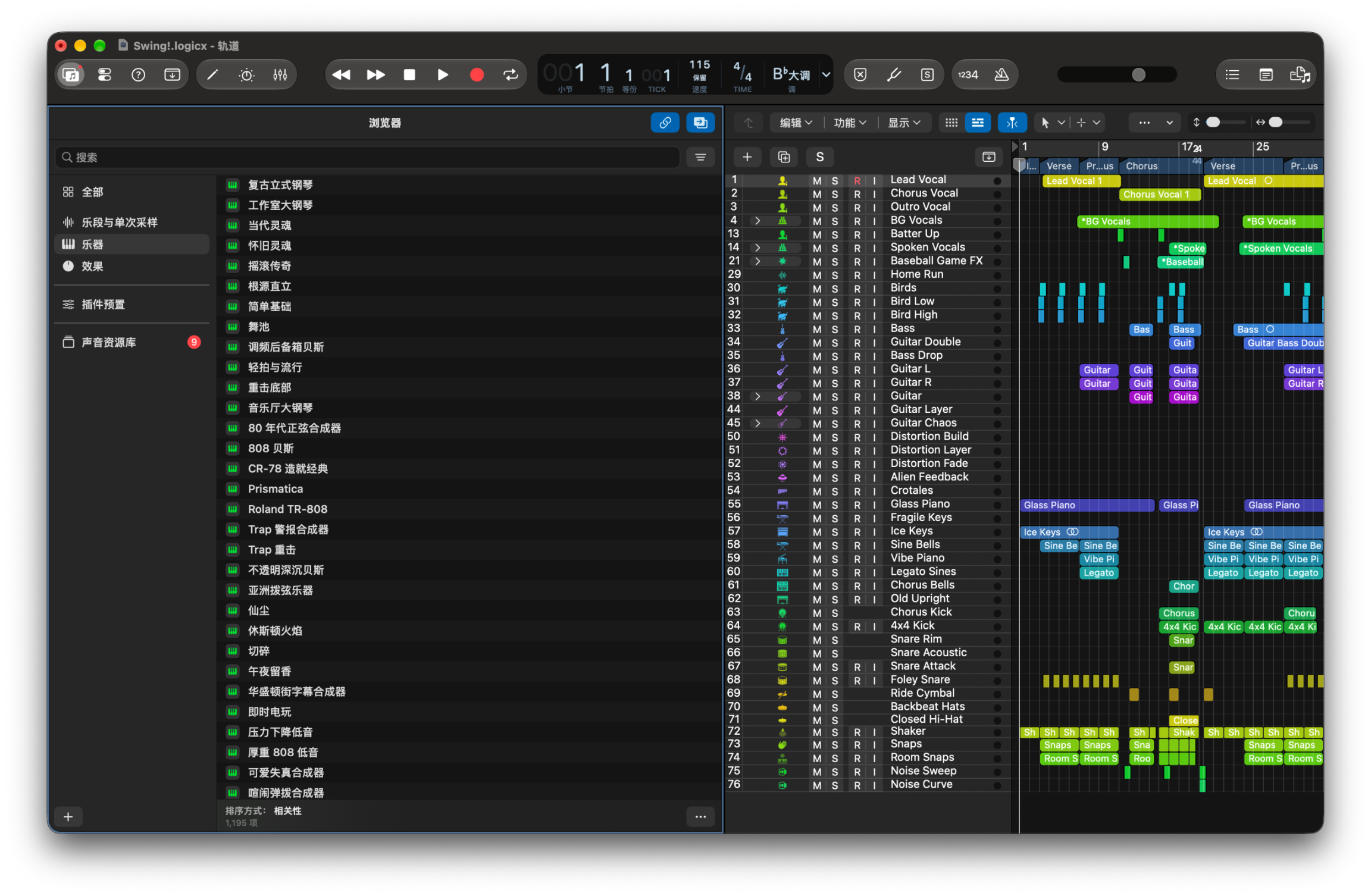
而在具体功能上,这次一个非常实用的升级,就是 Stem Splitter(音轨分离)了。
其实,Logic Pro 原本的音轨分离能力就已经相当好用了。面对一首已经完成混音的完整歌曲,它可以利用 AI 将人声、鼓组、贝斯和其他伴奏拆分成独立的音轨。
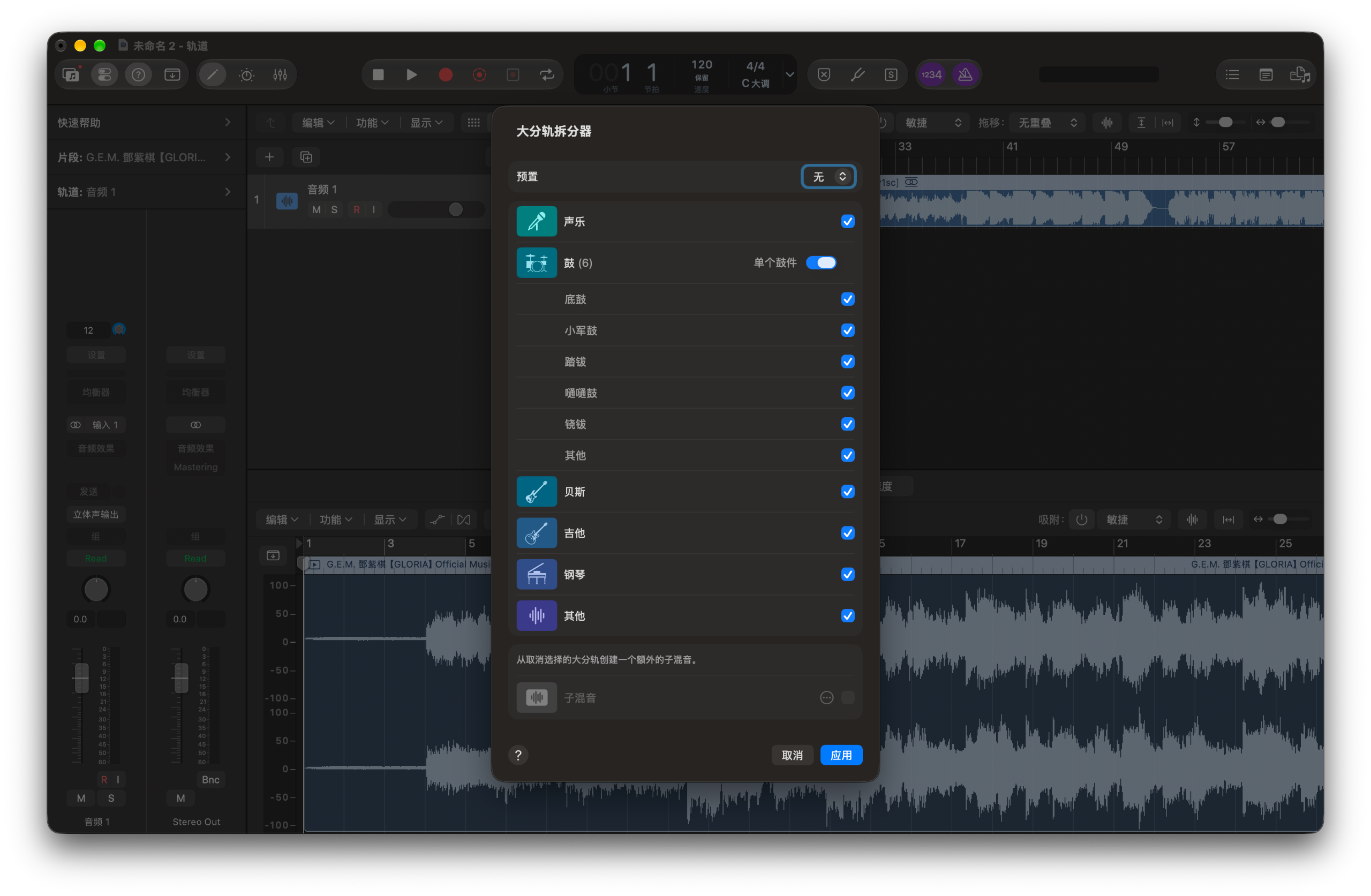
这次更新又进一步细化了这个功能——
相比于过去只能分离一整条鼓轨,新版本里 Logic Pro 还能继续向下拆分,将其中的底鼓、军鼓和镲片等部分分别提取出来,生成各自的独立音轨。
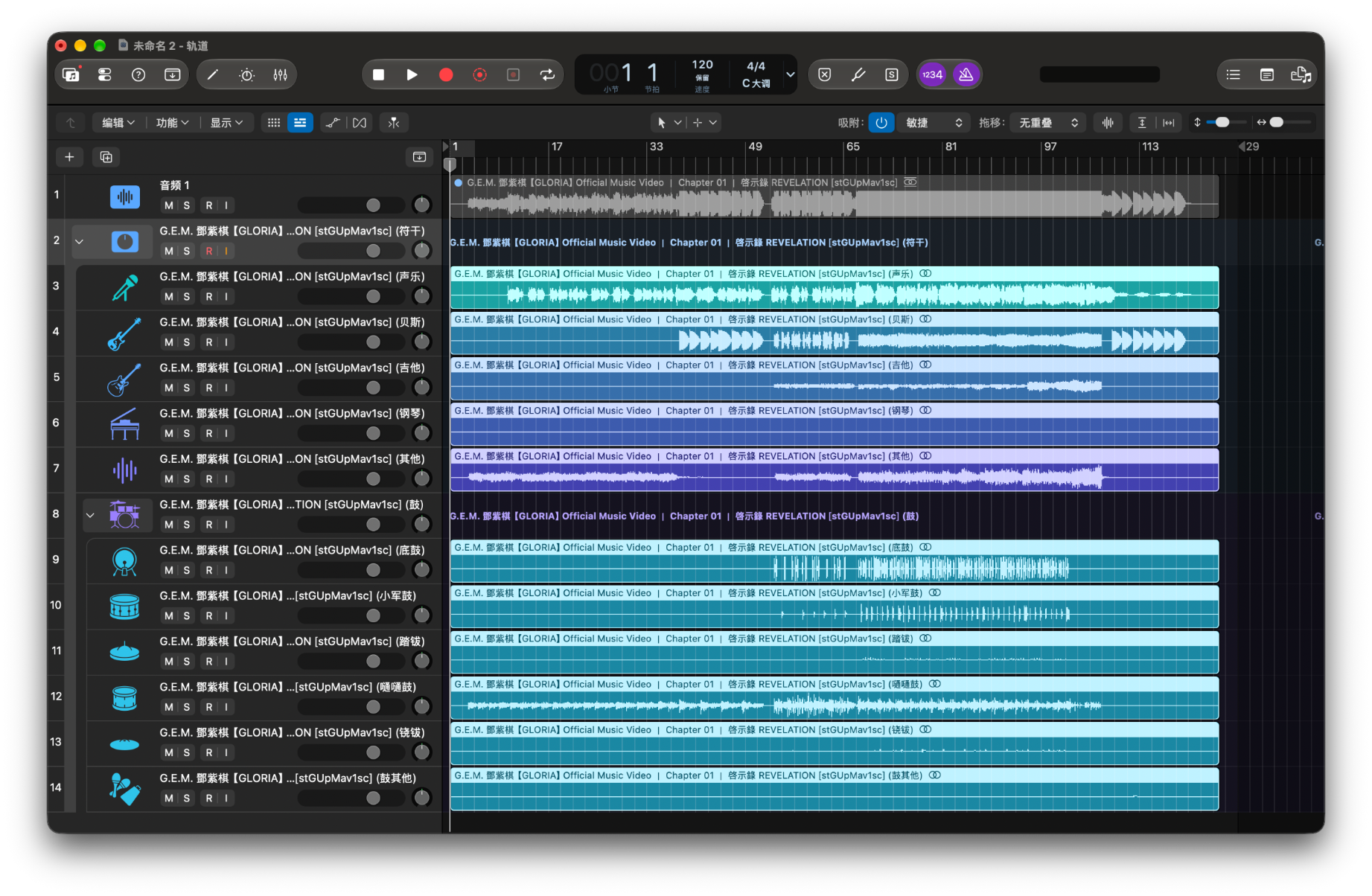
顺着这个功能,我们也实测了一下 M6 的处理速度。
先用一首时长约 4 分半钟的完整歌曲进行音轨分离:相比我日常使用的 M3 Pro 机型,手里这台 M6 MacBook Pro 完成同一项任务,足足快了将近一分钟。
随后,我们又对另一个音频工程进行了并轨导出测试——M6 用时 17 秒,而 M3 Pro 则需要 25 秒。
这种肉眼可见的速度提升,很大程度上得益于 M6 整体算力的增强。尤其是双 16 核神经网络引擎,以及 GPU 中新增的神经网络加速器,都在底层进一步拉高了芯片处理 AI 工作负载的效率。
另一个非常直观的差距来自 Pixelmator Pro。
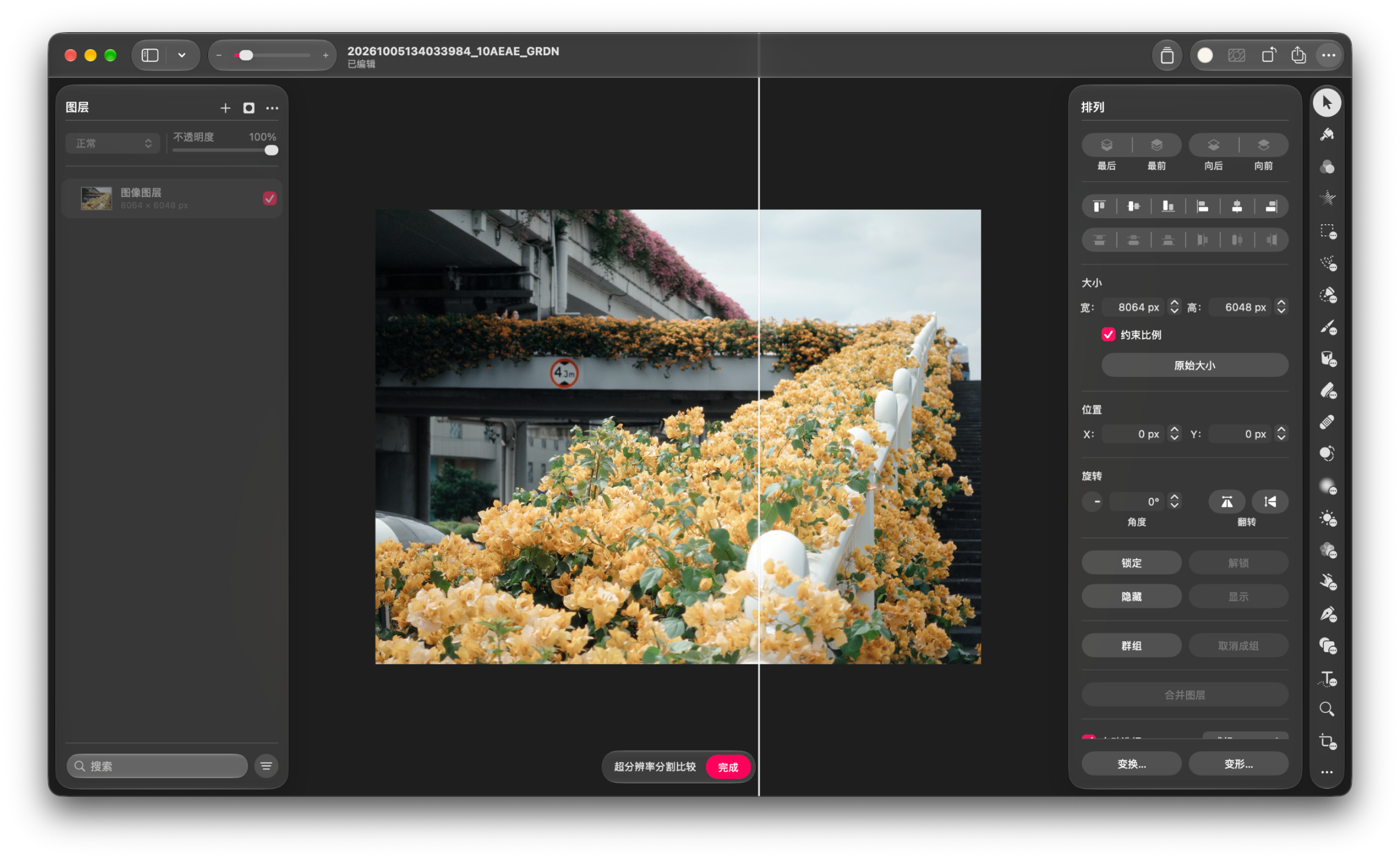
我们使用其中的「超分辨率」功能,同时对 5 张高像素照片进行放大处理。最终,M3 Pro 用时 2 分 52 秒,而 M6 只花了 48 秒——这也让 M6 的 AI 算力优势有了一个更具象的体现。
除了算力加持下的效率提升,这次 Creator Studio 其实还塞进了不少基于生成式 AI 的新功能。遗憾的是,这些生成式 AI 功能,我们暂时还没办法在国行环境下完整体验到。
好在我们也找来了满足条件的设备环境,先替大家浅尝一遍。
就比如说 Pixelmator Pro 新增的 Generative Fill(生成式填充)。只需要圈选照片中的一块区域,再用自然语言描述需求,AI 就能自动生成新的画面内容。
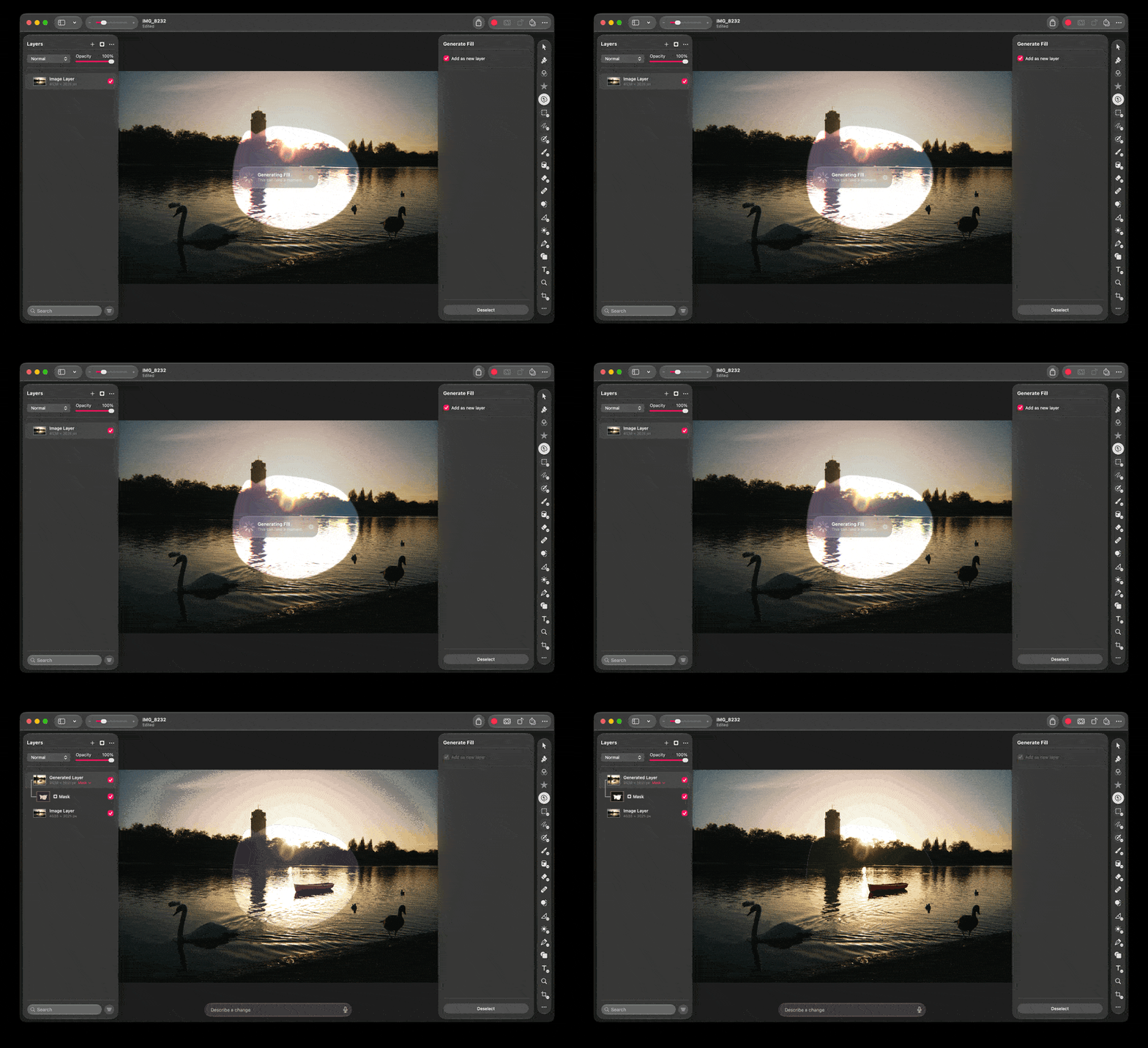
仔细观察整个过程,会发现 Pixelmator Pro 的处理方式还有些巧妙。
它会先围绕选区生成一块略大于圈选范围的矩形图像,再通过智能蒙版,将生成内容与原图融合。即便生成画面的边缘与原始环境存在差异,这套蒙版也能自动控制显示范围,让新旧画面之间的过渡更加自然。
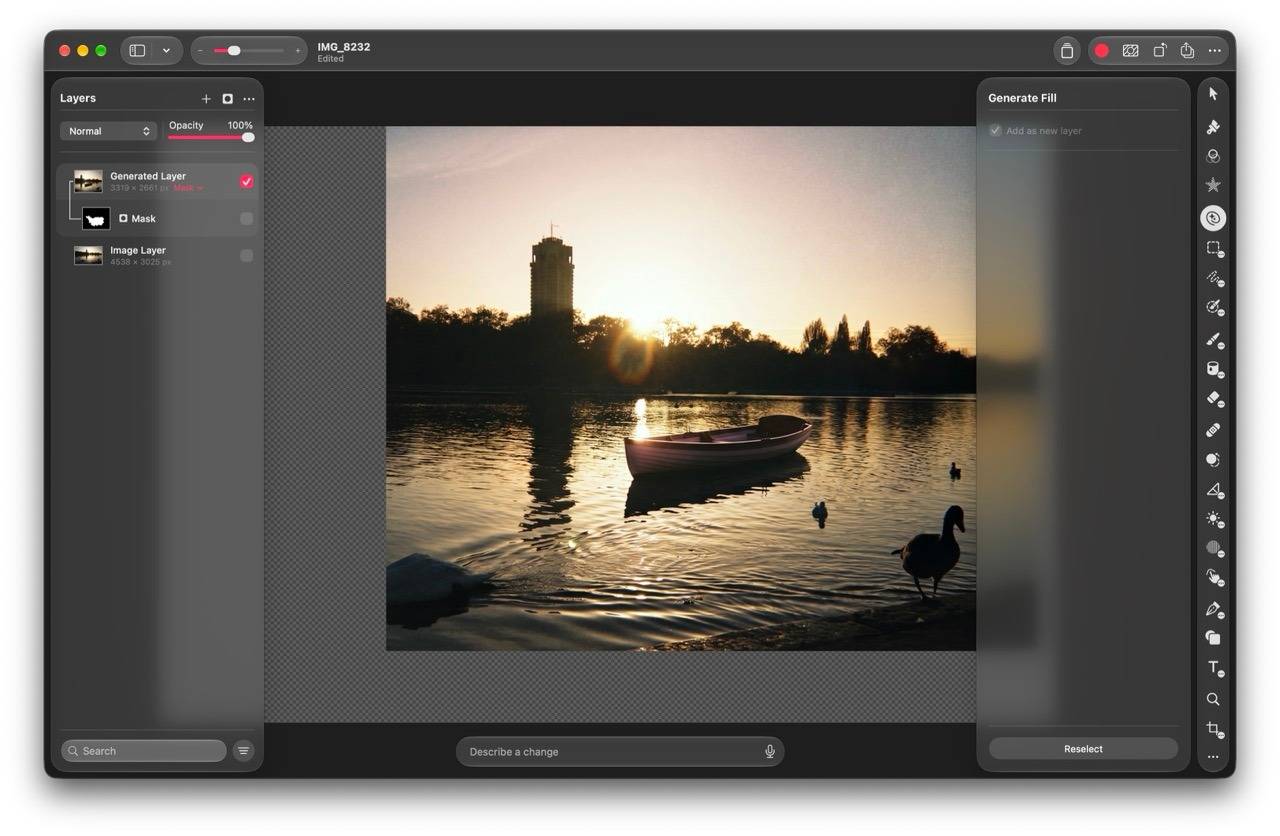
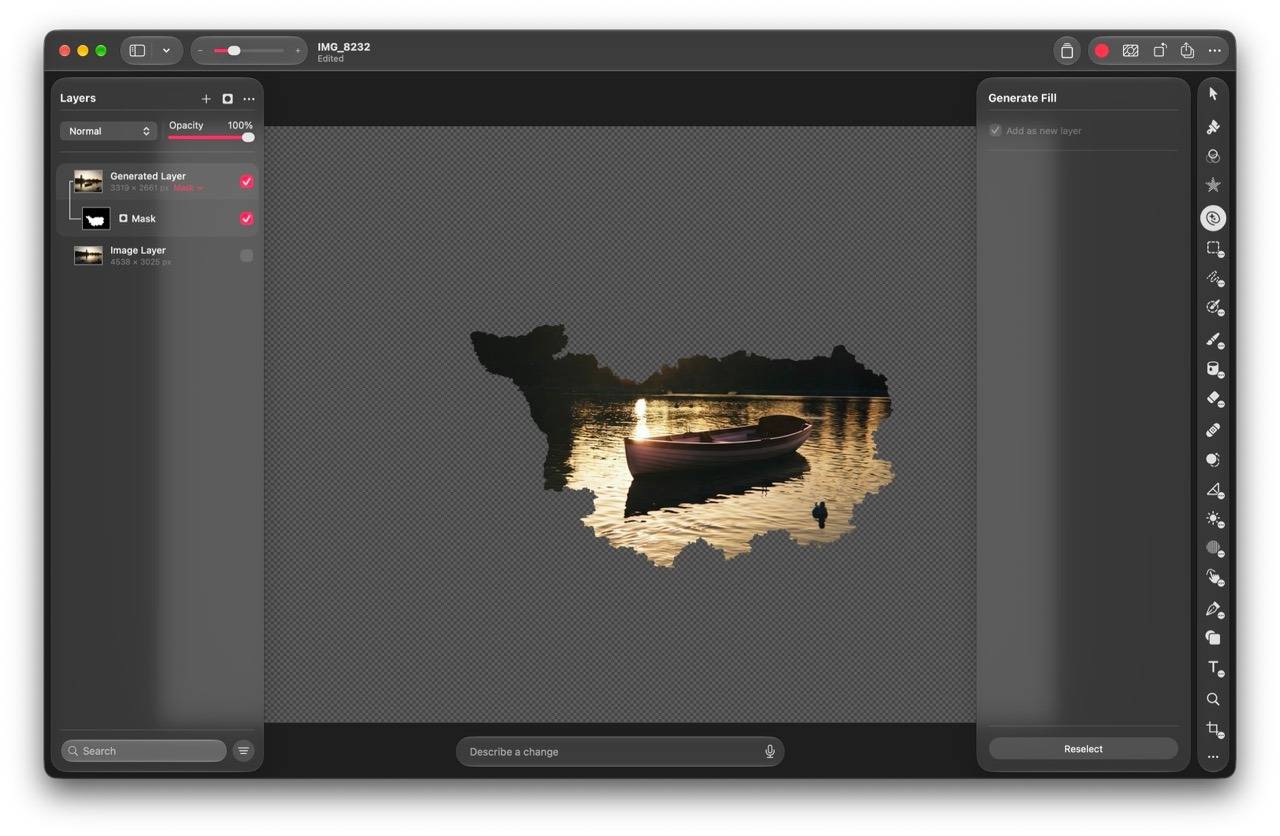
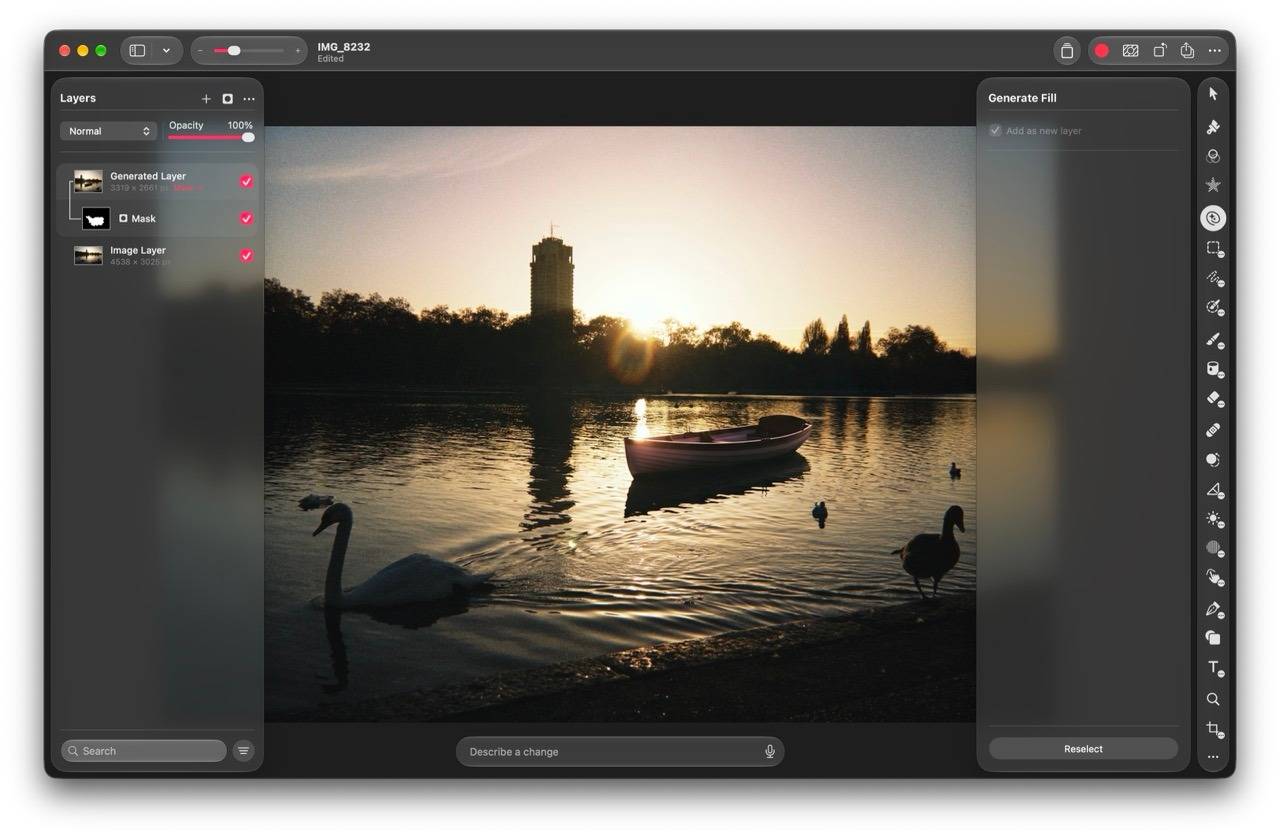
向左滑动查看更多内容
此外,Pages、Keynote 和 Numbers 三件套也都加入了全新的 AI Assistant,可以结合当前文档的上下文,帮用户撰写内容、调整演示文稿排版,或是整理分析表格数据。
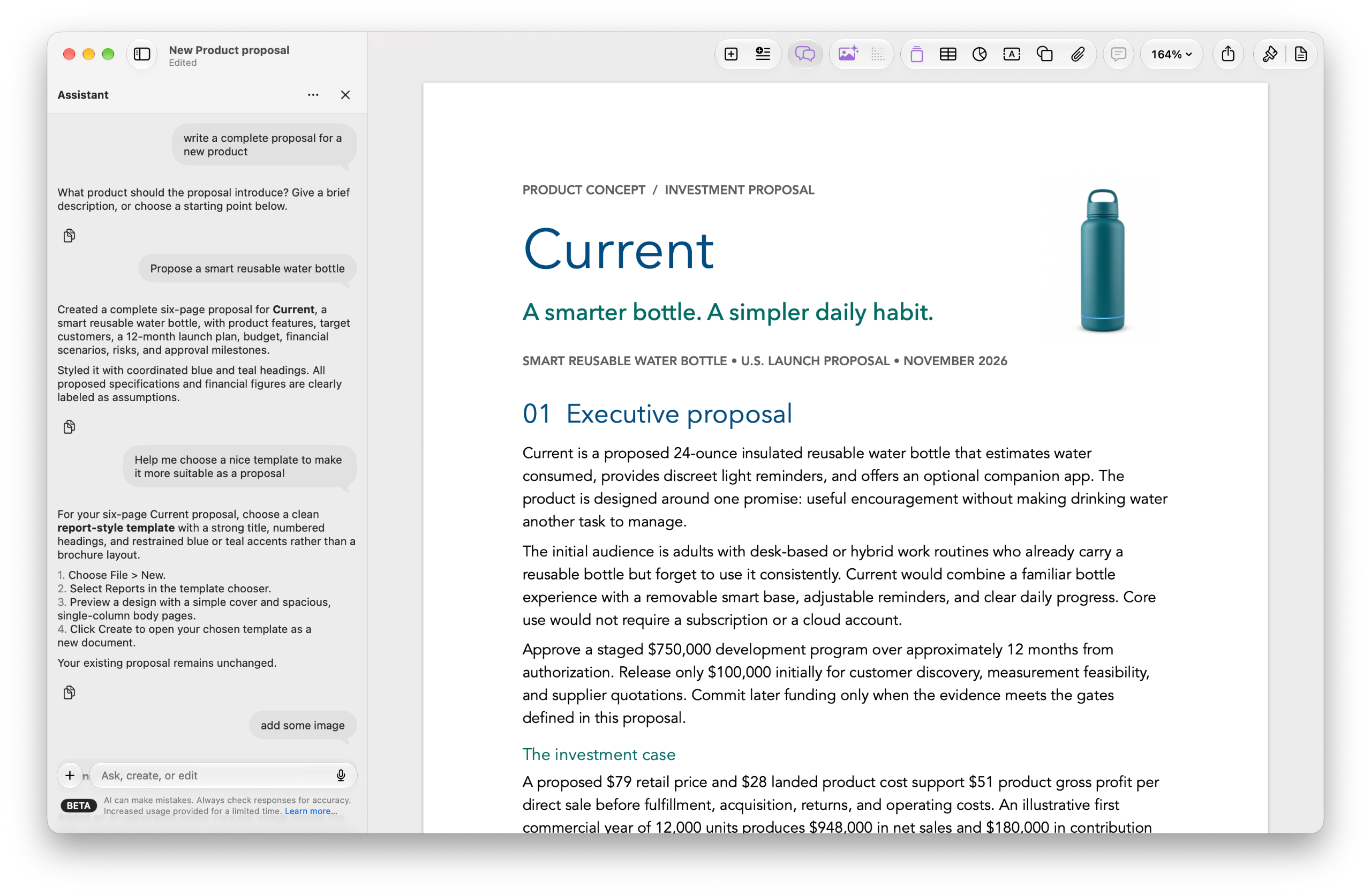
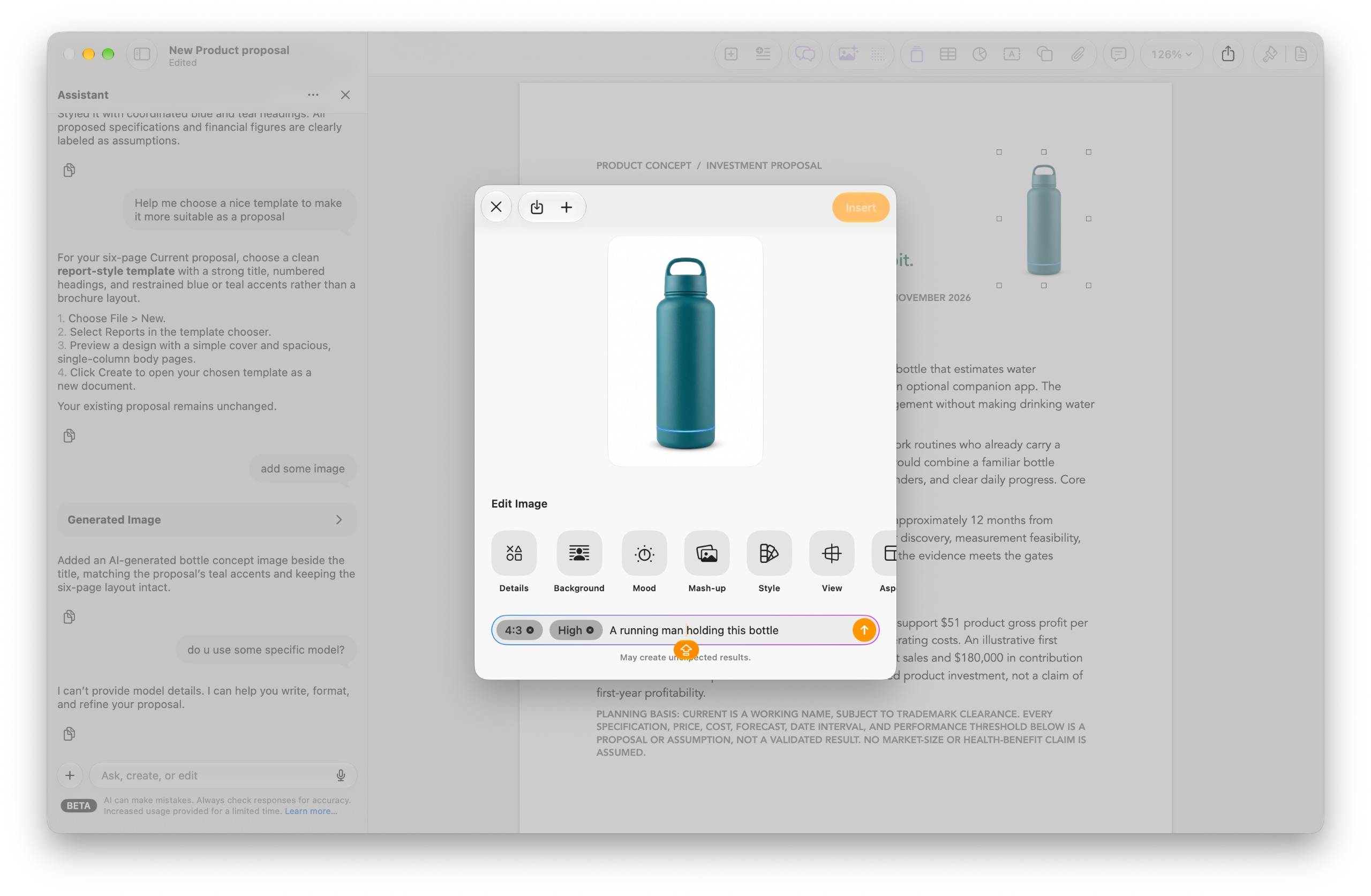
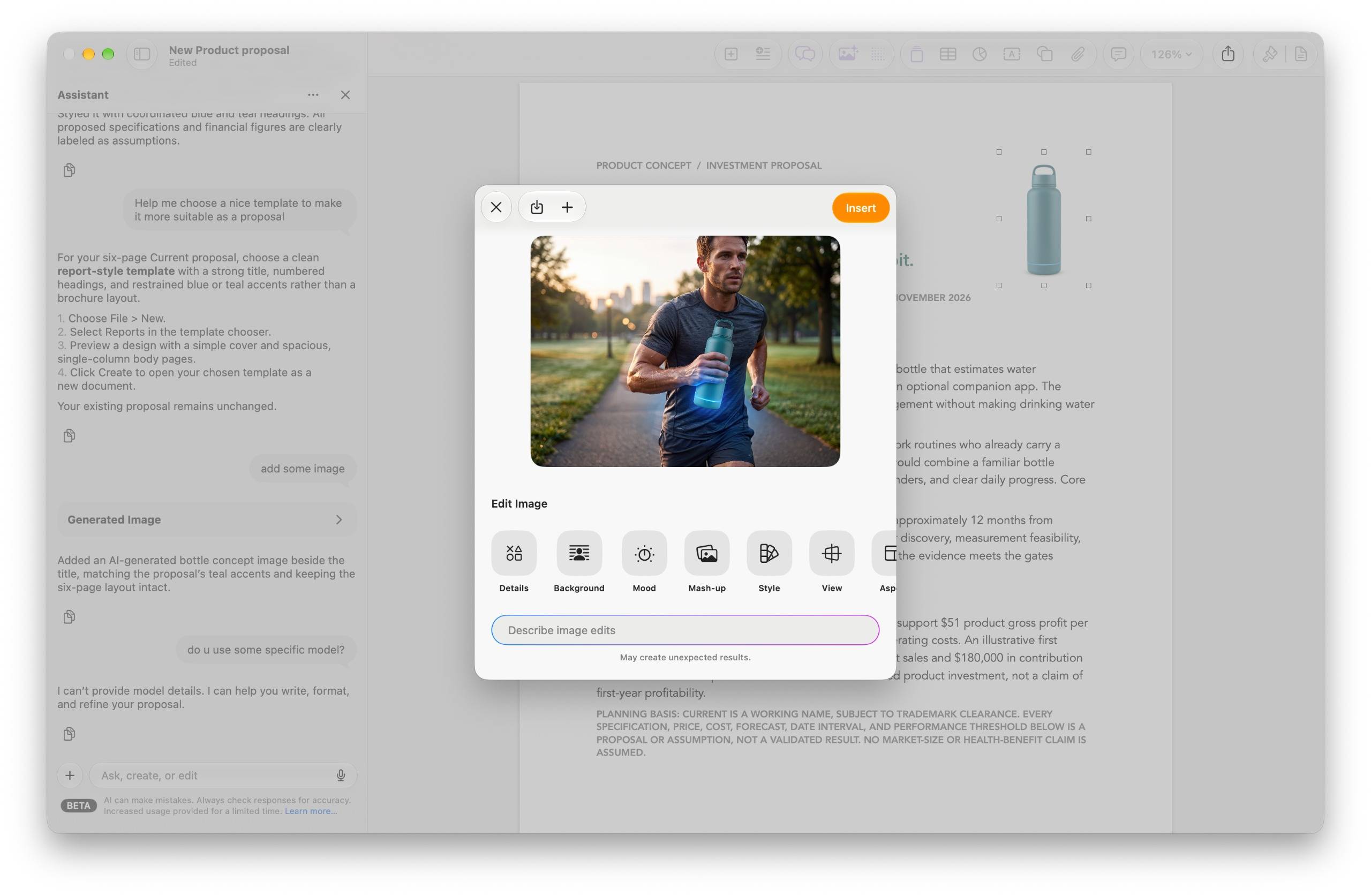
比较有意思的是,三件套也内置了图像生成功能。不仅可以生图,还能基于现有的某张图片,通过追加提示词进行二次修改,软件里甚至直接给好了一套相当丰富的修改预设,比如补充细节、切换风格等等。
向左滑动查看更多内容
虽然上面这些生成式 AI 功能对国行用户来说还有些距离,但这次更新还藏着另一个人人可用的底层变化:Pages、Keynote 和 Numbers 开始原生支持 MCP 了。

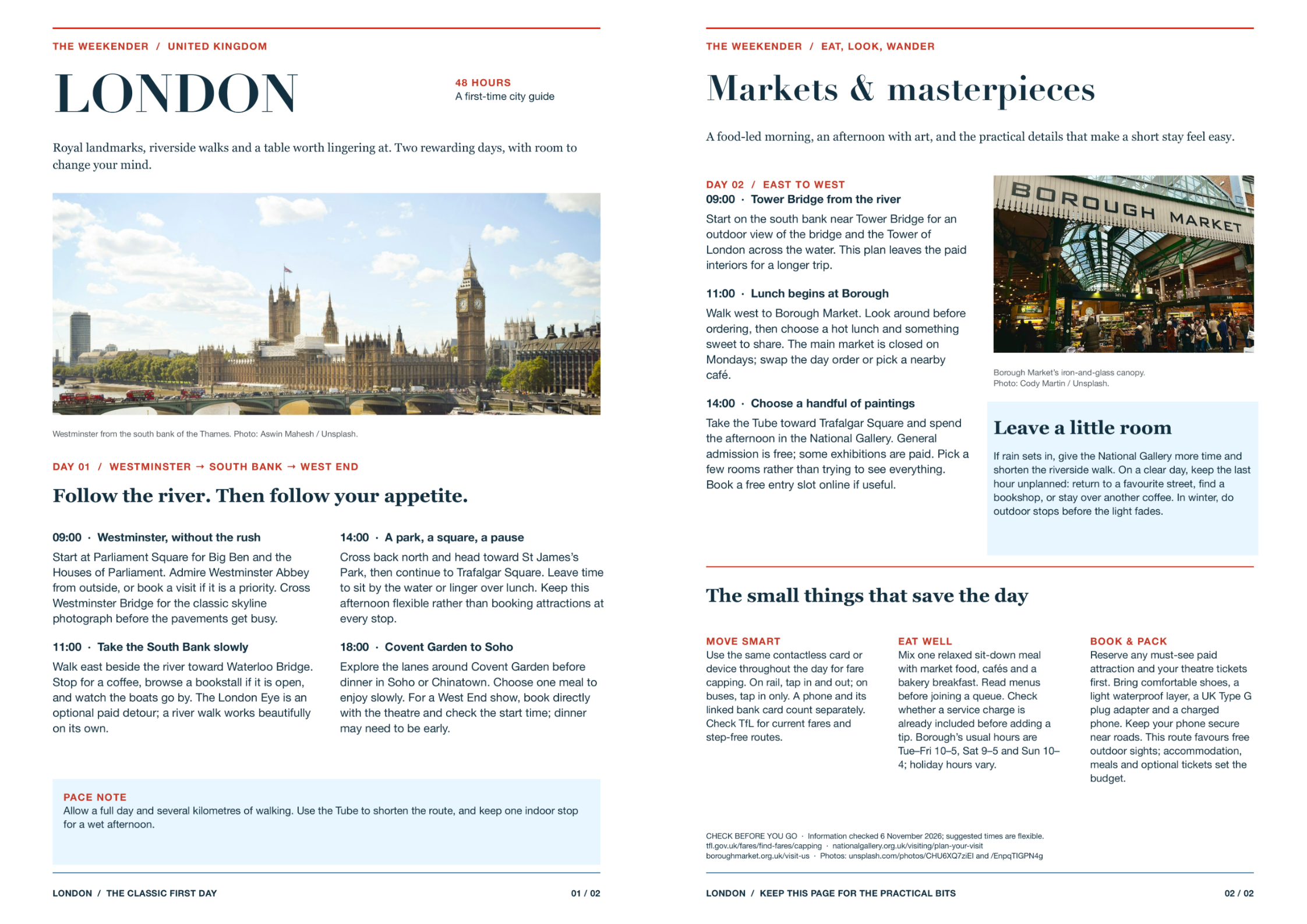
爱范儿也实际动手试了试。我们用 Codex 直接连接 Pages,让它自动生成一张排版和视觉层级都相对复杂的旅行画报。
最终呈现出来的效果相当不错,而且几乎所有的内容编辑与复杂排版——包括字体设置、段落样式、图文混排等等,全部是通过原生 MCP 接口直接调起完成的。
同样地,我们也尝试把 Keynote 接入进去,一样能跑出相当成熟的幻灯片排版效果。




向左滑动查看更多内容
软件,正在替硬件留住用户
Apple Creator Studio 正式发布已经一年多了。我自己在去年就自掏腰包成了订阅用户,所以想先从个人视角,聊聊这套软件最真实的上手体感。
当初决定订阅,其实有个比较私心的理由:作为一个入门级的音乐爱好者,Logic Pro 一直是我想尝试的专业软件。恰好赶上苹果推出 Creator Studio 订阅服务,不用一上来就花大价钱买断,我几乎没怎么犹豫就开了会员。

Art, philosophy, and science blend in beautiful wildlife photography
Excerpted from UNITED NATURE by Andrew Zuckerman. Copyright © 2026 by Andrew Zuckerman. Published in the United States by Crown, an imprint of the Crown Publishing Group, a division of Penguin Random House LLC.
For as long as I can remember, I have made images. Much of my childhood was spent in the darkroom in my parents’ basement, surrounded by the smell of chemicals and the magic of forms slowly appearing on paper. Of all the things I’ve pursued in my life, the camera has been the one constant. It has shaped how I see: a device that slows me down, compels me to look more deeply and to understand the subjects on an essential level. And for me, the subject has always been other forms of life.
In that sense, I am part of a long tradition. The very first images humans made were not of themselves, but of other beings. Almost forty thousand years ago, in the caves of Chauvet in France, someone painted lions, rhinoceroses, mammoths, and bears with striking naturalism, allowing the animals to emerge from the contours and relief of the stone walls. Nearly twenty thousand years later, in the caves of Lascaux, we find more painted walls: herds of horses in motion and bison colliding, painted with sophisticated perspective and composition. Humans have never stopped depicting other beings. In Egypt, cats and jackals accompanied the dead into eternity. Dolphins appear again and again on Greek pottery. In medieval manuscripts, we find lions and owls used to represent human virtues and vices. Enlightenment engravers focused on the natural world, seeking order through detail. A generation later, John James Audubon’s The Birds of America presented perhaps the most realistic natural history illustration: life-size depictions of herons, warblers, and owls, rendered with exquisite precision.
With the arrival of photography two centuries ago, the human act of depicting the natural world shifted profoundly. This was not just a new tool, it was a rupture: the first time nature could enact itself with a fidelity and presence previously unseen. The world’s first published book of photographs arrived in 1843: Photographs of British Algae: Cyanotype Impressions by Anna Atkins. Atkins treated paper with a chemical solution, added specimens onto the treated paper, and left them under sunlight. This produced a white silhouette against a blue background. Atkins created these pictures of algae at the height of botanical illustration. While her peers were exhibiting artistic mastery over nature, she was removing herself. Here, the algae left its own impression directly on the paper. The plant depicted itself. The plant had agency.
One year after Atkins’s algae cyanotypes, William Henry Fox Talbot published The Pencil of Nature, a book containing twenty-four calotypes, the first paper negative, which allowed multiple positive prints to be made from a single negative. Photography was so new that Talbot felt required to include a notice: “The plates of the present work are impressed by the agency of Light alone, without any aid whatsoever from the artist’s pencil. They are the sun-pictures themselves, and not, as some persons have imagined, engravings in imitation.” Like Atkins, Talbot emphasized that the image was not mediated by the hand of the artist but drawn directly by nature itself—“sun-pictures” made by light. These early inventors of photography were introducing a new way of observing and recording the living world—one in which nature was no longer simply depicted, but allowed to speak for itself.
Only a few years later, in 1859, Charles Darwin published On the Origin of Species, advancing the radical idea that all life was in flux and that variation, adaptation, and transformation were the fundamental conditions of existence. In this light, Atkins’s cyanotypes seem almost prophetic: life depicted not as a fixed emblem to be mastered, but as a living process.

Skipping forward to the late nineteenth century, Cherry Kearton was pioneering what is now considered wildlife photography by hiding in hollowed-out ox carcasses or building bird-shaped blinds to get close to subjects. In the early twentieth century, photography extended into motion. Eadweard Muybridge’s studies of horses and birds revealed the invisible mechanics of gait and flight, moments too fast for the human eye to clock. Jacques Cousteau created ocean documentaries that gave the general population access to and intimacy with distant species.
By the late twentieth century, nature photography and film had become not only a way of seeing, but also a way of caring—shaping public consciousness about endangered species, vanishing habitats, and the fragility of ecosystems.
This notion of the image as a tool to influence our thinking found perhaps its most profound expression in the late 1960s, when Stewart Brand lobbied NASA to release the first photographs of the whole Earth seen from space. When those images finally appeared on the cover of his Whole Earth Catalog, they offered a new planetary perspective: not a map or an illustration, but the living sphere itself. For the first time, humanity could see Earth as a singular organism.
That one image—blue oceans swirling with white clouds, landmasses without borders—reshaped the cultural imagination. It gave rise to the environmental movement, inspired new sciences of systems and ecology, and embedded the idea that the planet itself is alive into the culture.
In the decades that followed, technology expanded the reach of our seeing. Satellite imagery made the whole Earth continuously observable: forests shrinking, glaciers collapsing, storms forming in real time. Microscopy revealed networks of neurons firing, cells dividing, viruses mutating. Telescopes peered to the edges of the universe, returning images of galaxies colliding and stars being born. Today, cameras can show bacteria and galaxies with equal fidelity.

Each age has found its own surface, its own technique, but the effort has always been an attempt at understanding both the lives of others and our own experience. Across this long arc, from the walls of Chauvet to the cyanotypes of Atkins, from Muybridge’s horses to Br
Democrats just won control of Georgia Power’s regulator for the first time in 30 years — and its OpenAI data center contract was entirely redacted
“This story was originally published by Grist. Sign up for Grist’s weekly newsletter here.”
Beginning in January, three of the five officials on the Georgia Public Service Commission will be Democrats. It will be the first time the party has controlled the powerful energy regulation board in 30 years. The commission, which regulates utilities including the state’s largest electric provider, Georgia Power, has come under more scrutiny in recent years due to rising power bills and the high energy demands of data centers.
Now, Democrats plan to focus on affordability, clean energy, and closer scrutiny of Georgia Power.
“There’s a long laundry list of things that need to be looked into,” said Democratic commissioner Peter Hubbard, who won his reelection bid this week. “And so we’ll have to triage, in fact, and decide how best to move forward.”
One of his first priorities will be launching an affordability docket, he said — a series of hearings that would delve into the reasons for high power bills and ways to save customers money. Hubbard said he and his fellow Democrats also plan to bring close scrutiny to upcoming Georgia Power requests around making more energy and adjusting customer rates. Shelia Edwards and Alicia Johnson are the other two Democrats on the PSC.
But any changes, especially to power bills, will likely take time.
“We may not be able to expect immediate effects on our wallets,” said Emory University associate professor Kristin Phillips, who studies energy burden and the PSC. “But I think we can expect immediate change in the types of decisions that are made.”
Affordability and high energy bills were driving issues in the campaigns both this year and last year, the two elections that together resulted in the new Democratic majority on the commission.
“We knew that we had to connect the dots between energy and affordability,” said Brionté McCorkle of Georgia Conservation Voters, a group that campaigned for the Democratic candidates and worked to draw attention to the PSC elections. “It’s not just this obscure regulatory body like it used to be treated. Its decisions directly affect household budgets, communities, health, and our energy future.”
Chris Womack, the CEO of Southern Company, Georgia Power’s parent company, also acknowledged the central importance of affordability during the company’s third-quarter earnings call on Thursday. But Womack said he’s confident the utility can address those concerns with the new commissioners.
“If you look at what we have been doing with rate freezes, with benefits, with how we are providing benefits from growth to customers — existing customers — as well as to the communities, we think that’s a strong platform to stand on,” he said.
Since the data center boom in Georgia began, Georgia Power has maintained that the increased revenue would more than pay for the new infrastructure to serve them, which the utility argues would keep rates lower for residential and small business customers. The utility calls this “downward pressure.” It doesn’t mean rates will go down, but rather that any increases would be offset by the influx of revenue from data centers.
The utility recently doubled down on that promise as part of its deal to serve a massive new OpenAI data center. The deal, Georgia Power said, would bring $15 of not savings but downward pressure per month for what Georgia Power calls the “typical” residential customer.
Separately, Georgia Power also credited the increased revenue from data centers for the temporary rate freeze approved last year. But the rate freeze received criticism from some advocacy groups. Instead of first holding a PSC hearing to give advocates a chance to verify the utility’s financial claims, Georgia Power announced the temporary rate freeze. Advocates feel that the backward process left them unable to confirm whether the company was delivering on its promises and fully shielding ordinary customers from data center costs.
It’s part of a broader criticism often leveled at the PSC and Georgia Power: lack of transparency. The OpenAI contract was entirely redacted, and only a summary provided to the public after it was approved. Specific details involved in service contracts, deals to buy energy, and construction costs are often redacted from the utility’s public filings under the auspices of trade secrecy.
“I absolutely think transparency is potentially one of the biggest impacts here,” said Phillips of the election results. “It has been often on advocates to push on the way that the PSC communicates about the decisions that it’s making, and I’m hoping that there will be more clarity and transparency.”
The Democrats on the commission have promised to bring increased scrutiny to the next rate-setting process, due in 2028, along with Georgia Power’s long-term plans to make and deliver energy, its forecasts about rising demand, and other issues. Hubbard has also proposed conducting a rate case for the state’s natural gas utilities, which he said hasn’t been done in over a decade. And he said they’ll push for other changes going forward.
“We’ll continue with an agenda next year and the year after that to take advantage of this four-year period when we have the majority and can push for long-lasting reforms and shifting the direction of the state in terms of energy,” Hubbard said.
This article originally appeared in Grist at https://grist.org/georgia-psc/democrats-take-control-of-georgias-powerful-utility-regulator/.
Grist is a nonprofit, independent media organization dedicated to reporting on climate change.
This story was originally featured on Fortune.com
Asymptotic-Preserving Tensor Neural Networks for 3D High-Field Kinetic Equations with Applications to Uncertainty Quantification
StrataFlux: Memory-Hierarchy-Native Low-Bit LLM Inference
FluxFlow: Conservative Flow-Matching for Astronomical Image Super-Resolution
Flux as a Codec: Zero-Shot Lossy Compression with Flux
Improving Long-Tail Detection via Layout-Instruction Conditioned Diffusion Synthesis
A Proxy-Based Method for Measuring Racial Disparities in~Text-to-Image~Generators
More Performance From Every Byte: How Full-Stack Codesign Solves AI’s Memory Challenge
Larger models, longer contexts and agentic applications are increasing GPU memory pressure while supply tightens and prices rise — a trend expected to continue through the near term.
NVIDIA works closely with memory partners to rapidly adopt the latest memory technologies. NVIDIA was first to adopt HBM3e and HBM4 technologies into an accelerated computing stack.
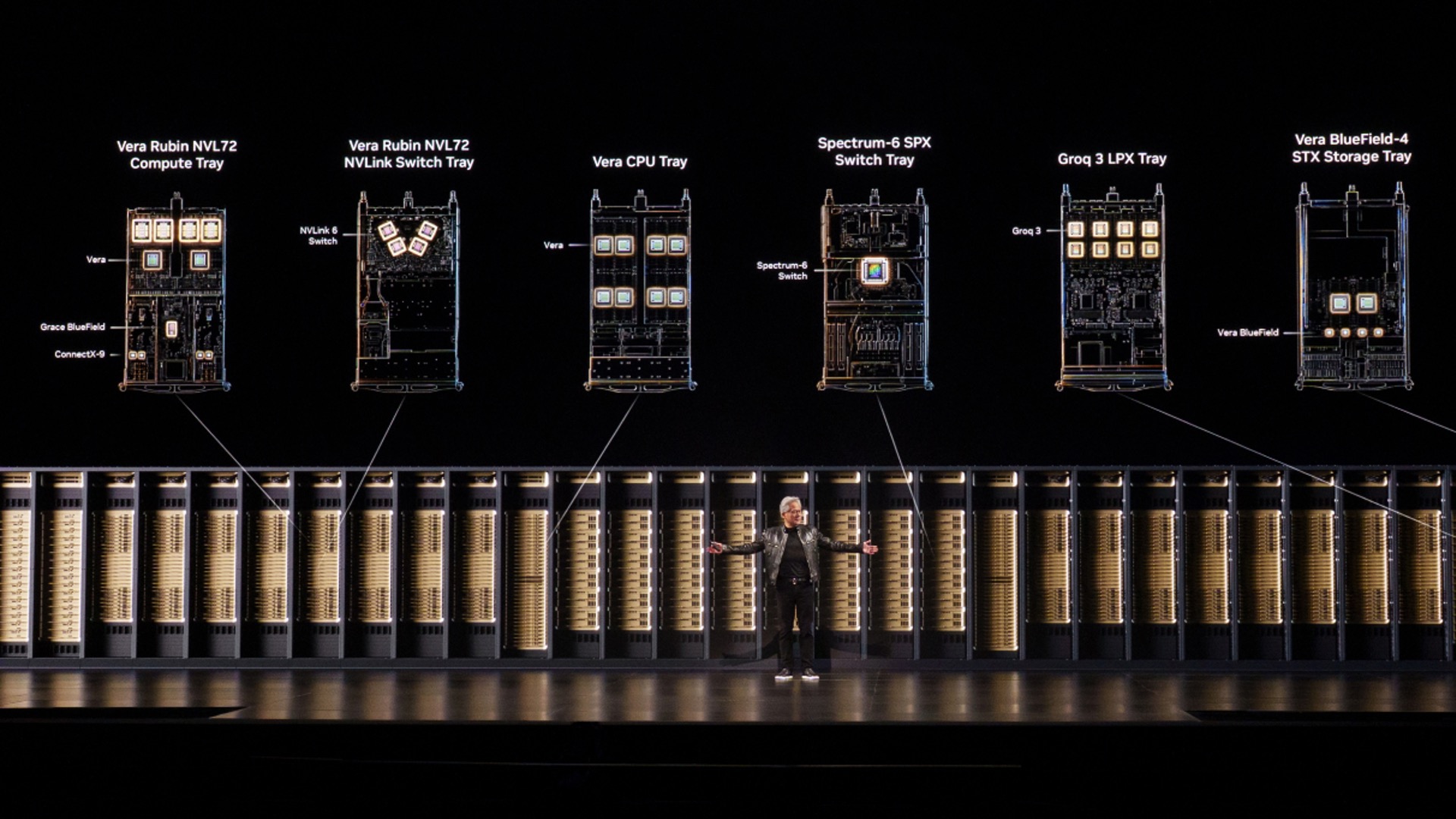
But the approach isn’t to simply pack more memory onto the GPU. It’s full-stack codesign. NVIDIA intentionally designs GPUs, CPUs, networking, storage and software together to get more useful work out of memory at every layer of the AI factory.
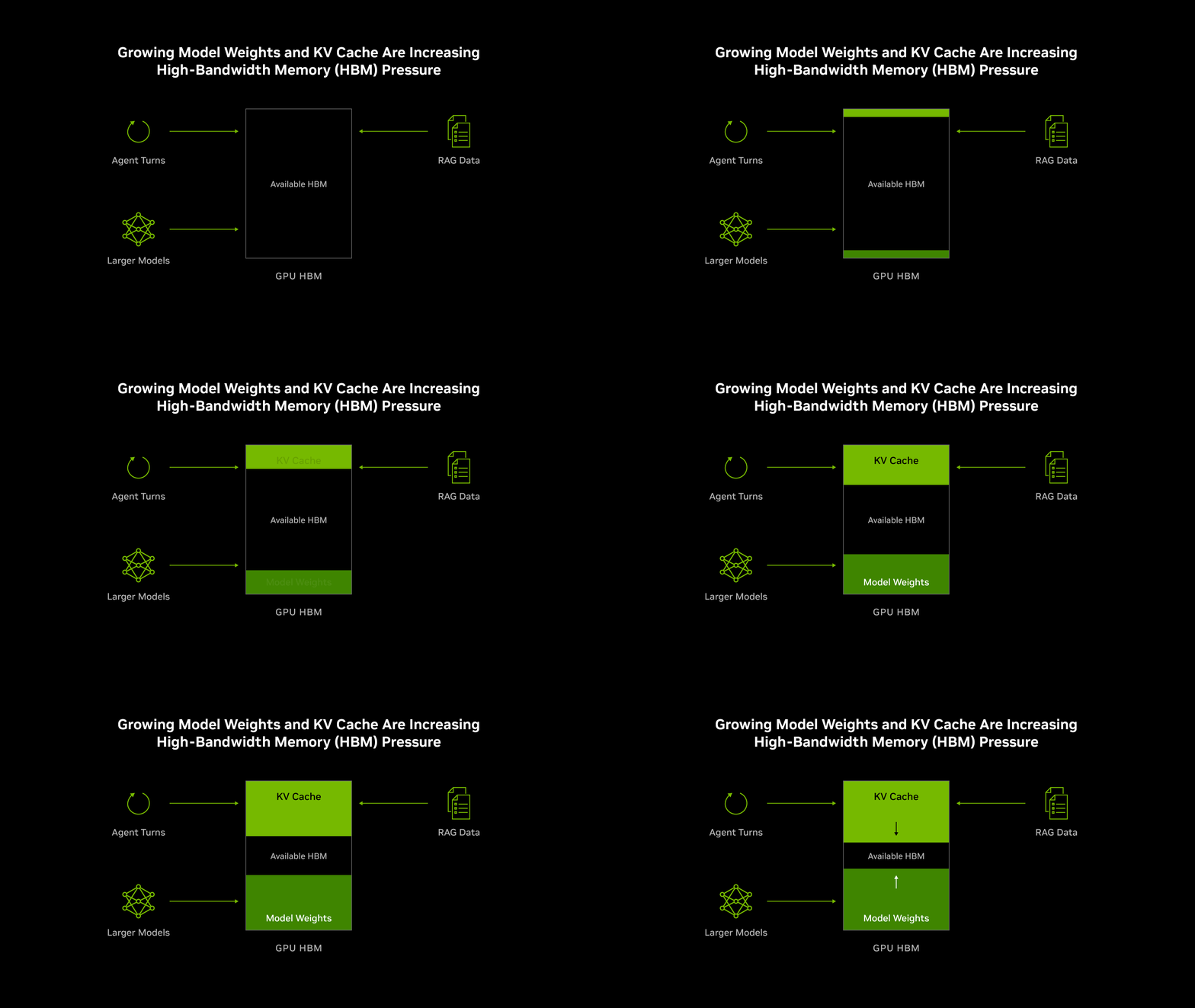
That matters because an AI factory runs on a memory and storage hierarchy. GPU high-bandwidth memory (HBM) is the fastest, most expensive and most contested tier — with model weights and KV cache competing for limited capacity. Below it sit CPU memory, local SSDs and shared storage, each trading speed for more capacity at a lower cost per bit.
How much useful work a byte does depends on how well the whole hierarchy is used: shrinking what must be stored, placing it on the right tier and bringing it back to the GPU before it’s needed.
Byte for byte, NVIDIA makes the most efficient use of memory at every layer — and the results show it. From NVIDIA Blackwell Ultra to the Vera Rubin platform, HBM capacity per GPU rose roughly 3%, while agentic throughput per dollar rose by up to 30x on SemiAnalysis AgentX.
Agentic Inference Is Putting More Pressure on HBM
Frontier models now have trillions of parameters — the values that hold what an AI model learned in training.
KV cache, which holds the context the model needs to understand each active request without reprocessing the same information, is also expanding. Agentic trajectories carry prior context across repeated model and tool calls, in some cases processing up to 3 million tokens, so each request’s working memory grows over time.
Retrieval-augmented generation (RAG) adds relevant enterprise information to prompts, creating even more context to process and retain.
During inference, HBM primarily holds both model parameters and KV cache. The result: greater pressure on HBM.
Why AI Factories Need a Memory Hierarchy
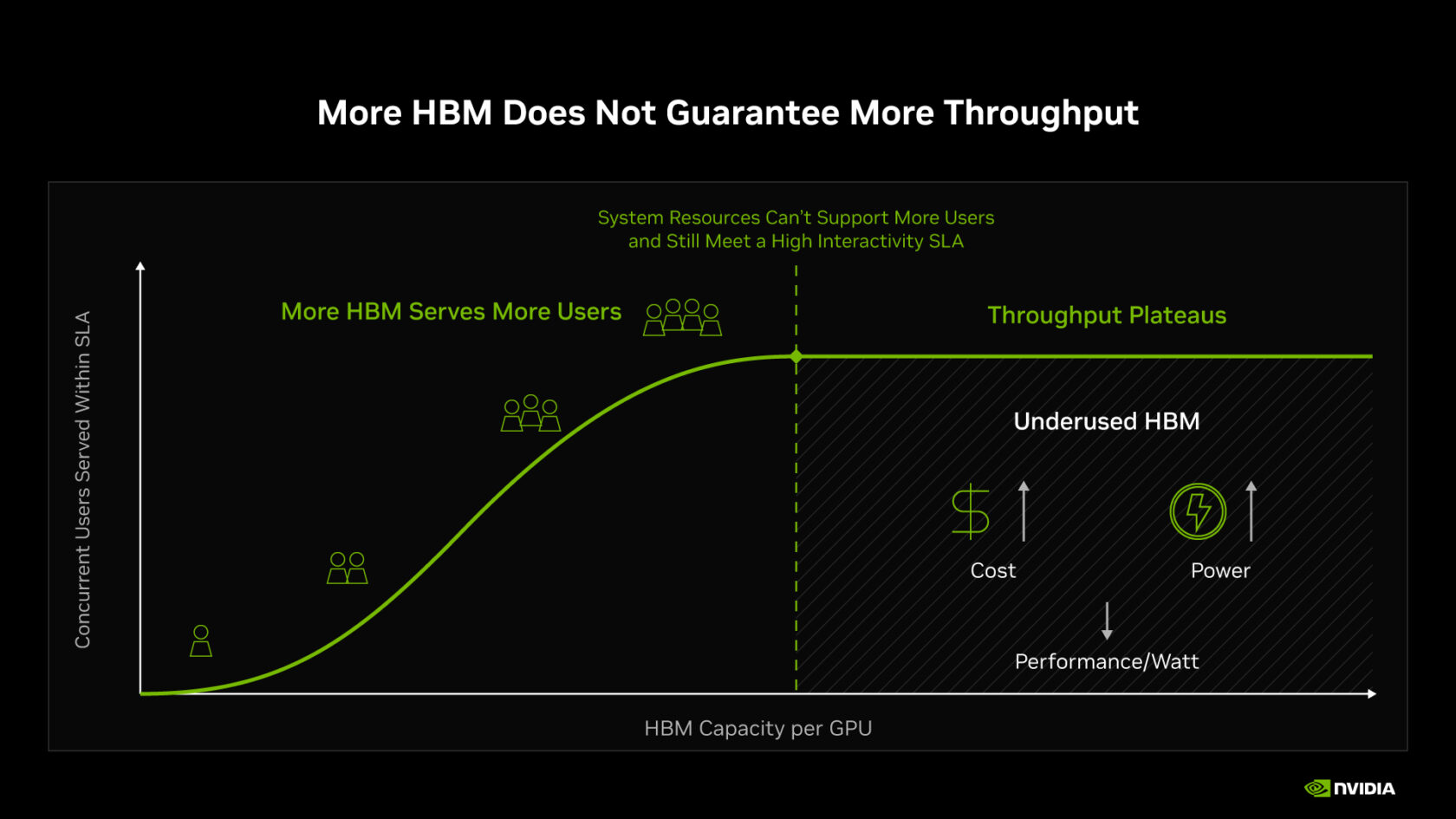
Adding more HBM capacity per GPU is the obvious response to that pressure, but capacity delivers only what bandwidth can move.
Think of HBM as a warehouse and memory bandwidth as its loading docks. A larger warehouse holds more inventory, but the docks set how much can move in and out at a time. Once the docks are at capacity, moving more inventory takes longer and slows response times. If delays exceed the required service level, the added space can’t be used effectively, even as it adds cost and draws power.
That’s also why no operation keeps all its inventory in the closest, fastest space. What’s in motion stays near the line. What’s waiting moves to a larger, cheaper space nearby and returns before it’s needed.
An AI factory faces the same limit.
More HBM can hold more KV cache and support more concurrent users. Every added user shares the same compute and memory bandwidth. But when each user expects fast responses, eventually memory bandwidth is unable to supply data as fast as compute can use it: a limit engineers call the memory wall.
Past that point, extra HBM capacity can’t be put to work, yet it still adds costs and draws power. The data still needs a place to live, but not all of it needs the fastest, most expensive tier. This is why an AI factory manages data across a memory and storage hierarchy.
Maximizing the Value of Every Byte With Full-Stack Codesign
NVIDIA’s full-stack codesign makes every byte of HBM count by relieving pressure from model weights, KV cache and RAG data. It does this with techniques that each target a different source of inefficiency:
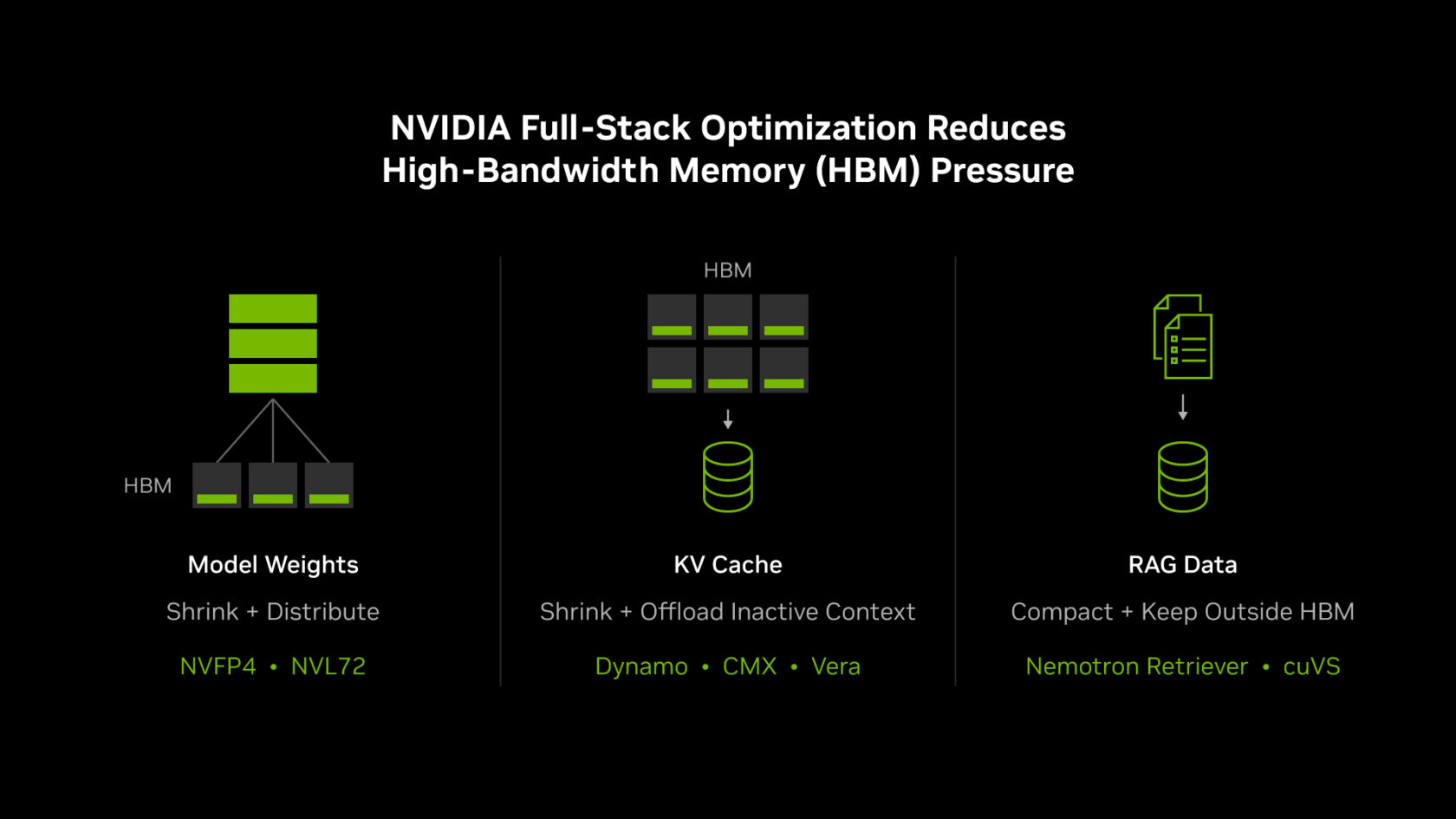
Shrink model weights and distribute them across the NVL72 domain.
- The NVFP4 format reduces the space required for weights compared to FP8, the lowest precision possible on the NVIDIA Hopper platform. Recent models, including FLUX.2 [klein] from Black Forest Labs, Inkling from Thinking Machines Lab, Beam 1.0 from Reflection, Meta Muse Spark from Meta, Step 5 Preview from StepFun and NVIDIA Nemotron 3.5 Super VL have been released with NVFP4 checkpoints, demonstrating growing model-builder adoption of 4-bit precision for faster, more memory-efficient inference.
- Within an NVL72 system, model weights can be distributed across up