

AI热情叠加中东局势缓和预期,纳指四连涨新高,美金融股下挫,原油五连跌,黄金走V
华尔街见闻纳斯达克100指数收涨0.8%,道琼斯工业平均指数下跌0.4%,标普500指数基本收平。芯片股连续第六个交易日上涨,美光科技和英伟达领涨,而金融板块则成为当日市场最大拖累。黄金收涨0.4%至每盎司4361美元,比特币小幅下跌0.9%至约86196美元,美元指数收于近期高位。

GPU、ASIC之后,CPU又来抢产能:ABF为何成为AI的新瓶颈?
华尔街见闻GPU和ASIC过去两年持续吞噬高端ABF载板产能,如今CPU成为新的需求变量。Agentic AI带动服务器CPU需求快速上修,而AI芯片尺寸扩大、层数增加、良率下降,又在持续压低“有效产能”。
更值得关注的是,高端压合设备订单交期已延至2031年,载板扩产受到设备、材料、认证和良率多重约束。
当三类高性能芯片开始争夺同一批高端产能,ABF产业链会出现怎样的新机会?

玻璃基板加速起风:英伟达正式入局,巨头竞赛谁能抢占先机?
华尔街见闻英伟达把一份“两年内必须完成开发”的时间表拍在了韩国、日本和中国台湾基板厂商的桌上。

iQOO公布自研电竞芯片Q4 11:59
网易科技
阿里巴巴发布新款AI芯片,公布更大模型计划 - 华尔街日报中文网
Google News 中国大模型阿里巴巴发布新款AI芯片,公布更大模型计划 华尔街日报中文网

财中ETF风向标|Kimi K3落地亚马逊大模型平台,智能体加速重塑算力基建预期|人工智能早参 - finance.sina.com.cn
Google News 中国大模型财中ETF风向标|Kimi K3落地亚马逊大模型平台,智能体加速重塑算力基建预期|人工智能早参 finance.sina.com.cn


Arguing about arguments
Lobsters
Plain-text files are at risk
Lobsters
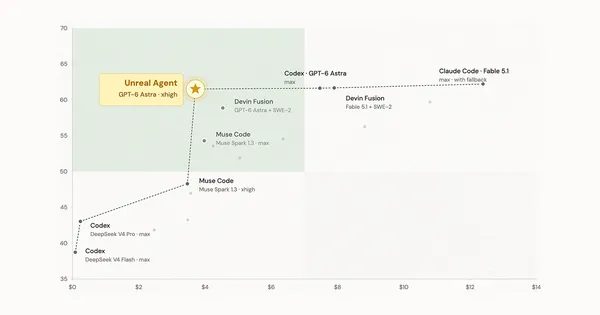
Unreal Agent
Hacker NewsComments

Quasi-SVD: Learning a Lie-constrained matrix factorisation for real-time imaging
arXiv cs.LGarXiv:2607.25967v2 Announce Type: replace-cross
Abstract: Singular Value Decomposition (SVD) underlies matrix factorisation tasks across many fields, with imaging applications demanding real-time processing. Yet SVD algorithms are inherently sequential, constraining real-time GPU throughput and limit online deployment in imaging pipelines. This study introduces a fully parallelized matrix factorization framework for GPUs by enforcing matrix orthogonality on left singular vectors via Lie-parametrised algebra and recovering the remaining components through soft constraints. This asymmetric constraint design enables an efficient parallel and provably valid decomposition, achieves high reconstruction fidelity and substantially accelerates computation relative to the exact SVD, with real-time throughput exceeding standard video frame rates. Performance is evaluated on multiple imaging tasks spanning complementary computational regimes: (1) spatio-temporal background subtraction for ultrasound localisation microscopy, requiring high-dimensional matrix separation, (2) Mueller matrix polarimetry for neurosurgical tissue characterisation, requiring massive batch processing of small matrices, and (3) an MNIST denoising benchmark at an intermediate scale with known ground truth. Across regimes and instruments, the proposed framework demonstrates robust domain transfer at various matrix scales, sufficient for live image-guided workflows that classical solvers cannot currently support in these settings. By prioritising downstream reconstruction fidelity over exact spectral recovery, the proposed SVD framework makes structured matrix factorisation practical for real-time processing.
The Virtue of Sparsity in Complexity
arXiv cs.LGarXiv:2604.17166v2 Announce Type: replace-cross
Abstract: Sparsity or complexity? In modern high-dimensional asset pricing, these are often viewed as competing principles: recent empirical evidence favors richer models, while economic intuition has long favored parsimony. We reconcile this tension by distinguishing capacity sparsity-restrictions on effective model capacity-from factor sparsity-the parsimonious structure of priced risks. Revisiting the benchmark empirical design of Didisheim et al. (2025), we combine nonlinear feature expansions with basis pursuit, using column generation and GPU acceleration to scale estimation to 432 million candidate factors. Reaching this scale reveals a reversal in out-of-sample performance: sparse portfolios trail dense ridgeless benchmarks at lower complexity but achieve a higher Sharpe ratio and lower pricing error at the largest candidate set. Capacity expansion and factor sparsity are therefore complements: enlarging the candidate space allows a parsimonious pricing kernel to outperform its dense counterpart.
Lifelong Learning of Video Diffusion Models From a Single Video Stream
arXiv cs.LGarXiv:2406.04814v4 Announce Type: replace-cross
Abstract: Video diffusion models can enable embodied agents to anticipate plausible futures from the recent past, but they are typically trained offline on curated datasets--a mismatch with the agents' learning setup at deployment: online, from a single video stream that sequentially outputs one frame at a time. We bridge this training gap and demonstrate that training autoregressive video diffusion models from such a stream, resembling the experience of embodied agents, is not only possible but can also perform comparably to standard offline training given the same number of gradient steps. We find that this robustness to video stream autocorrelation and nonstationarity can be achieved using experience replay methods that retain a subset of the video stream. To support training and evaluation in this setting, we introduce five new datasets for streaming lifelong generative video modeling: Lifelong Bouncing Balls (O), Lifelong Bouncing Balls (C), Lifelong 3D Maze, Lifelong Drive, and Lifelong PLAICraft, each consisting of one million consecutive frames from environments of increasing complexity. Together, our datasets and experiments lay the groundwork for video generative models and world models that continuously learn from single-sensor video streams rather than fixed datasets.
Converge to Surprise: Evolutionary Self-supervised Image Clustering
arXiv cs.LGarXiv:2607.06887v2 Announce Type: replace
Abstract: A variety of self-supervised image clustering approaches are invented in the past years. However, all dominant approaches are exploitative: The direction of parameter updates is determined by known states (observed input samples and existing parameters). We propose an explorative self-supervised learning framework that steps out of this zone. We define a surprise score that measures how unlikely the model's output representation is, assuming that all pixels are i.i.d. random noise. Maximizing the surprise score forces the deep learning model to reject the random noise null hypothesis, or equivalently, to discover non-randomness from data. Also, we propose a fundamental assumption: a surprise score cannot, in general, be fully optimized by exploitative optimization approaches. Thus, we propose the converge-to-surprise scheme to optimize a model: an evolution-strategy (ES) outer loop, which maximizes the surprise score using the mutation-selection mechanism, paired with a periodic gradient-descent inner loop, which uses the surprising clusters already discovered by ES as surrogate targets. On simple image benchmarks, our framework trained from scratch achieves new state-of-the-art results in non-parametric self-supervised image clustering --- the strictest deep-clustering setting, where the number of classes is unknown during training.
SPLICE: Latent Diffusion over JEPA Embeddings for Conformal Time-Series Inpainting
arXiv cs.LGarXiv:2605.00126v2 Announce Type: replace
Abstract: Generative models for time-series imputation achieve strong reconstruction accuracy, yet provide no finite-sample reliability guarantees, a critical limitation in power systems where imputed values inform dispatch and planning. We introduce SPLICE (Self-supervised Predictive Latent Inpainting with Conformal Envelopes), a modular framework coupling latent generative imputation with distribution-free, online-adaptive prediction intervals. A JEPA encoder maps daily load segments into a 64-dimensional latent space; a conditional latent bridge with four sampling modes generates candidate gap trajectories; an hourly-conditioned decoder maps back to signal space; and Adaptive Conformal Inference (ACI) wraps the output with coverage-guaranteed prediction bands. The flow-matching variant achieves comparable quality to DDIM in 5--10 ODE steps (5-10x speedup). On thirteen load datasets (nine proprietary, three UCI Electricity, ETTh1), SPLICE achieves the lowest mean Load-only MSE (0.056), winning 9/12 non-degenerate datasets at 91-day gaps and 18/32 across all gap lengths vs. five established baselines, and produces the best CRPS (0.161, -18.3% vs. the strongest competitor). ACI delivers 93--95% empirical coverage, correcting under-coverage failures of up to 7.5 pp observed with static conformal prediction. A pooled JEPA encoder trained on nine feeds transfers to four unseen domains, matching or exceeding per-dataset oracles with only a quick bridge fine-tuning.
继续滚动加载更多…